


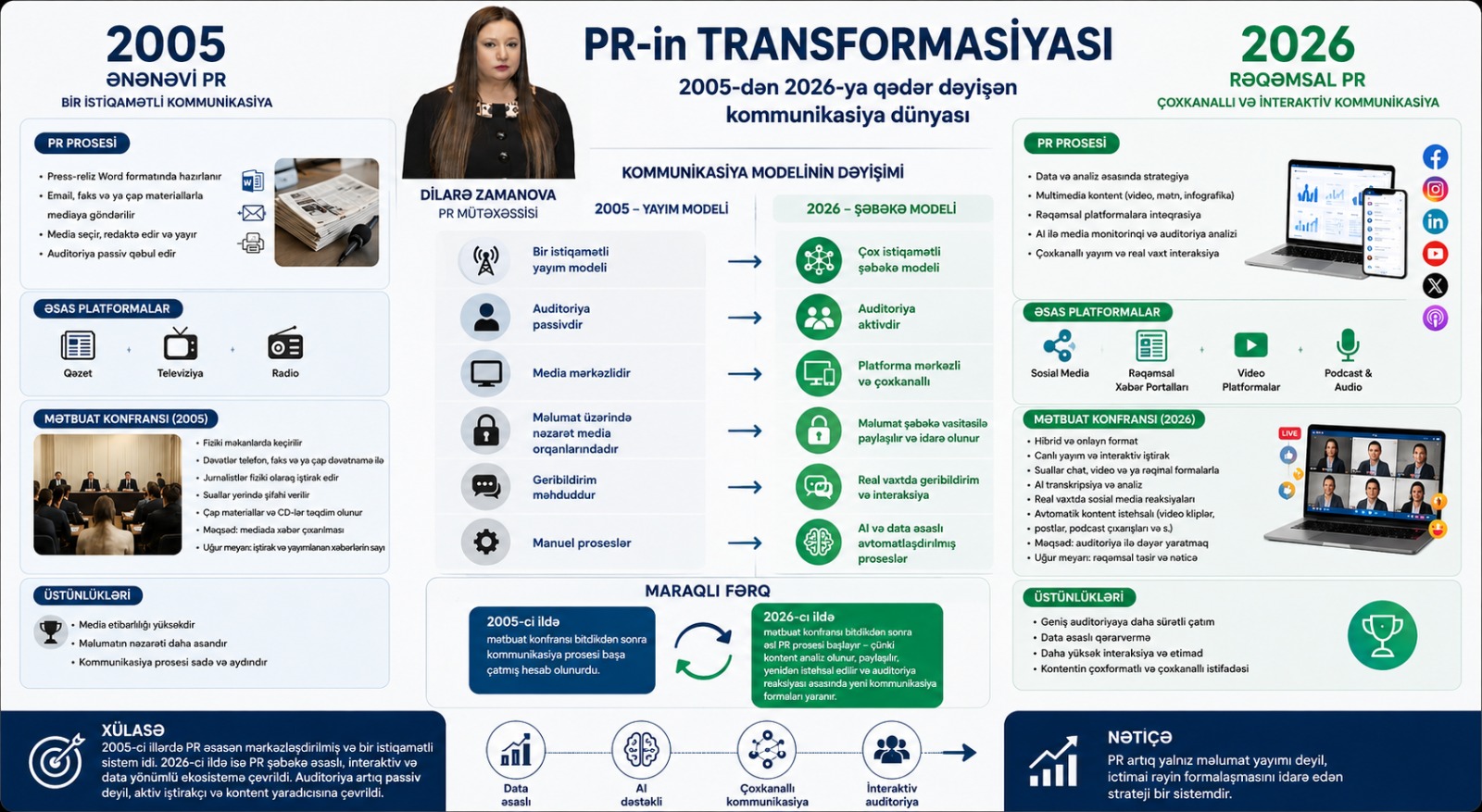
Transformation of PR: The Changing World of Communication from 2005 to 2026
PR activity between 2005 and 2026 has undergone a significant transformation in its essence. These changes are related not only to technological development but also to the fundamental shift in communication models, the media environment, and audience behavior. In 2005, PR was mainly built around traditional media, and the primary goal was to deliver information to the public through newspapers, television, and radio.
In 2005, the central element of the PR process was the press release. Press releases prepared by institutions and companies were usually created in Word format, written in an official style, and sent to media outlets via email. In some cases, materials were also provided in printed form or on electronic media (CDs, DVDs). The media, in turn, selected information according to their editorial policy and published it as news if they considered it appropriate. At that time, television was regarded as one of the main platforms of PR activity.
Over time, important changes occurred in the information environment. In particular, the development of social media transformed the structure of the PR field. Starting from the 2010s, the dissemination of information began to take place not only through traditional media but also via digital platforms. At this stage, PR gradually shifted toward content creation and direct communication with audiences.
By 2026, PR operates as a fully digital, data-driven, and multi-channel communication system. Social networks, digital news portals, podcasts, and video platforms have become the main communication tools. Artificial intelligence technologies are widely used in PR processes. Through them, media monitoring and audience behavior analysis are carried out.
In 2026, television channels also function in accordance with digital transformation. Traditional physical or simple electronic forms of information delivery have been replaced by integrated digital media packages. Materials prepared by PR structures include video, text, and metadata elements and are delivered to media companies in a comprehensive format. These materials are directly integrated into digital newsroom systems and, in many cases, processed by automated systems. Digital newsroom systems are platforms that organize the preparation, management, and publication of news in a digital environment.
In the modern era, the communication model has radically changed compared to previous periods. In 2005, PR activity was mainly based on a one-way communication model. In this model, the flow of information was fully controlled and followed a step-by-step process. First, information was prepared by an organization, then transferred to the media, and the media processed it according to their editorial policy and delivered it to the public. In this system, the audience played a passive role, with the main function of simply receiving information. Direct feedback from the audience was extremely limited.
At that time, the communication process was mainly based on a “broadcast model.” Control of information was largely in the hands of media organizations and editorial offices. The main task of a PR specialist was to ensure the publication of news in the media. Public opinion formation occurred indirectly—through the media. Due to limited feedback mechanisms, communication essentially functioned as a one-way flow.
With the development of digital technologies, this model has completely changed. In particular, the widespread use of social media has transformed communication from a centralized system into a networked model. By 2026, communication has become multi-directional and interactive. Information is no longer transmitted from a single source to an audience; instead, it is formed through continuous interaction among various participants.
The audience is no longer a passive recipient of information but an active participant in the process. People not only consume information but also react to it, share it, comment on it, and create new content. Thus, the audience becomes part of the communication process and directly influences the direction of information flow. This has changed the balance of power in PR and eliminated the concept of centralized control over information.
In 2026, the communication ecosystem has a fully networked structure. The same information spreads simultaneously across different platforms—social media, news portals, video platforms, podcast channels, and other digital environments—while different audience reactions are formed on each platform. These reactions generate new information flows, and the communication process becomes a continuous cyclical movement.
Artificial intelligence technologies have also become an essential part of this process. AI systems analyze audience behavior, identify trends, and help optimize communication strategies. This makes PR a more dynamic and flexible system.
As a result, the communication model of 2005, which was a simple, one-way, media-centric system, has transformed by 2026 into a multi-directional, interactive, networked, and complex ecosystem in which the audience plays an active role. These changes have transformed the very essence of PR, turning it from a tool of information dissemination into a strategic system for managing public opinion.
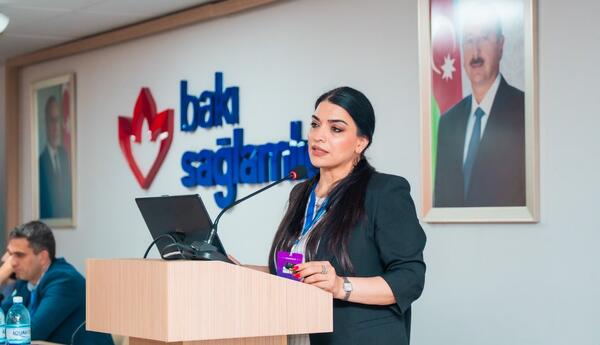
Press Conferences in 2005
In 2005, press conferences were considered one of the most important forms of communication in PR activity. They were mainly held in physical spaces—hotels, conference halls, or administrative buildings of organizations.
Media representatives were invited in advance by telephone or fax, and in some cases, official printed invitations were sent to journalists. On the day of the event, journalists gathered physically at the venue, registered, and participated in the event.
The structure of press conferences was usually standard: first official speeches were delivered, followed by a question-and-answer session with journalists. Questions were generally asked orally on the spot rather than submitted in written form.
From a technical perspective, conferences were relatively simple. Basic sound systems, projectors, and limited photo and video recording equipment were used. At the end of the event, journalists were provided with printed press releases, brochures, and sometimes additional materials on CDs.
The main goal of press conferences at that time was to ensure media coverage of the news, and the main success criteria were the number of journalists attending and the number of published materials.
Press Conferences in 2026
By 2026, press conferences are conducted in a fully hybrid and digital format. Physical presence still exists, but the main communication environment is integrated into digital platforms.
Conferences are simultaneously broadcast both in-person and online. Journalists can join remotely, asking questions via chat, video calls, or pre-submitted digital forms.
One of the most important changes is that press conferences are now optimized not only for human audiences but also for digital systems and AI-powered media monitoring tools. Systems automatically transcribe speeches, extract key messages, and instantly distribute them in formats adapted for different platforms.
The structure of conferences has also changed. After official speeches, not only a Q&A session is held, but also real-time social media reaction analysis is conducted. It is immediately identified which part of the audience is most actively responding to specific topics.
From a single conference, short video clips, social media posts, podcast segments, and news articles are automatically generated.In 2005, after the press conference ended, the communication process was considered complete.
In 2026, on the contrary, the main PR process begins after the press conference ends—because the content is instantly analyzed, distributed, repurposed, and new communication forms are created based on audience reactions.
PR activity, especially the format of press conferences, shows that communication is no longer a static process. PR is constantly evolving and changing. Methods that were effective yesterday are updated today, and modern approaches will tomorrow be replaced by even more automated and data-driven systems.
The biggest difference between PR in 2005 and 2026 lies in the change of control over communication and the direction of information flow. In 2005, PR was a centralized and one-way system: information was transmitted from organizations to the public through the media, and editorial offices controlled the process. The audience remained a passive recipient of information.
In 2026, PR has fully shifted to a networked and interactive model. Information is no longer controlled by a single center; it is continuously created and distributed through social networks, digital platforms, and user-generated content. The audience not only receives information but also creates, modifies, and influences its distribution.
PR Specialist
Dilara Zamanova
Bütün xəbərlər Facebook səhifəmizdə






.jpg)
.jpg)







.jpg)
.png)
 USD
USD
 EUR
EUR
 GBP
GBP
 RUB
RUB