


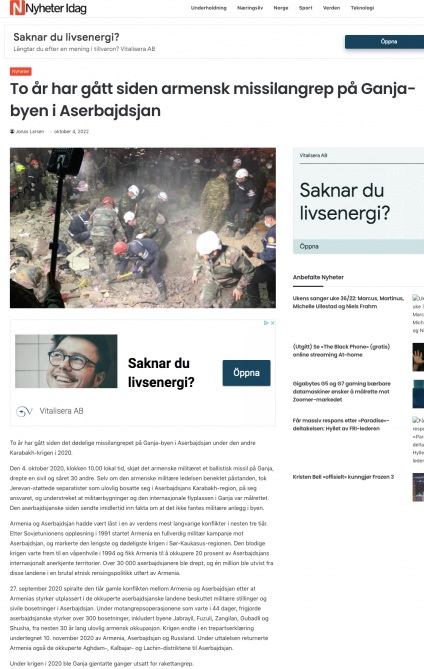
The Norwegian media outlet has published articles about the missile attacks of Armenians targeting the civilian population in Ganja.
An article published on the news website nyheteridag.news states that, two years have passed since the first deadly missile attack on the city of Ganja in Azerbaijan during the Patriotic War in 2020, SIA reports.
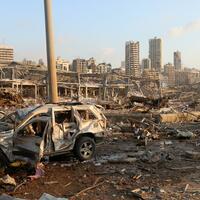
The article states that on October 4, 2020 at 10:00 local time, a ballistic missile was fired by the Armenian armed forces in the direction of Ganja, as a result of which 1 civilian was killed and 30 were injured. Although the Armenian military leadership denied the attack, the separatists, who are illegally settled in the Karabakh region of Azerbaijan and supported by Yerevan, took responsibility for the attack and emphasized that military facilities and the international airport in Ganja were fired upon. However, the Azerbaijani side presented the facts about the absence of military facilities at the site of the attack.
Talking about the events that happened two years ago, the article mentions that Armenia and Azerbaijan have been parties to one of the longest conflicts in the world for nearly thirty years. After the collapse of the Soviet Union in 1991, Armenia launched a large-scale military campaign against Azerbaijan, resulting in the longest and bloodiest war in the South Caucasus region. The first phase of the bloody war ended in 1994 when a ceasefire was reached and Armenia occupied 20 percent of Azerbaijan's internationally recognized territories. More than 30,000 Azerbaijanis were killed and a million people were displaced from their homes due to the brutal ethnic cleansing policy implemented by Armenia.
The long-term conflict between the two countries flared up again after the Armenian armed forces located in the occupied Azerbaijani lands opened fire on military positions and settlements in Azerbaijan on September 27, 2020. As a result of the 44-day counter-offensive operations, the Azerbaijani Army liberated more than 300 settlements, including the cities of Jabrayil, Fuzuli, Zangilan, Gubadli and Shusha, from the Armenian occupation that lasted for nearly 30 years. On November 10, 2020, the war ended with the signing of the tripartite Declaration between Armenia, Azerbaijan and Russia. In the statement, Armenia undertook to return the occupied Aghdam, Kalbajar and Lachin regions to Azerbaijan.
Returning to the issue of attacks on Azerbaijani cities, the author notes that during the 2020 war, Ganja was repeatedly attacked by missiles. After the first incident on October 4, the Armenian military attacked the second largest city of Azerbaijan on October 5, 8, 10 and 17. The number of civilians killed in the attacks was 32, and at least 125 people were injured.
The Demining Agency of the Republic of Azerbaijan (ANAMA) confirmed that "Smerch" unguided artillery missiles and "Skad-B" ballistic missiles were used in the attacks on Ganja.
It was noted that many international organizations have acknowledged what happened. According to Hugh Williamson, head of the European Region and Central Asia Office of the Human Rights Watch organization, Armenian forces repeatedly fired at Azerbaijani cities with various types of weapons, including unguided missiles. These attacks were repeated many times during the six-week war.
The article emphasizes that the government of Azerbaijan strongly condemned these attacks as an act of genocide against the people of Azerbaijan. Assistant to the President of Azerbaijan - Head of the Department of Foreign Policy Affairs of the Presidential Administration, Hikmat Hajiyev called the incident "an act of state terrorism" by Armenia and called on the international community to condemn what happened.
The Turkish government accused Armenia of committing a war crime and became the first country to investigate the attacks on Ganja. The ambassadors of Qatar, Switzerland, Malaysia and Great Britain in Azerbaijan expressed their condolences to the families of those who died as a result of the third missile attack. The European Union also condemned the fourth attack, and UN Secretary General Antonio Guterres called what happened unacceptable.


.jpg)







 USD
USD
 EUR
EUR
 GBP
GBP RUB
RUB