


Today, almost 97 percent of Kazakhstan's oil exports are transported through Russia. In case of hypothetical closure of transit routes, Kazakhstan will have to use all alternative routes. Although the Krasnodar Regional Court upheld the appeal of the Caspian Pipeline Consortium (CPC) and reversed the decision of the Primorsky District Court, it fined the company 200,000 rubles instead of suspending its operations for 30 days. CPC can continue the transportation of Kazakh oil after that. But Kazakhstan has already announced plans to diversify the supply of raw materials abroad.
CPC OJSC stated that the Consortium is a continuously operating enterprise, the immediate suspension of its activity may lead to irreversible consequences for the production process, the technological requirements for oil transportation do not allow immediate and simultaneous suspension of the production activity. Therefore, the consortium filed an appeal against the decision of the district court.
Oil and sanctions
In May of this year, the Southern Department of "Rostransnadzor" conducted an off-site inspection at CPC, and discovered several violations of the oil spill response plan. On June 6, an order was issued to eliminate the violations of law identified by the companies by November 30 of this year. However, the state agency decided not to wait for the appointed time and asked the district court to punish the consortium immediately, which they did on July 5. However, a few days later, the regional court granted the company's petition and replaced the suspension with a fine. The inspection itself was sanctioned by the Deputy Prime Minister of Russia Viktoria Abramchenko. The company promised to fix the violations "as soon as possible". However, there is no guarantee that by November there will not be other lawsuits against CPC from inspection agencies that would allow the oil pipeline to be suspended.
There are different opinions about what happened. Some experts consider the Russian authorities to have "struck" the CPC, where approximately 80% of Kazakhstan's export oil is transported. This is the answer to Kazakhstan's desire to use its hydrocarbon potential to "stabilize the situation in the world and European markets". President Kassym-Jomart Tokayev said this during a telephone conversation with the Chairman of the European Council, Charles Michel. Others believe that Moscow has thereby protested the intention of the Kazakh authorities to ban the supply of goods to Russia and Belarus, which are subject to Western sanctions.
As for oil exports to Europe, Kazakhstan already sells more than 50 million tons of raw materials to the West per year. Russia exported about 108 million tons of crude oil to Europe last year. However, Kazakhstan alone cannot replace Russian oil on the European market. The total export volume for 2021 was 67.6 million tons. Plans for this year are 69 million tons.
The suspension of the CPC may be related to Kazakhstan's plans to comply with Western sanctions. The Russian newspaper "Kommersant" reports that the Ministry of Finance of the Republic of Kazakhstan has released the draft order "On the approval of the rules for the implementation of the pilot project on accounting for the movement of certain types of goods during export from the territory of the Republic of Kazakhstan to the territory of the Russian Federation and the Republic of Belarus" for public discussion. Adoption of the order may close the supply of a number of goods to these countries. The publication writes that the document was removed from the e-government website after a request to the Kazakh government to clarify whether the "pilot" applies to all supplies of goods sanctioned to Russia and Belarus.
Meanwhile, the European Union is still the biggest buyer of Kazakh oil. Europe, not only as a consumer, but also as a seller, is interested in uninterrupted supply of oil and gas products. This means that by exporting oil from Kazakhstan, Europe is trying to reduce hydrocarbon dependence on Russia, and this remains relevant.
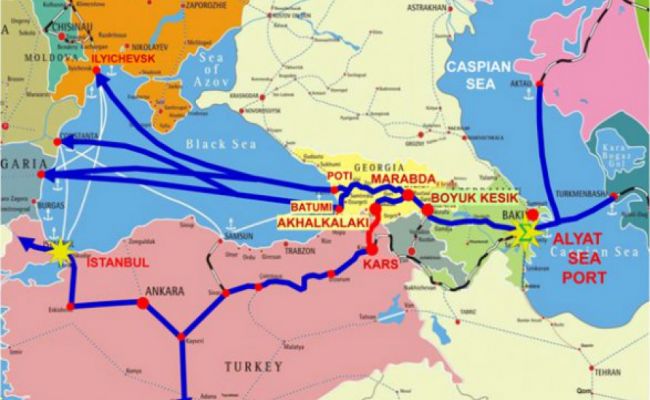
Last week, a day after the Russian court decided to suspend the work of the Oil and Gas Oil and Gas Company, Kassym-Jomart Tokayev held a meeting on the development of the country's transport and transit potential, where he explained the importance of oil supply diversification. At the same time, he called the Trans-Caspian route a priority export direction. The President offered the national oil and gas company "KazMunayGaz" the best option for its implementation, including the opportunity to attract investors from the Tengiz project, to the government to increase the potential of Atyrau-Kenkiyak together with "Samruk-Kazyna", to change the Kenkiyak-Kumkol oil pipelines, ports on the Caspian Sea and ordered to strengthen the fleet. In principle, all these are the main steps that should be taken to open another alternative way for oil exports to Russia.
The construction of this route, called "Kazakhstan Caspian Transport System" (KCTS), was announced back in the mid-2000s. In 2007, a consortium was even formed for this project with the participation of KMG, Chevron, ExxonMobil and a number of other foreign companies. It was assumed that an infrastructure would be created that would allow Tengiz and Kashagan oil from Mangystau to be transported to the Caspian coast and then transported by tankers to the sea terminal in Baku for shipment to the Baku-Tbilisi-Ceyhan (BTC) oil pipeline.
In the fall of 2016, the Milli Majlis approved the draft law "On the approval of the Agreement between the Republic of Kazakhstan and the Republic of Azerbaijan on support for facilitating the transportation of oil from the Republic of Kazakhstan to international markets through the Caspian Sea and the territory of the Republic of Azerbaijan through the BTC system." Then the Ministry of Energy of Azerbaijan declared that the parties plan to build the Eskene-Kurik-Baku oil transportation system. The project includes the construction of an oil pumping station in Tengiz, the main oil pipeline "Tengiz - Oporni - Uzen - Aktau", an oil terminal and a new port in Kurik, as well as the reconstruction and expansion of the port of Aktau. At the initial stage, the transmission capacity of the new pipeline will be 25 million tons of oil per year, and in the future it will be expanded to 56 million tons. The project was valued at 5 billion dollars, 50% of which was to be invested in the construction of the Eskene-Kurik oil pipeline (for the delivery of Kashagan oil). It was assumed that KCTS will ensure the export of oil from Kashagan during the second and third stages of field development. Now the government and the participants of the North Caspian project are only discussing the details of increasing production in the offshore field.
Given the decline in oil production in Azerbaijan (30% - from 1 million barrels per day to approximately 0.74 million barrels per day in 2010-2021), redirection of part of the crude oil for BTC shareholders and Kazakh exporters Bringing materials from Kazakhstan to this pipeline would be useful for both sides. Last year, the actual loading of BTC with a project capacity of 60 million tons per year was 26 million tons. However, the Transcapian route is not the only direction Kazakhstan can channel its oil. There is also the Kazakhstan-China Pipeline (KCP) system, which includes the Atasu-Alashankou and Kenkiyak-Kumkol main oil pipelines. KazTransOil (a subsidiary of KMG) has a 50% stake in this enterprise. However, to reach the design capacity of 20 million tons per year, it is necessary to build intermediate oil pumping stations. Today, the belt is operating below its potential. This is probably why the president ordered to increase the transmission capacity of the Atyrau-Kenkiyak and Kenkiyak-Kumkol oil pipelines so that part of the oil can be transferred to this route. Now the system works mostly for the transportation of Russian oil (about 10 million tons) to oil refineries from fields operated by Chinese and Kazakh companies within the republic. According to the Ministry of Energy, a total of 966,000 tons of Kazakh oil was exported through Atasu-Alashankou in 2021. Although China bought 3.6 million tons of oil from Kazakhstan last year. It turns out that the rest were delivered to China by tankers through Russia.
Kazakhstan could also organize oil exports to Central Asian countries, especially Uzbekistan, where some of the capacities of oil refineries are not being used due to a lack of raw materials. The total demand of Uzbekistan's oil refineries is 10 million tons per year. In addition, it is possible to increase the production of oil products and export to Kyrgyzstan and Tajikistan, which currently import Russian fuel. It should be recalled that 67.6 million tons of oil were exported from Kazakhstan last year, more than 78 percent of which, or more than 53 million tons, were sent through the CPC line. Almost the entire volume was supplied from Tengiz, Kashagan and Karachaganak fields. Another 18% of exports, or 12 million tons, were sent to the Atyrau-Samara oil pipeline and then to the Black Sea port of Novorossiysk or the Baltic port of Ust-Luga via Russia's Transneft pipeline system. Thus, today almost 97% of Kazakhstan's oil exports are transported through Russia. In case of the next closure of CPC or other routes by the Russian authorities, Kazakhstan will have to use all alternative routes to maintain oil exports, including through BTC, which runs from Azerbaijan to Turkey.
V. VALYEV

Bütün xəbərlər Facebook səhifəmizdə
















 USD
USD
 EUR
EUR GBP
GBP RUB
RUB