


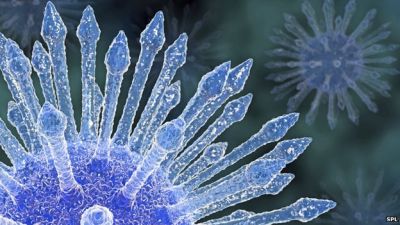
HIV can rapidly form invulnerable strongholds in the body, dashing hopes that early treatment might cure the virus, according to new research.
A baby was thought to have been cured with treatment hours after birth, but the virus emerged years later.
Monkey research, published in the journal Nature, suggests untouchable "viral reservoirs" form even before HIV can be detected in the blood.
Experts described it as a "sobering" and "striking" finding.
Reservoirs of HIV in the gut and brain tissue are the massive obstacle in the way of a cure.
Remarkable progress in developing antiretroviral drugs means HIV can be kept in check in the bloodstream and patients have a near-normal life expectancy.
But if the drugs stop, the virus will emerge from its reservoirs.
International research is focused on flushing the virus out of its reservoirs, but there had been hope that early treatment could prevent them forming in the first place.
In the study, rhesus monkeys were infected with the monkey equivalent of HIV - simian immunodeficiency virus (SIV).
The monkeys were then given antiretroviral drugs as early as three days or as late as two weeks after infection.
Treatment stopped after six months, but the virus re-emerged irrespective of how quickly antiretroviral treatment started.
It showed that viral reservoirs formed incredibly early in the course of the infection.
Dan Barouch, professor of medicine at Harvard Medical School, said: "Our data show that in this animal model, the viral reservoir was seeded substantially earlier after infection than was previously recognised.
"We found that the reservoir was established in tissues during the first few days of infection, before the virus was even detected in the blood."
Bütün xəbərlər Facebook səhifəmizdə

.jpg)

.jpg)
.jpg)

.jpg)





















 USD
USD
 EUR
EUR GBP
GBP RUB
RUB