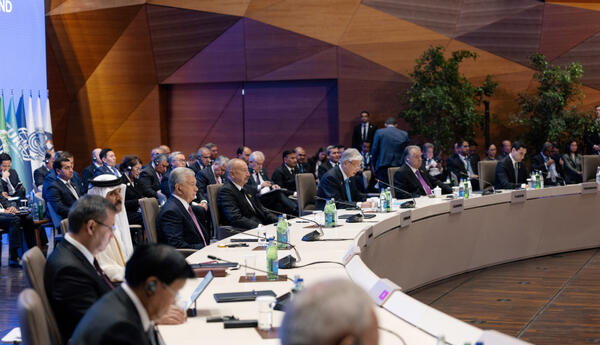
The 13th World Congress of the Russian Press ended in the Ukrainian Black Sea port of Odessa on Friday. The final session of the forum was devoted to issues of the Russian media’s self-financing, the establishment of public media and social media. The participants discussed prospects for international humanitarian financing and Russian grants.
The president of the World Association of the Russian Press, Itar-Tass Director-General Vitaly Ignatenko described the congress, which was held in two stages - in Kiev and Odessa - as successful. "We have worked successfully and productively," he said and added, addressing the delegates that "irrespective of how hard you may find it to carry on your work is very useful and promising." Ignatenko thanked the Ukrainian colleagues for their hospitality and for the opportunity to comprehensively discuss the challenges and problems of the global Russian-language press on Ukrainian soil.
Congress participants drew attention to the interest the leaders of Ukraine had taken in the work of the media forum. On its first day in Kiev President Viktor Yanukovich addressed the delegates to assess the situation in the country and speak about the priorities of Ukraine's development.
"National pragmatism in the foreign policy of President Yanukovich can be seen from afar," the editor-in-chief and publisher of a Russian language newspaper in Ireland, Sergei Tarutin, said about Yanukovich’s address. "We in Ireland, although that country is far from the Ukraine, clearly see the desire of the authorities in Kiev to defend the country's interests in various spheres." This, he said, is evident in relations between Ukraine and its strategic partner - Russia. "Kiev takes a principled stance in negotiations on a range of gas issues. This is true not only of the strong demand for lowering gas prices, but also of the issue of establishing a joint venture between Gazprom and Naftogaz Ukrainy. One cannot but feel respect for the president’s policy of protecting Ukrainian interests at negotiations with the EU. There is an unmistakably technocratic approach of Yanukovich and his team to all foreign partners," said Tarutin.
The editor-in-chief and publisher of Russian Switzerland magazine, Alexander Peske, believes that President Viktor Yanukovich can go down in the history of Ukraine as a reformer. "Not every politician will undertake to implement the heavy reforms to modernize different spheres of life," said Peske. "At first almost any reform is fraught with a wary attitude to it by society and as a consequence, with a fall of the rating of confidence in the politician. Nevertheless Yanukovich acts regardless of the forthcoming elections to parliament. This demonstrates the purity of his thoughts and the commitment to raise the standard of living of his people. "
The editor-in-chief of the Lithuanian Courier, Valery Tretyakov, believes that Ukraine's democratic gains are in no danger. "The alarm bells are being rung by those who have nothing to suggest instead of the program for the modernization of the country and for restoring elementary order. The fight against corruption is being used by the opposition to whip up tensions over human rights and civil liberties. The Lithuanian journalist said that the recently adopted Ukrainian law on access to public information showed the authorities’ openness to society and their willingness to give full information about government activities," said Tretyakov.
"President Viktor Yanukovich’s policy of restoring good-neighborly strategic relations with Russia meets the interests of an overwhelming majority of citizens of Ukraine," said the editor-in-chief the Finnish newspaper Spectrum, Eilina Gusakinskaya. She said she judges the situation in Ukraine not only by opinion polls, because she often visits Ukraine and knows the mood of the people "not by hearsay."
"The recent five years of ‘orange rule’ are recalled by many Ukrainians as a nightmare," the journalist from Finland said about Ukraine’s modern history. "Some wished to spark a quarrel among the Ukrainians and the Russians and to build a barbed-wire fence on the border, to break up the large family of two Slavic nations - Ukrainian and Russian."
The next World Congress of the Russian Press will be held in Italy next year.

























 USD
USD
 EUR
EUR
 GBP
GBP RUB
RUB