


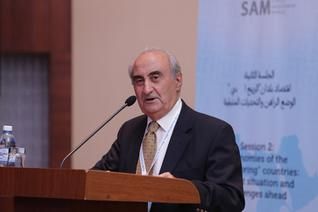
Interview with DR. Mete Durdag, former head of representative of Turkish office of International Monetary Fund in 90s, he also used to head few projects of USAID, WB and other organization in Turkey, SIA reports.
You participated and gave a speech in the International Conference arranged by the Center for Strategic Studies (SAM) in Baku on November 7-8, 2013 to discuss recent transformations in the Middle East and North Africa (MENA) after the Arab Spring. What can you say about the Conference?
With this Conference, the Center for Strategic Studies under the President of the Republic of Azerbaijan has provided a valuable venue for bringing together views and evaluations on political, social and economic implications of the Arab Awakening by a large number of international experts from a wide range of most reputable institutions in the MENA, Europe and the US. The Arab Spring protestors’ demands included particularly greater civil liberties, better governance, and increased inclusion in political and economic life. Much emphasis has rightly been placed by the participants of the Conference on political aspects of the Arab Spring, particularly democratization of social order and the state regimes.
I fully agree with participants’ identification of demands for the establishment of democracy as the key implication of popular revolts in the Arab Spring countries because of its great importance not only for human rights and civil liberties but also for attaining a broad-based and socially more inclusive and equitable economic development. Discussions on current political processes after the Arab Spring focused on the role of Political Islam, particularly the Muslim Brothers movement, in the re-shaping of the political and social systems of the MENA countries. No one, however, felt it necessary to define "democracy" aspired by the revolting masses of the Arab Spring probably because its principles are obvious to everyone from current practices of several EU countries and the US. This would first require the replacement of the old rulers with new leaders through fair elections. The democratization of the whole state governance, however, requires much more than fair elections.
There is a great need to move away from past system of patronage, nepotism, rent-seeking and corruption towards a regulatory system that fosters fair competition and equal access to opportunities with greater transparency, accountability and participatory decision making. I am doubtful that the current political processes in the Arab Spring countries, with sectarian, tribal and ethnicity-based political parties, could lead to democratization as understood in the West. It would most likely lead to change of the rulers but not past political processes and eventually to internal strife among different sectarian, tribal and ethnic groups.
As we know, you have been head of the IMF’s Baku office in the 1990s. What comparison can you make between Azerbaijan in the 90s and Azerbaijan now (in all areas)?
I was seconded from the World Bank to the IMF to serve as the first Resident Representative of the Fund to Azerbaijan for just over two years from May 1993. I took up my assignment when Azerbaijan was in a political turmoil following President Elchibey’s departure from Baku under pressure from Huseynov’s rebellious troops. It took several months for Heydar Aliyev, first as the Speaker of the National Assembly and then as President, to establish political stability and secure the national unity. The economy had been badly hit by the collapse of Soviet Union and all economic relations with Russia and other former Soviet Republics. Production in all sectors, including oil production, has sharply declined, unemployment blown up, and inflation sky-rocketed. We could not find a descent loaf of bread to buy, a good enough restaurant to dine, and a proper apartment to rent.
This dismal picture has fortunately started improving once President Aliyev and his government established first political and then economic stability with the support of international community and agreements with major international oil companies. Azerbaijan economy was opening up to outside world through market reforms and trade liberalization measures. With increasing foreign direct investments and oil exploration contracts as well as growing inflow of workers’ remittances, Azerbaijan economy had already began gaining some growth momentum when I completed my assignment in Baku by mid-1995.
After taking early retirement from the World Bank in 1996, I have undertaken several short-term consulting assignments with private commercial banks in Baku and one with the Ministry of Finance through 2000. I then headed (Chief of Party) a major USAID technical assistance project in Baku, called Public Investment Policy and Program (PIPP), for almost two years during 2005-06. I have since had three more opportunities to visit Azerbaijan to participate in seminars and conferences. I have thus observed closely the remarkable changes that Azerbaijan has been going through since independence in terms of infrastructure, institutional, and economic developments. The Government of Azerbaijan has been using the country’s oil and gas earnings for a rapid buildup of the country’s economic and social infrastructure which is both fostering private sector incomes and boosting domestic and foreign private investment for production and employment growth. Hence, it is natural that Azerbaijan, as a resource-rich country, would show remarkable economic and social developments over the past 20 years.
The meaningful question, however, should be: (i) whether Azerbaijan has been making most efficient use of her national wealth, and as a corollary of this question, (ii) whether future generations’ interests are being adequately safeguarded?
How would you evaluate current Azerbaijan-IMF relations?
The latest financial arrangement between Azerbaijan and the IMF was an Extended Credit Facility (ECF) approved in July 2001 and expired in July 2005. Azerbaijan used SDR 54.7 million on this latest ECF, and its repayment will be completed in 2015. The IMF has had a Resident Representative to Azerbaijan during 1993-2009 and currently has only a liaison office at the Ministry of Finance. Also, as in the all transition countries, Azerbaijan has, since 1993, been receiving extensive technical assistance from the Fund in reforming its national accounts, public financial management, budgetary system, tax administration, public debt management, pension system, monetary statistics, Central Bank management, banking supervision, external trade statistics, balance of payments statistics, and many others. Finally, the IMF holds annual discussions with Azerbaijan, as with all member countries, on economic development and policies under Article IV of the IMF’S Articles of Agreement. Based on last Article IV consultation between the IMF and the Government of Azerbaijan, a Staff Report of the Fund team was completed in April 2013 and made public on the IMF website (http://www.imf.org/external/pubs/ft/scr/2013/cr13164.pdf).
The main message of the last Staff Report is that continued expansionary policies of the Government may be fueling short-term risks to macroeconomic stability while the depletion of oil reserves undermines the medium-term viability of the development strategy. It also notes that the Government’s 2020 vision of making Azerbaijan a competitive and diversified economy would require ambitious structural reforms to reduce barriers to trade and competition, improve the business climate, facilitate access of private companies to capital, and combat corruption. The Government responds that it is cognizant of these risks and requirements, but is also confident of tackling them on the strength of Azerbaijan’s foreign exchange reserves and through sound fiscal and monetary policies.
How would you evaluate fiscal and monetary policies of Azerbaijan?
Azerbaijan has been enjoying over the past decade a remarkable growth both in her overall economy and non-oil production while also maintaining a stable foreign exchange rate and a moderate rate of inflation. Data on this process are given in the latest IMF Staff Report on Azerbaijan (http://www.imf.org/external/pubs/ft/scr/2013/cr13164.pdf). Hence, Azerbaijan’s fiscal and monetary policies should be rated successful, (of course with a caveat) thanks to transfers to the Budget from the State Oil Fund and to the Central Bank’s ample reserves. In my view, it would be more meaningful to ask whether Azerbaijan has the right policy and institutional frameworks to design and implement sound macroeconomic policies (particularly fiscal, monetary and exchange rate policies) to attain a broad-based and inclusive economic development with most efficient resource use.
Azerbaijan has been receiving over the past two decades numerous technical assistance on all aspects of public financial management and monetary and banking reforms from the UNDP, IMF, WB, ADB and the major donor countries. With the support of such assistance, Azerbaijan has developed its national accounts, external trade and balance of payments statistics, budgetary and fiscal systems, and monetary and banking management and statistics. However, what is critically missing is the use of a medium-term macroeconomic framework integrating a medium-term budgetary framework, a multy-year public investment program, and monetary program. Such macroeconomic planning and management tools should be institutionalized with well-defined and detailed procedures ensuring full transparency and participatory decision making. The USAID technical assistance project of Public Investment Policy and Program that I headed during 2005-06 provided a wide range of technical notes and training as well as a detailed Public Investment Programming Manuel to help the Government develop the necessary macroeconomic planning and management framework. There is, however, a resistance by the Government, not only in Azerbaijan but in all transition economies, to such proposals because it requires the political leaders to restrict themselves from discretionary and arbitrary decision making.
What can you say about Azerbaijan’s international rankings?
World economies’ performance is being surveyed by a number of international institutions to identify their comparative rankings both vis-a-vis other countries and against their past performance. A careful review of these surveys’ rankings of Azerbaijan will help identify the main hindrances to achieving her medium-term goals of becoming a competitive and diversified economy by 2020. The 2012-13 Global Competitiveness Index of the World Economic Forum ranks Azerbaijan at 46 out of 144 countries, which reflects quite a satisfactory state for future development of the country. Recently, in the latest one, the country was even raised in the ranking to 39th place.
The presence of a most conducive business environment for both domestic and foreign private investment is essential to fostering competitiveness and diversification of the economy. Azerbaijan has quite a good standing in this respect as reflected by her ranking at 70th out of 189 countries included in the World Bank’s 2013 Ease of Doing Business Index. The content of this index, however, also shows that Azerbaijan should particularly emphasize improvements in the areas of paying taxes (70/189), resolving insolvency (86th), trade across borders (168th), dealing with construction permits (180th), and getting electricity (181st). Another source that sheds light on Azerbaijan’s international standing in ease of doing business is the World Bank Group’s Enterprise Surveys (Azerbaijan Country Profile 2009, dated January 2010). Summary indicators of this survey show that Azerbaijan firms enjoy business conditions better than or about the same as the average indicators of East European and Central Asian (EECA) as well as the Lower Middle Income countries with regard to regulations, taxes and business licensing, finance, infrastructure, and crime and informality. On the other hand, Azerbaijan firms’ indicators relating to (i) percentage of firms with female managers and female ownership; (ii) percentage of firms having their own website and using e-mail for business communication; (iii) percentage of exporter firms, and most importantly (iv) incidence of graft (corruption) lag well behind that of the two groups of comparator countries. The last indicator (graft/corruption) is the most critical one as verified by the World Economic Forum’s surveying of Azeri firms which identified corruption as the most problematic factor for doing business out 15 factors put to them (The Global Competitiveness Report 2012-2013, p. 98).
Addressing the above-noted weaknesses of business environment and rendering it more conducive to private sector investment and entrepreneurship will require that Azerbaijan continues with democratization of its social order and state system through increased transparency, accountability and participatory decision making. This will find its reflection in the improvement of Azerbaijan’s ranking in the international freedom indexes. At present, Azerbaijan’s score (59.7) at the Heritage Foundation’s 2013 Index of Economic Freedom is equal to the world average (59.6); slightly higher than the regional average (57.4), but well below the free economies’ average (84.5). Azerbaijan’s average score, which ranks her at 88th out of 177 countries, is pulled down by her very poor scores in property rights (25.0), freedom from corruption (24.0), and financial freedom (40.0). Economic freedom in a country is closely linked to prevailing state of democracy.

Bütün xəbərlər Facebook səhifəmizdə





















 USD
USD
 EUR
EUR
 GBP
GBP RUB
RUB