


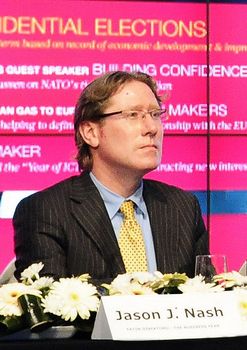
"Since the presidency of national leader Haydar Aliyev, and throughout the administration of President Ilham Aliyev, Azerbaijan has undergone an economic transformation," Editor-in-Chief of The Business Year magazine Jason John Nash said at the presentation ceremony of the magazine`s special edition on Azerbaijan, SIA reports citing AzerTAc.
The following is the full transcript of the speech:
"Thank you very much for kindly attending the launch party for The Business Year: Azerbaijan 2013. This is our third publication on Azerbaijan, and every year our coverage of the country grows, just as its economy has. And just as in every year, we seek to publish the opinions of leaders in the public and private sector who are helping to shape Azerbaijan`s future.
Since the presidency of national leader Haydar Aliyev, and throughout the administration of President Ilham Aliyev, Azerbaijan has undergone an economic transformation. From the constrictive restraints of the Soviet economic model, Azerbaijan has rapidly undertaken steps to become a market economy that has achieved regional and global economic and geopolitical reach. In the space of just 5 years, Azerbaijan has boosted its GDP from some $4 billion to over $25 billion. Its GDP alone already accounts for over 80% of economic activity in the South Caucasus region. Among all of the CIS states, Azerbaijan can justifiably say that it has been the most successful in improving the living standards of its people. Azerbaijan can now count itself as one of the middle-income frontier economies that within the coming decade will graduate to emerging economy status. It joins high-income countries such as the UAE and Qatar, which are also seeking to become emerging market economies.
However, producing economic success is never as easy as many would think. Although Azerbaijan has been able to use its oil and gas wealth to support economic development, the injection of such wealth has to be done in a careful way to avoid speculative bubbles and the much talked about Dutch Disease. Economic diversification is key to be able to transform the ephemeral financial resources coming from oil and gas into real jobs and a real future for the country. The dangers of a two-speed economy, whereby commodities drive narrow but sharp growth whilst other sectors underperform, should be avoided.
Under this metric, Azerbaijan has done well. GDP growth over the past few years has been underpinned by that occurring in the non-oil economy, rather than from oil and gas revenues alone. More needs to be done, however, to ensure that this growth in the non-oil economy remains realistically strong. Not only does this growth need to be spread across sectors, it also needs to be delivered to regional areas.
The problem of rural-urban drift is one that many countries are grappling with, especially when the commercial capital begins to dominate smaller markets. The pressure that this can put on infrastructure, services, and jobs can cause nationwide imbalances that threaten a stable economic growth pattern. The stress that Ilham Aliyev`s administration has been putting on regional growth is very much a product of the need to deliver to the people of Azerbaijan a more balanced growth picture. In many ways, to ensure that the rising tide of growth will float all of the economy`s boats.
And growth also needs to be able to ensure that Azerbaijan is competitive in the rapidly changing global economy. The declaration of 2013 as the "Year of ICT" is just one example of how the government is looking to prepare Azerbaijan`s people for the future, and this was underlined by the launch of the Azerspace satellite in the first quarter of 2013. Other sectors such as tourism, agriculture, and transport have also received attention, and we are seeing students being prepared to move into these and many other fields of economic activity.
The local finance sector, and especially banking, is also being prepared to face the complexities of the future. The raising of capital requirements for the banks in early 2014 will see consolidation in the sector, and strengthen balance sheets. As well, such changes may also see more activity on Azerbaijan`s local capital markets, especially in terms of corporate bonds and perhaps leading to growth in the equities market. For Azerbaijan to move from frontier to emerging market status, more sophisticated capital market institutions and healthy liquidity levels, both at home and from abroad, are needed.
And it is as a member of the international community that Azerbaijan will secure its future. The country is increasingly becoming an important component of Europe`s energy security, and the country will be deciding how that relationship will develop further in 2013 as new gas pipeline routes are determined. Azerbaijan`s hosting of international events has raised its profile, and the hosting of the 2015 European Olympic Games will only further enhance its international status. Its ongoing membership of the UN Security Council and its engagement with the global community complement this strategy.
In conclusion, it would be difficult for many just over 20 years ago to have imagined just how far Azerbaijan could have come within such a short amount of time. Many of the long-term plans put in place by national Heydar Aliyev have borne fruit over the past decade, while the current administration continues to enhance strategic planning across all sectors of the economy. While the path to economic growth and success is a long one, and is never smooth, the people of Azerbaijan have much to look forward to in the future.
Thank you ladies and gentlemen, and I hope to see all of you once again next year."

Bütün xəbərlər Facebook səhifəmizdə





















 USD
USD
 EUR
EUR
 GBP
GBP RUB
RUB