



In today’s world, where the flow of digital information is accelerating, confusing the concepts of “information” and “communication” has become a widespread trend in the PR field. However, these two terms differ in essence, purpose, and outcome.
What is Information?
Information is a one-way process of delivering a fact or event to an audience. The main priority in this process is to present information accurately, clearly, and without distortion. Dialogue plays a secondary role here; the focus is on delivering the information to the recipient in a timely and correct manner.
The process of informing is unidirectional. That is, the party transmitting the information is active, while the recipient remains passive. In this model, audience feedback is not the primary goal. The aim is not to generate discussion but to deliver the existing information.
Information is not designed to create an emotional impact. It relies on objective facts. The content is presented according to principles of accuracy, specificity, and formal style.
The main purpose of informing is to make the audience aware. For example, an official statement by an organization, changes in work schedules, the announcement of a new decision, or sharing statistical data all fall under the process of informing. The key goal is to ensure the audience is aware of the current situation.
What is Communication?
Communication is a dynamic process that enables the establishment of mutual and multi-directional relationships. This process is not limited to merely transmitting information; it also takes into account the other party’s reactions, emotions, position, and behavior. Communication aims to create mutual understanding and maintain ongoing relationships.
Communication is bidirectional. Both the sender and the receiver of the message are active participants. The message is not only transmitted but also received, interpreted, and responded to. When building relationships, factors such as tone, facial expressions, intonation, body language, empathy, and trust play a critical role. Sometimes the way a message is delivered is more important than its content.
The main purpose of communication is not just to provide information but to establish connection and influence. This influence may manifest as a change in mindset, the formation of an attitude, building trust, or guiding certain behaviors.
Thus, communication is a process of relationship building and management. Although informing and communication may appear similar, they differ significantly in essence and purpose. These differences are most evident in the nature of the process. Informing is a one-way process: information flows from the source to the audience without expecting active participation. Communication, on the other hand, is a two-way or multi-way process in which parties actively interact.
Differences are also clear in terms of goals. The main purpose of informing is to provide information and notify the audience about a fact or decision. The purpose of communication is broader: it aims to establish a connection, create mutual understanding, and generate influence.
Consequently, informing ensures audience awareness, while communication produces deeper results: the audience not only receives information but also understands, accepts, and reacts. Therefore, communication is considered a more complex and strategic process.
According to modern PR concepts, dialogue is crucial for effective management.
Example:
• Information: “New medical equipment has been acquired.”
• Communication: “How will the new equipment affect the quality of patient care? We answer your questions.”
The first sentence simply informs, while the second builds trust.
In modern PR, the main goal is no longer just spreading news but creating continuous dialogue with the audience. Reputation, loyalty, and corporate image are built on communication.
In internal PR, it is not enough to merely inform employees — they must be listened to, engaged, and involved in the process. If informing creates structure, communication creates culture.
• Posting a post — informing
• Writing comments on a post — communication
• Responding to comments — managed communication
Why does the same information receive different reactions on various social platforms?
YouTube and TikTok are video-based platforms that have a stronger emotional impact on the audience. Information is delivered not only through text but also through visuals, sound, and movement, making content more vivid and realistic.
Video shows the person’s face, facial expressions, and body language. Tone, intonation, and emphasis enhance the emotional layer of the message. Movement and dynamics help maintain attention longer. TikTok’s algorithm prioritizes content that generates discussion and reactions. Videos with comments, shares, and emotional responses spread faster, encouraging users to actively participate.
On these platforms, users often do not use their real names, and profile identification is more informal and flexible. This creates a sense of anonymity and psychological distance, allowing users to express opinions more openly and freely.
On Facebook, emotional impact is weaker due to a larger share of text and static visuals. Users often remain in a “passive scroll” mode, consuming information without active reaction.
Age also affects platform behavior: older audiences comment less and mostly observe, preferring to read information.
The presence of a real social circle on Facebook, including relatives, colleagues, and acquaintances, also influences behavior. Users are more cautious in expressing open and emotional reactions because their comments are visible to a broader, real-life network. As a result, active commenting decreases.
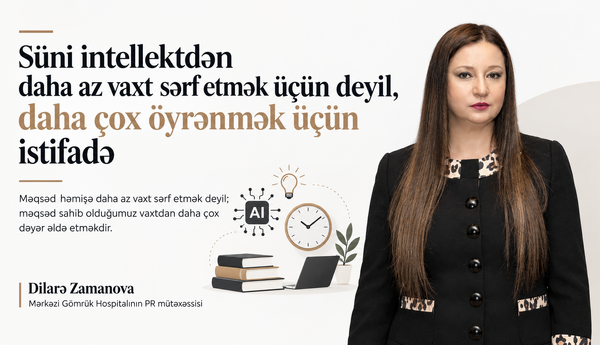
Dilara Zamanova
PR Specialist of
Central Customs Hospital
Bütün xəbərlər Facebook səhifəmizdə


.jpg)
.jpg)








.png)



 USD
USD
 EUR
EUR
 GBP
GBP
 RUB
RUB