


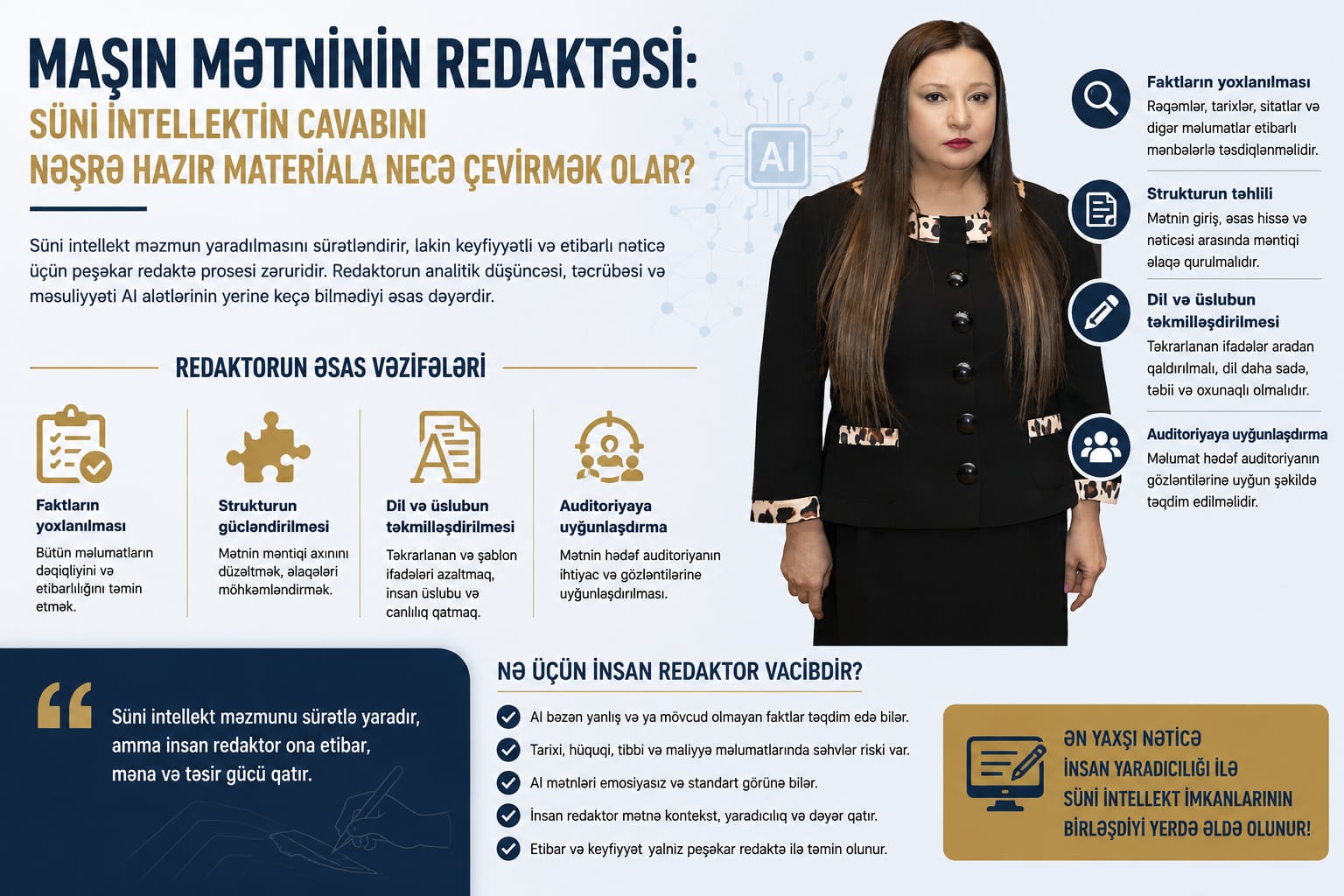
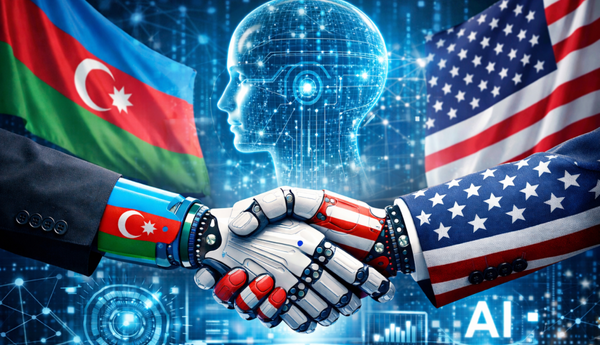
In recent years, the rapid development of artificial intelligence technologies has created new opportunities in the fields of information production and communication. Today, neural network systems such as ChatGPT, Gemini, Claude, and others have become daily working tools for PR specialists, journalists, and content creators. These tools are capable of producing articles, press releases, interviews, social media posts, and various other communication materials in a very short time.
However, the high speed of content creation using artificial intelligence does not mean that these texts are immediately ready for publication. On the contrary, in many cases such texts require professional editing and verification. This is why, in the modern era, the concept of “machine text editing” has gained particular importance.
Artificial intelligence speeds up the content creation process but cannot replace human analytical thinking, professional experience, and responsibility. This is because AI systems sometimes provide non-existent facts, make errors in historical data, or incorrectly cite sources.
One of the main problems with texts generated by neural networks is their overly standard and emotionless nature. At first glance, such texts may seem logical and well-structured, but they often fail to create an emotional connection with the reader. Therefore, one of the key tasks is to add a human style and natural language to the text.
The editing of AI-generated texts should begin, first and foremost, with fact-checking. All figures, dates, quotes, and other information mentioned in the material must be verified through reliable sources. This is especially important in sensitive fields such as healthcare, PR, and finance.
In the next stage, the structure of the text should be analyzed. Artificial intelligence sometimes presents information in an incorrect sequence, which disrupts the logical flow of the narrative. In such cases, it is important to strengthen the connection between the introduction, main body, and conclusion.
In addition, AI texts often contain repetitive expressions and formulaic constructions. Phrases such as “plays an important role,” “is of great importance,” “is considered one of the key factors,” “serves as an important element,” “creates wide opportunities,” “it is important to note that,” and “it should be emphasized that,” when overused, reduce the expressiveness of the text. Therefore, editors aim to simplify the language and use more natural expressions.
When using artificial intelligence, the characteristics of the audience must also be taken into account. The same material should be presented differently for media representatives, social media users, or corporate partners. This type of adaptation improves communication effectiveness.
According to experts, the successful PR specialist of the future will not only be a content creator but also a professional editor of materials generated by artificial intelligence. In this context, skills such as fact-checking, style improvement, information structuring, and audience adaptation become especially important.
Artificial intelligence remains a powerful tool that accelerates communication processes; however, the human factor still plays a crucial role in producing high-quality and reliable content. The most successful results are achieved when human creativity is combined with the capabilities of artificial intelligence. Therefore, machine text editing is becoming an integral part of modern PR and media activities.
Practical consequences of using artificial intelligence-generated texts
The use of AI-generated texts without editing can lead to a number of serious problems. These issues are mainly related to informational errors, reputational risks, and communication inconsistencies.
One of the most common consequences is the publication of unverified or inaccurate information. In some cases, AI may present non-existent statistics or facts in a convincing way. This can lead to a serious loss of trust, especially in media and PR sectors.
Another problem is the excessive generalization of texts and lack of specificity. In practice, such materials in press releases often fail to attract journalists’ interest and reduce the likelihood of publication. Media outlets typically require concrete facts, figures, and real quotations.
In some cases, inconsistency in tone is also observed in AI-generated texts. For example, serious medical or official topics may be presented in a very neutral and emotionless way, whereas the audience expects a clearer and more human explanation. This creates a communication gap between the text and the reader.
Another risk observed in practice is reputational damage. Publishing inaccurate or incorrect statements on behalf of an official organization can lead to a loss of public trust. Such mistakes spread very quickly on social media, which may result in a crisis situation.
In addition, the unedited use of AI texts leads to the loss of a unique brand voice. Instead of the organization’s own communication style, a uniform, standard “robotic language” emerges. This reduces opportunities for long-term communication differentiation.
Bütün xəbərlər Facebook səhifəmizdə



















 USD
USD
 EUR
EUR
 GBP
GBP RUB
RUB