


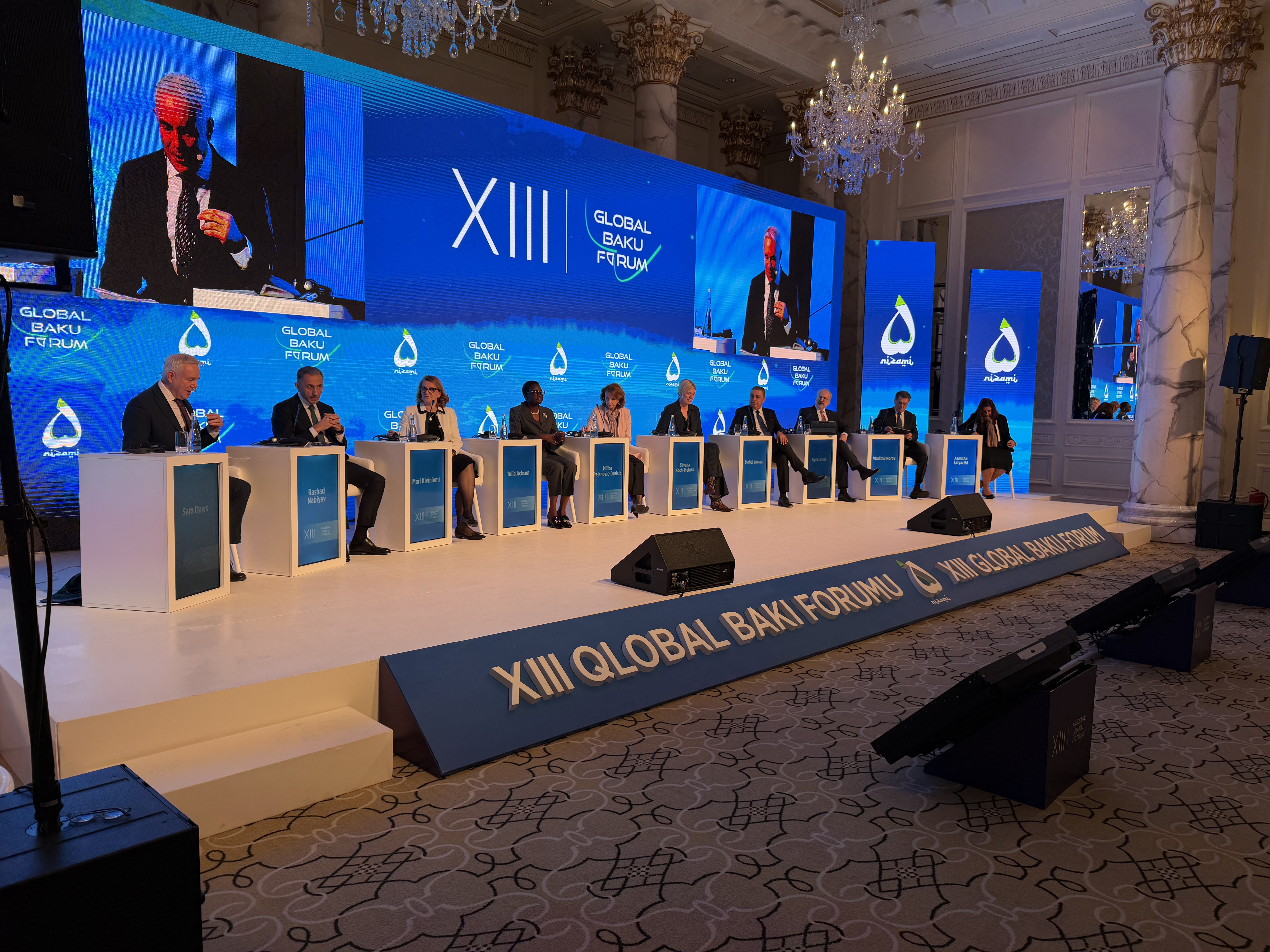
Within the 13th Global Baku Forum, a panel discussion was held under the theme Digital Futures: AI, Governance and Ethics of Innovation.
According to Report, participants discussed potential risks and challenges related to the development of artificial intelligence.
During the discussion, former Prime Minister of Finland Mari Kiviniemi emphasized that for people to trust AI, societies must learn to regulate and manage its development.
"According to a survey conducted in the US in December 2025, 77% of Americans expressed concern that artificial intelligence could pose a threat to humanity, while 68% said they would not trust it to make decisions on their behalf without oversight," she noted.
Kiviniemi added that transparent mechanisms, protection of personal data, and equal access to modern technologies for all segments of society are essential to ensure safe use of AI and effective functioning of regulators.
In turn, President of the Inter-Parliamentary Union Tulia Ackson highlighted that national parliaments should have the ability to summon representatives of AI-developing companies to hearings in order to answer committee questions:
"The problem is that private companies do not report directly to parliaments, yet they create products later used worldwide," she said.
Former Vice-President of the European Parliament Silvana Koch-Mehrin argued that AI can indeed be regulated, provided societies abandon the widespread perception that governments always lag behind technological innovation. She noted that regulations and boundaries allow policymakers to define the frameworks within which AI technologies can be used.
Former Prime Minister of Tunisia Mehdi Jomaa stressed that AI is intended to support human decision-making, not replace it. He warned that algorithms should not make decisions instead of humans, especially in the current global political crisis. Jomaa added that AI technologies can influence states and even make them dependent:
"Political leaders must understand that strategic dependence on foreign technologies is unacceptable, particularly when it concerns national security and human lives," he said.
Former President of Latvia Egils Levits remarked that national digital sovereignty is practically impossible for most countries, with the exception of the US and China.
"They have the real potential for full national digital sovereignty. Europe, as a unified space, holds the greatest chance to create a third digital power," he noted.
Former Foreign Minister of Uzbekistan Vladimir Norov underlined that AI brings significant benefits to the economy and daily life, while rapidly transforming the global security system.
He pointed out that large-scale investments are being made in data centers and computing infrastructure to support this growth: "It is projected that investments in the creation and development of data centers will exceed $1 trillion in 2026-2030."
Bütün xəbərlər Facebook səhifəmizdə






















.jpg)

 USD
USD
 EUR
EUR
 GBP
GBP
 RUB
RUB