


Working group on "international standards in human rights" has criticized an Amnesty International report on Azerbaijan as biased

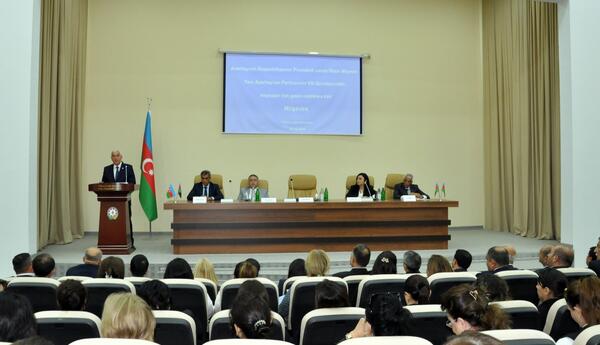
The Joint Working Group for the Implementation of International Human Rights Standards made the comment at a meeting in Baku on Friday.
"Azerbaijan has achieved good results in developing democracy. Within
the last 20 years, this country has walked on the straight path, showing
good governance. Democracy can’t be established in a short period, it
needs time," a member of the working group, Belgian Constitutional Court
judge Jean-Paul Murman stated.
According to Murman, Azerbaijan is characterized by the presence of
tolerance, gender equality, religious freedom and the development of its
citizens.
"Of course, an ideal doesn’t exist. However, Amnesty International at
times makes biased assessments. Reports of this organization don’t
reflect current situations and distort reality. Today, Azerbaijan is a
victim of occupation policy which negatively reflects itself in the
development of democracy. Therefore, we think that each and every detail
and aspect should be taken into account during assessments," Murman
underscored.
"It seems that authors of the report wish that the revolutionary wave
of the Arab spring would also touch Azerbaijan. The statement that
spring didn’t come here shows the same intention. It’s necessary to note
that big revolutions cause big shocks and countries suffering from the
Arab spring are in a very difficult situation," the judge stressed.
The Amnesty International Report, entitled "The Spring That Never Blossomed: Freedoms Suppressed in Azerbaijan", accuses Azerbaijan of criminalizing peaceful protest and stifling dissent.
The co-chairman of the joint working group on rights standards, Shahin Jamalov, in turn criticized the report.
"The report says that Azerbaijan didn’t let the Arab revolution take
place, preventing it at birth. This is an indication that the report was
biased. The report cites opposition sources without consulting official
state resources," Jamalov said.
According to the co-chairman, the authors bypassed the priority issue
for Azerbaijan – the conflict with Armenia over Nagorno-Karabakh
conflict.
"If the authors of the report had an objective viewpoint, they would
certainly have done research into the continuing occupation of
Azerbaijani lands by the Armenian side and the presence of millions of
Azerbaijani IDPs," the co-chairman stressed.
Member of PACE Monitoring Committee and Slovenian Parliament Zmago
Jelinčič also doubted the objectivity of the report because it
overlooked the Nagorno-Karabakh conflict.
"The question rises as to why the report didn’t include a single word
about Nagorno-Karabakh. Despite four UN resolutions on occupied
Azerbaijani territories, the international community hasn’t made any
step to implement the resolutions. Amnesty International also keeps
silent when it comes to this issue," Jelinčič underlined.
According to the Slovenian MP, he has visited Azerbaijan several times and seen no sign of political tyranny.
"Such negative moments can be seen just in France and the UK," the MP said.
The Amnesty International report said that peaceful protest had effectively been criminalized by a ban on demonstrations and the imprisonment of those who organize and take part in them.
A member of the Belgian Parliament Alain Destexhe underlined that
Amnesty International had admitted blunders before while making
assessments.
"Freedom of speech and assembly is, no doubt, an integral part of
democracy, but it should be regulated by the legislation of every
country individually," Destexhe said.

Bütün xəbərlər Facebook səhifəmizdə
























 USD
USD
 EUR
EUR
 GBP
GBP RUB
RUB