


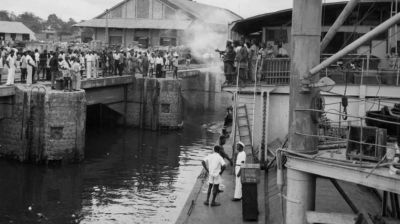
The Aids pandemic started in the city of Kinshasa - now the capital of the Democratic Republic of Congo - in the 1920s, scientists have concluded.
A "perfect storm" of population growth, a rampant sex trade and railways allowed HIV to spread, according to the team from the journal Science.
They used archived samples of the virus's genetic code to trace its source and found the evidence pointed to Kinshasa, then known as Leopoldville, where unsterilised needles used in health clinics helped spread the disease.
The virus was helped by the large number of men in the city - where they outnumbered women by two to one - which lead to the growth of a massive sex trade.
Once the disease took hold in the city, it was spread to neighbouring regions by the Belgian-backed railway.
"Data from colonial archives tells us that by the end of 1940s over one million people were travelling through Kinshasa on the railways each year," Nuno Faria of Oxford University's Department of Zoology, one of the authors of the paper, said.
"We think it is likely that the social changes around the independence in 1960 saw the virus 'break out' from small groups of infected people to infect the wider population and eventually the world."

Bütün xəbərlər Facebook səhifəmizdə


.jpg)
.jpg)

.jpg)



























 USD
USD
 EUR
EUR
 GBP
GBP
 RUB
RUB