


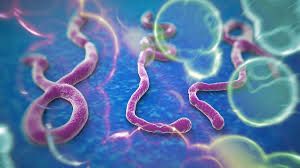
The Ebola virus causes viral hemorrhagic fever, which according to the U.S. Centers for Disease Control and Prevention (CDC), refers to a group of viruses that affect multiple organ systems in the body and are often accompanied by bleeding.
The virus is named after the Ebola River in the Democratic Republic of Congo (formerly Zaire), where one of the first outbreaks occurred in 1976. The same year there was another outbreak in Sudan.
The WHO says there are five different strains of the virus -- named after the areas they originated in. Three of these have been associated with large outbreaks of hemorrhagic fever in Africa.
These are the Bundibugyo -- an area of Uganda where the virus was discovered in 2007 -- Sudan and Zaire sub-types.
There has been a solitary case of Ivory Coast Ebola. This subtype was discovered when a researcher studying wild chimpanzees became ill in 1994 after an autopsy on one of the animals. The researcher recovered.
Finally, Reston Ebola is named after Reston in the U.S. state of Virginia, where this fifth strain of the Ebola virus was identified in monkeys imported from the Philippines. The CDC says while humans have been infected with Ebola Reston, there have been no cases of human illness or death from this sub-type.
Symptoms of Ebola
Early symptoms include sudden onset of fever, weakness, muscle pain, headaches and a sore throat. These symptoms can appear two to 21 days after infection.
The WHO says these nonspecific early symptoms can be mistaken for signs of diseases such as malaria, typhoid fever, meningitis or even the plague.
MSF says some patients may also develop a rash, red eyes, hiccups, chest pains and difficulty breathing and swallowing.
The early symptoms progress to vomiting, diarrhea, impaired kidney and liver function and sometimes internal and external bleeding.
Ebola can only be definitively confirmed by five different laboratory tests.
How is treated Ebola?
There are no specific treatments for Ebola. MSF says patients are isolated and then supported by health care workers.
"This consists of hydrating the patient, maintaining their oxygen status and blood pressure and treating them for any complicating infections," it says.
There have been cases of health care workers contracting the virus from patients, and the WHO has issued guidance for dealing with confirmed or suspected cases of the virus.
Caregivers are advised to wear impermeable gowns and gloves and to wear facial protection such as goggles or a medical mask to prevent splashes to the nose, mouth and eyes.
MSF says it contained a 2012 outbreak in Uganda by placing a control area around its treatment center. An outbreak is considered over once 42 days -- double the incubation period of the disease -- have passed without any new cases.
How does this virus spread?
The WHO says it is believed that fruit bats may be the natural host of the Ebola virus in Africa, passing on the virus to other animals.
Humans contract Ebola through contact with the bodily fluids of infected animals or the bodily fluids of infected humans.
MSF says that while the virus is believed to be able to survive for some days in liquid outside an infected organism, chlorine disinfection, heat, direct sunlight, soaps and detergents can kill it.
MSF epidemiologist Kamiliny Kalahne said outbreaks usually spread in areas where hospitals have poor infection control and limited access to resources such as running water.
"People who become sick with it almost always know how they got sick: because they looked after someone in their family who was very sick -- who had diarrhea, vomiting and bleeding -- or because they were health staff who had a lot of contact with a sick patient," she said.

Bütün xəbərlər Facebook səhifəmizdə

.jpg)
.jpg)

.jpg)























 USD
USD
 EUR
EUR
 GBP
GBP
 RUB
RUB