


Although the relations between Azerbaijan and Iran had been strained for some time, this culminated in a fully fledged political crisis between the two countries in the run-up to this year’s Eurovision Song Contest (ESC) in Baku, since the Iranians accused the Azerbaijani government of insulting Islam through hosting a European song competition in a Muslim country. They also blamed the Azerbaijani side for allowing gay parades in Baku, although actually such an event never took place there. Thereupon, Teheran summoned the Azerbaijani ambassador to present him with an official note of protest, and called back its own representative in Baku for consultations.
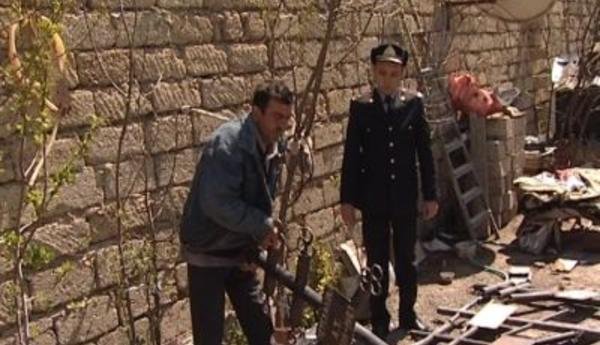
In Iran, a state-run media campaign against the ESC host country Azerbaijan preceded this diplomatic escalation. Iranian clerics and politicians massively criticized this allegedly "un-Islamic" and "scandalous" show on Muslim soul. There was talk even of "insulting Islamic sanctities". It was certainly Tehran’s response to the demolition of an Iranian network of spies in Baku as well. So, in March 2012 22 suspected Iranian agents were arrested by the Azerbaijani security forces. They were accused of plotting terrorist attacks against Western embassies and companies in Azerbaijan.
The recent development is not surprising, especially as the further deepening of good relations between Azerbaijan and Israel, the United States and other Western countries, disconcerts the Iranian side. Teheran shows little enthusiasms for Azerbaijan being mainly oriented toward the Western integration structures and culture. Already in the 1990s, the Iranian theocratic leadership was heavily involved in exporting his (socio-) political model to Azerbaijan, and regarded the West as an arch-rival. Even today, training Shiite clerics and supporting Shiite organizations in Azerbaijan, the Iranian side endeavors to strengthen its long-term political influence in the country.
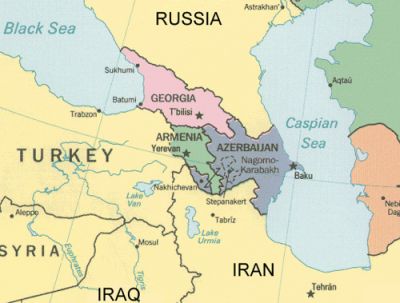
And this is also why it is in the best interest of the West that Azerbaijan preserves its independence and sovereignty, not only from its Northern neighbor Russia, but also from the theocratic Iran in the South and is integrated within the transatlantic community of democracies. Azerbaijan’s importance in geo- and regional politics is evident: Not only is it situated between Russia and Iran; it is also the gateway to Central Asia which presumably holds enormous energy reserves. Especially the US appreciates the value of Azerbaijan’s strategic proximity to Iran. Thus, the geographic location of Azerbaijan at the crossroads of Europe and Asia, located between two great, respectively regional powers, plays an important role in international politics towards the country.

After the fall of the Soviet Union, Azerbaijan’s relations with Iran started on a new tack, and Tehran was happy to see the new power vacuum in the Caspian region. Since then, the core problem in the Iranian-Azerbaijani relations is and remains the legal status of the Caspian Sea. Here, it’s not just about purely economic, but also geopolitical interests. Specifically, Iran regards Azerbaijan, being politically independent and gaining economic strength, whose foreign policy does not meet just expectations of the Iranian regime - the close cooperation established by Azerbaijan with the West, particularly US and Israel can be mentioned as an example - as a potential security risk from outside. Azerbaijan, in turn, is skeptical about Iran’s good relations with Armenia because the Christian neighbor has militarily occupied large parts of its territory including the Nagorno-Karabakh region in breach of international law since the early 1990s.

Another factor which still generates tension is historical: The division of Azerbaijan in the Turkmancay treaty of 1828 between the Russian and Persian empires has so far not been (and certainly not politically either) dealt with on both sides. In Iran, many in the political establishment still consider Azerbaijan as being a part of the historic Iran, which Russia had annexed by force at that time. On the other hand, in Azerbaijan, the way in which Azerbaijan was divided among the two empires at the beginning of the 19th century is still perceived as an historical injustice which has to be mended. In this regard, some political circles (especially in opposition) see even a possible war to be started by the U.S./Israel against Iran as an opportunity that could lead to the reunification of Azerbaijan. In addition, the high sense of injustice is permanently being kept awake by the fact that the Azeri minority living in Iran still does not own collective rights (especially education and media in Azeri language). Their estimated figures vary between 20 and 30 million.
Overall, it is not surprising that there are now and then crisis situations between two Muslim neighbors. What is new is that the recent tense relationship showed a cultural dimension in light of the further deterioration of bilateral relations duo to ESC held in May 2012 in Baku. Although in both countries Shiite Islam dominates, and historically they are closely linked, the diplomatic dispute over hosting the ESC in Azerbaijan once again shows today’s significant differences in socio-political values between the two countries. First and foremost: If Azerbaijan is being secularly governed, Iran is a theocratic state. With regard to foreign policy, Azerbaijan is oriented toward Europe and - in terms of values - also being measured with European standards as a member of European Counsel, whereas the theocratic Iranian government runs unabatedly an openly confrontational course against the West. Thus, in general, given this complicated constellation in the geopolitically sensitive Caspian region, the secular Azerbaijan needs today more than ever Western support on its way into the future.


























 USD
USD
 EUR
EUR
 GBP
GBP
 RUB
RUB