


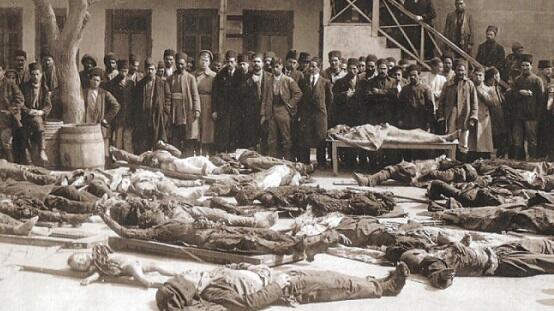
Today marks 108 years since the Armenian Dashnaks committed the act of genocide against Azerbaijanis together with the Bolsheviks, SİA informs.
Taking advantage of the February and October 1917 coups in Russia, the Armenians managed to implement their smear plans under the Bolshevik flag.
From March 30 to April 3, 1918, the Baku commune, under the guise of a struggle against counter-revolutionary elements, began to implement its nefarious plans to clear the Baku province of Azerbaijanis.
On these days, the Baku Soviet and the armed formations of the Armenian Dashnaks committed genocide against the Azerbaijani people in Baku, in various parts of the Baku governorate, as well as in Shamakhi, Guba, Khachmaz, Lankaran, Hajigabul, Salyan, Zangazur, Karabakh, Nakhchivan, and other territories of the country.
Nearly 12,000 Azerbaijanis were killed, and tens of thousands of people were missing.
Since March 1918, the Baku Commune began implementing a devious plan to expel and kill Azerbaijanis in the Baku province under the slogan of fighting against counter-revolutionary elements.
During the March massacre, Armenians destroyed many historical and architectural monuments, including shrines, and shelled the Ismailiyya building, considered one of the pearls of world architecture. As a result of the shelling by the naval fleet stationed in the Caspian Sea, the minarets of the Juma and Taza Pir mosques were severely damaged.
Dashnak armed detachments brutally killed people in the caravanserai and burned their corpses right there. Armenians, who used the Sovietization of Transcaucasia for their smear purposes, in 1920 declared Zangazur and a number of other Azerbaijani lands as territory of the Armenian SSR. In the subsequent period, they resorted to new means to expand the policy of deportation of Azerbaijanis from these territories.
For this purpose, they achieved at the state level the adoption of a special decree of the Council of Ministers of the USSR dated December 23, 1947, "On the resettlement of collective farmers and other Azerbaijani population from the Armenian SSR to the Kura-Aras lowland of the Azerbaijan SSR." This led to the mass deportation of Azerbaijanis from their historical lands in 1948-1953. In 1988, the deportation policy continued, and about 300,000 Azerbaijanis living in Armenia were evicted from their homes.
The Azerbaijan Democratic Republic twice marked March 31, 1919, and 1920 as a national mourning day. After Azerbaijan gained independence, it became possible to create an objective picture of our people's historical past. The decree "On the genocide of Azerbaijanis," signed on March 26, 1998, by National Leader Heydar Aliyev, gave a political assessment of these events and, for the first time, officially announced the genocide of Azerbaijanis committed by Armenians.
Recently, facts revealing the mass killings committed by Armenians during the events of 1918 in Guba have been uncovered. The countless human bones that have been found are tangible evidence confirming Armenian vandalism during these massacres. The Guba Genocide Memorial Complex has been established in this area as proof of the killing of tens of thousands of people and as a sign of respect for their memory.
The Genocide Memorial Museum of the Military Prosecutor's Office of Azerbaijan is also important for conveying the truth about the terrible events in Azerbaijan to the world community.
The genocide of Azerbaijanis in 1918 has not yet received a legal assessment at the international level.

Bütün xəbərlər Facebook səhifəmizdə





















 USD
USD
 EUR
EUR
 GBP
GBP RUB
RUB