


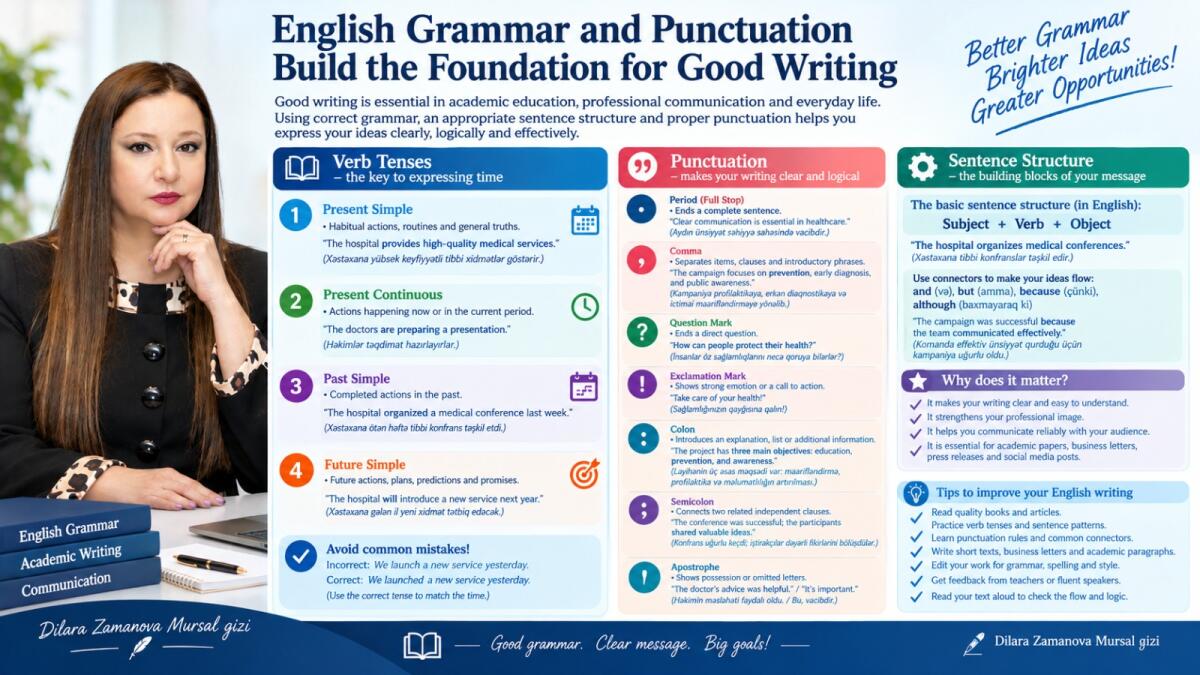
The ability to express ideas clearly and accurately is essential in academic studies, professional communication, and everyday life. Clear, coherent, and grammatically correct writing helps readers understand a text more easily and follow its main ideas. To produce high-quality texts in English, it is important to understand the basic rules of grammar, verb tenses, sentence structure, and punctuation.
The Importance of English Grammar
Grammar is a system of rules that governs how words are connected, how sentences are constructed, and how ideas are expressed logically. Following English grammar rules improves the clarity of writing and the accuracy of communication.
One of the most important areas of English grammar is verb tenses. Verb tenses indicate when an action takes place, whether it is continuing, or whether it has already been completed. Choosing the correct tense is essential for communicating the intended meaning accurately.
The Main Verb Tenses in English
1. Present Simple
The Present Simple is used to describe habits, regularly repeated actions, and general facts.
Example: The hospital provides high-quality medical services.
2. Present Continuous
The Present Continuous describes actions happening at the moment of speaking or during the current period.
Example: The doctors are preparing a presentation.
3. Past Simple
The Past Simple describes actions that happened and were completed in the past.
Example: The hospital organized a medical conference last week.
4. Future Simple
The Future Simple is used to express future actions, predictions, and promises.
Example: The hospital will introduce a new service next year.
Using verb tenses correctly helps maintain the logical sequence of a text.
For example, the sentence “We launch a new service yesterday” is grammatically incorrect. The word “yesterday” indicates the past, while the verb “launch” is used in the Present Simple.
The correct version is:
We launched a new service yesterday.
However, using different tenses within the same text is not necessarily an error. The important point is to choose tenses that correspond to the meaning and sequence of the events being described.
The Correct Use of Punctuation in English
Punctuation marks organize written communication, show relationships between ideas, and make texts easier to read. The most commonly used punctuation marks in English include the period, comma, question mark, exclamation mark, colon, semicolon, and apostrophe.
The Period (.) is placed at the end of a complete declarative sentence.
Example: Clear communication is essential in healthcare.
The Comma (,) is used in lists, after certain introductory expressions, and in specific types of complex sentences.
Example: The campaign focuses on prevention, early diagnosis, and public awareness.
The Question Mark (?) is placed at the end of a direct question.
Example: How can people protect their health?
The Exclamation Mark (!) expresses strong emotions, commands, or emphasis.
Example: Take care of your health!
The Colon (:) introduces an explanation, a list, or additional information.
Example: The project has three main objectives: education, prevention, and awareness.
The Semicolon (;) can connect two independent clauses that are closely related in meaning.
Example: The conference was successful; the participants shared valuable ideas.
The Apostrophe (’) is used to indicate possession and omitted letters in contractions.
Examples:
The doctor's advice was helpful.
It is important. → It's important.
Correct punctuation makes a text more readable and helps prevent misunderstandings.
How to Construct Clear Sentences in English
Effective English writing involves more than knowing grammar and punctuation rules. It also requires logical sentence structure, appropriate word choice, and the avoidance of unnecessary repetition.
The basic structure of a simple English sentence is often Subject + Verb + Object.
Example: The hospital organizes medical conferences.
In this sentence, “The hospital” is the subject, “organizes” is the verb, and “medical conferences” is the object.
Word order is particularly important in English. While word order can be relatively flexible in some languages, English generally follows established rules governing the placement of subjects, verbs, and other sentence elements.
For example:
Incorrect: Organizes the hospital medical conferences.
Correct: The hospital organizes medical conferences.
Using conjunctions to connect related ideas also improves the flow of a text. Words such as and, but, because, and although help demonstrate logical relationships between ideas.
Example: The campaign was successful because the team communicated effectively.
Why Is English Grammar Important in Professional Writing?
Grammar and punctuation are particularly important when preparing academic articles, business emails, reports, press releases, and social media posts. Well-written texts help communicate information accurately, strengthen the author's professional image, and build trust with the target audience.
For example, when announcing an event that will take place in the future, it is important to choose the appropriate verb tense.
Incorrect: Our hospital held a conference tomorrow.
Correct: Our hospital will hold a conference tomorrow.
The second sentence uses the Future Simple, making it clear that the event has not yet taken place.
When editing an English text, writers should check not only grammatical errors but also sentence clarity, word choice, and the suitability of the writing style for the intended audience.
How to Improve English Writing Skills
Developing strong writing skills requires regular practice, reading, and editing. The following strategies can help:
Read high-quality articles and books in English.
Study verb tenses through a variety of examples.
Practice sentence construction and correct word order.
Learn the rules governing punctuation.
Write short texts, business emails, and academic paragraphs.
Review completed texts for grammatical, spelling, and stylistic errors.
Seek feedback from teachers or proficient English speakers and work on recurring mistakes.
Reading a completed text aloud is also useful. It helps writers evaluate whether sentences sound natural, identify awkward transitions, and recognize unnecessary repetition.
Conclusion
A sound understanding of English grammar and punctuation is fundamental to effective writing. Using verb tenses correctly, following appropriate word order, constructing logical sentences, and applying punctuation accurately all contribute to clear communication.
Applying these principles improves the quality of academic essays, business correspondence, press releases, and social media publications. Through regular practice, careful editing, and continuous improvement of grammatical knowledge, writers can communicate in English more accurately, confidently, and professionally.

Bütün xəbərlər Facebook səhifəmizdə

























 USD

 EUR

 GBP
 RUB