
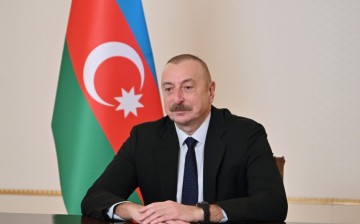
President of the Republic of Azerbaijan Ilham Aliyev gave an interview to the Vietnam News Agency (VNA).
SİA presents the interview.
– Dear Mr. President, ahead of your official visit to Vietnam, which is expected to mark a new stage in bilateral cooperation, how would you characterize the current state of political dialogue between Azerbaijan and Vietnam?
– Reflecting on the nearly 70-year history of Azerbaijan–Vietnam relations, I would first like to look back at the origins of this friendship and recall with sincere gratitude the great leaders who laid its foundations.
The starting point was undoubtedly the year 1959, when President of the Democratic Republic of Vietnam Ho Chi Minh paid a memorable visit to Baku. Another significant milestone came in 1983, when a Soviet delegation led by Heydar Aliyev, then a member of the Politburo of the Central Committee of the Communist Party of the Soviet Union and First Deputy Chairman of the Council of Ministers of the USSR, visited Vietnam. At the initiative of the National Leader of the Azerbaijani people, the visit lasted eight days and encompassed key regions of the country. The agreements reached during that visit provided a powerful impetus for the development of Vietnam's economy and laid the groundwork for long-term cooperation.
Building on these strong, time-tested traditions of friendship, we have consistently worked to strengthen our ties and expand our mutually beneficial partnership. In 2014, I paid my first state visit to Vietnam, followed in May 2015 by a reciprocal visit to Azerbaijan by President of the Socialist Republic of Vietnam Truong Tan Sang.
The first state visit to Azerbaijan by To Lam, General Secretary of the Central Committee of the Communist Party of Vietnam, in May 2025 marked the beginning of a new chapter in our bilateral relations. The constructive discussions encompassed a wide range of areas, from energy and investment to defense and cybersecurity. The adoption of the Joint Statement on Strategic Partnership was a logical outcome of these discussions. This landmark document elevated Azerbaijan–Vietnam relations to a new level. The visit once again demonstrated our mutual interest in deepening our partnership and translating it into concrete cooperation.
Alongside high-level political dialogue between the heads of state, productive engagement continues through the intergovernmental commission, relevant ministries and agencies, and interparliamentary friendship groups. Close cooperation is also being developed between the ruling parties of our two countries – the Yeni Azerbaijan Party and the Communist Party of Vietnam.
Beyond bilateral dialogue, our countries also cooperate closely in multilateral forums, particularly within the United Nations, the Non-Aligned Movement, the Conference on Interaction and Confidence-Building Measures in Asia (CICA), and other international organizations.
All this clearly demonstrates that the long-standing political dialogue between Baku and Hanoi continues to deepen steadily, based on equality and mutual respect for each other's interests.
– What are the key achievements, priority areas, and prospects for the development of trade and economic relations?
– Trade and economic relations between Azerbaijan and Vietnam are developing steadily. In 2025, bilateral trade exceeded US$150 million. However, this figure does not yet reflect the full potential of our economic ties, and both countries have considerable opportunities to expand bilateral trade.
The oil sector, which has been a cornerstone of our partnership since the Soviet era, remains a key area of cooperation. In this context, strengthening ties between the State Oil Company of the Republic of Azerbaijan (SOCAR) and the Vietnam Oil and Gas Group (PetroVietnam) is particularly important. The Memorandum of Understanding signed in 2025 envisages cooperation in such areas as oil and gas exploration and development, technical services, and the training of specialists.
The presence of Vietnamese businesses in Azerbaijan is another important aspect of our bilateral economic ties. One example is ROX Group, which has expressed interest in projects in the fields of construction, infrastructure development, and solar and wind energy. In September 2026, relevant agreements were signed with ROX Group in Baku on the sidelines of the Second Azerbaijan International Investment Forum.
Positive trends have also been observed in transit freight transportation. From January to September 2026, transit freight volumes increased nearly sixfold compared with the corresponding period of 2025, exceeding 8,000 tons.
Azerbaijan's transport and logistics infrastructure can be effectively utilized to facilitate the transportation of goods from Vietnam to Europe and vice versa via the Middle Corridor and the North-South Transport Corridor. This would not only strengthen Azerbaijan's role in international transport networks but also generate additional economic value, create new opportunities for cooperation, and further expand bilateral ties.
Our countries possess the necessary resources and potential to substantially increase bilateral trade and successfully implement major joint projects in energy, industry, agriculture, transport, and logistics – in short, across virtually all key sectors. I am confident that sustained, coordinated efforts will enable us to achieve tangible results in the near future.
– What role do humanitarian, educational, and cultural ties play in bringing our countries closer together, and what initiatives are contributing to this process?
– Humanitarian cooperation serves as an important bridge between our peoples and countries. Over the decades, these ties have steadily strengthened through educational initiatives, charitable projects, and regular cultural exchanges.
The Heydar Aliyev Foundation plays a particularly important role in this process, actively contributing to the strengthening of humanitarian ties with Vietnam. Its activities encompass a wide range of areas, from infrastructure projects, such as the construction of a primary school in Ha Giang Province, to support for various educational programs.
A significant step in strengthening these ties was the visit to Vietnam in 2025 by Leyla Aliyeva, Vice-President of the Heydar Aliyev Foundation. During the visit, she held meetings with senior Vietnamese officials, representatives of the creative community, and Vietnamese graduates of Azerbaijani universities. Financial assistance was also provided to the Hanoi College of Commerce and Tourism.
In addition to charitable activities, scientific and educational cooperation continues to develop steadily. Leading universities in both countries have signed a number of cooperation agreements and memorandums of understanding. Vietnamese citizens are eligible to participate in educational grant programs established by my decree for citizens of the member states of the Non-Aligned Movement.
It is encouraging that these academic ties are rooted in rich historical traditions. During the Soviet era, around 5,000 Vietnamese citizens studied in Azerbaijan and subsequently applied their knowledge and experience for the benefit of their homeland. The opening of the Ho Chi Minh Memorial Room at Azerbaijan State Oil and Industry University in 2025, attended by To Lam, General Secretary of the Central Committee of the Communist Party of Vietnam, was a symbol of the long-standing friendship between our two countries. The event was held to mark the 135th anniversary of the birth of this outstanding statesman.
Cultural exchanges naturally complement educational ties. Vietnam Days are regularly held in Azerbaijan. In 2026, this initiative reached a qualitatively new level, as the fourth festival was held in two cities – Baku and Gabala – for the first time. Another significant cultural milestone was the publication in Azerbaijan of At Dawn, a collection of poems by the renowned Vietnamese poet Mai Van Phan.
The cultural dialogue between our peoples dates back several decades. In 1955, composer Gara Garayev composed Vietnam Suite for the first Soviet-Vietnamese documentary film. These creative ties were further strengthened by filmmaker Ajdar Ibragimov, who lived and worked in Vietnam from 1959 to 1962. He helped lay the foundations of the country's national film school, contributed to the training of local directors and actors, and authored several books about Vietnam. One of them, What I Saw in Vietnam, was translated into Vietnamese, and the book was presented in Hanoi this year.
Our strong bonds of friendship are reflected not only in joint projects but also in our willingness to support each other in times of need. Azerbaijan provided financial assistance to help Vietnam recover from the devastation caused by Typhoon Yagi in 2024 and address the damage caused by severe flooding in 2025.
– What are your expectations for the upcoming visit to Vietnam?
– I look forward to my visit to friendly Vietnam. I am confident that it will mark another important step in deepening the mutually beneficial partnership between Azerbaijan and Vietnam.
Today, Vietnam is a rapidly developing country in Southeast Asia, while Azerbaijan is a key transport, logistics, and energy hub in the South Caucasus. By joining forces, we can gain access to new markets, implement joint projects, and create additional opportunities for business and investment. Our cooperation undoubtedly holds enormous potential for constructive engagement and for delivering tangible benefits to both countries and their peoples.
Bütün xəbərlər Facebook səhifəmizdə








 USD

 EUR

 GBP
 RUB