


Effective Social Media Strategy – Expanding Audience Reach, Managing Advertising and Measuring Results in the Digital World
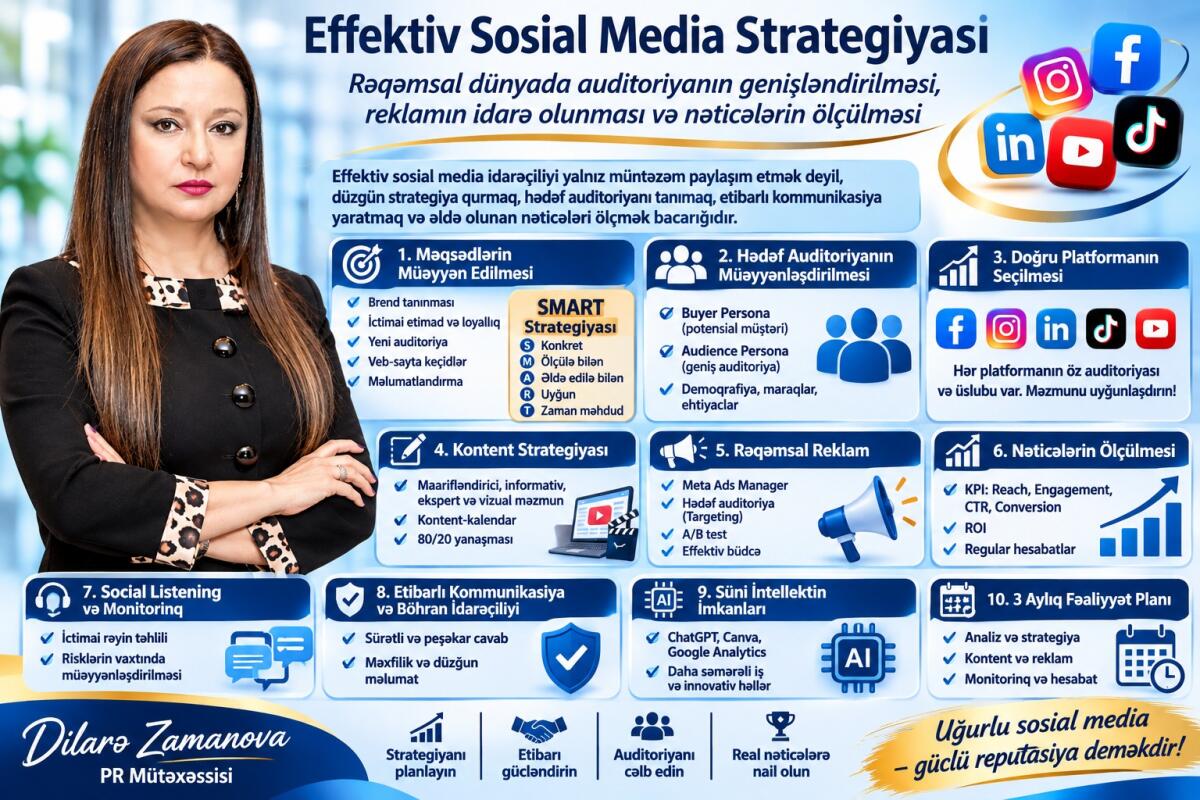
Effective social media management is not simply about publishing content regularly. It is about developing the right strategy, identifying the target audience, building trusted relationships through communication, and measuring the results achieved.
Social media has become an essential tool for organizations, companies and government institutions to engage with the public. Today, platforms such as Facebook, Instagram, LinkedIn, TikTok and YouTube are used not only to distribute information but also to build brand reputation, strengthen audience trust, promote services and achieve strategic objectives.
To succeed in the digital environment, social media activities should not be carried out randomly. Instead, they should be based on clearly defined objectives, audience analysis, a content plan and measurable results. In this context, developing an effective social media strategy is one of the key professional skills required of a modern PR specialist.
1. Developing a Social Media Strategy
A social media strategy is a plan that defines why, for whom, through what type of content and by which methods an organization will communicate with its audience across digital platforms.
Developing a strategy involves several essential stages.
1.1. Setting Objectives
The first step is to determine what results the organization aims to achieve through social media.
The main objectives may include:
- Increasing brand awareness.
- Strengthening public trust and loyalty.
- Reaching new audiences.
- Increasing website traffic.
- Providing information about products and services.
- Building ongoing communication with customers and audiences.
- Protecting and developing the organization's reputation.
Objectives should be established according to the SMART principle. Under this approach, each objective must be Specific, Measurable, Achievable, Relevant and Time-bound.
SMART – Five Key Criteria for Setting Objectives
|
Letter |
English Term |
Meaning |
|
S |
Specific |
The objective must be clear and well-defined. |
|
M |
Measurable |
The results must be quantifiable and assessable. |
|
A |
Achievable |
The objective must be realistic in terms of available resources and capabilities. |
|
R |
Relevant |
The objective must align with the organization's overall strategy. |
|
T |
Time-bound |
A specific deadline must be established for achieving the objective. |
Practical Example – Central Customs Hospital's Social Media Activities
Let us assume that our objective is to improve the performance of the hospital's Instagram page.
- S – Specific: Increase the reach of healthcare educational content published on the hospital's Instagram page.
- M – Measurable: Increase reach by 20%.
- A – Achievable: Achieve this result through high-quality video materials, doctor interviews, Reels and scheduled publications.
- R – Relevant: This objective supports the hospital's strategy of promoting public health education and digital communication.
- T – Time-bound: Achieve the established objective within three months.
For example, rather than simply aiming to increase the number of social media followers, a more specific objective would be to increase the reach of the Instagram page by 20% within three months.
1.2. Identifying the Target Audience
One of the most important conditions for an effective social media strategy is understanding the target audience.
A PR specialist should find answers to the following questions:
- Who are we communicating with?
- What are the age groups and interests of our audience?
- Which social media platforms do they use?
- What type of information do they need?
- Which content formats attract the most interest?
- What problems are they looking to solve?
To understand audience behaviour, it is necessary to analyse demographic data, interests, social media statistics, survey results and user feedback.
Based on this information, an audience profile is developed, known as a Buyer Persona or Audience Persona.
1.2.1. What Is a Buyer Persona?
A Buyer Persona is a fictional, detailed profile of a potential customer or service user.
This profile is developed using real research, audience behaviour, needs, interests and challenges.
A Buyer Persona helps answer the following questions:
- Who is our potential customer?
- What needs and problems do they have?
- Which services are they interested in?
- Which social media platforms do they use?
- What type of information influences their decision-making?
- How can we earn their trust?
1.2.2. What Is an Audience Persona?
An Audience Persona is a broader profile representing the target audience that an organization communicates with through its social media activities and communication strategy.
A Buyer Persona is primarily focused on potential customers, their interest in choosing services and their decision-making behaviour.
An Audience Persona is a broader concept. It includes not only people interested in purchasing a service but also different audience groups that need to be informed, educated and engaged in communication.
For example:
- Patients and their family members.
- Doctors and healthcare professionals.
- Journalists and media representatives.
- Employees of government institutions.
- Medical university students.
- The general public.
1.3. Choosing the Right Social Media Platforms
Each social media platform has its own audience, communication style and content presentation characteristics.
Suitable for reaching a broad audience, publishing news and announcements, building communities and running advertising campaigns.
Used for visual communication and audience engagement through Reels, Stories, photographs and video content.
An important platform for corporate communications, building professional reputation, developing business relationships, strengthening an organization's expert image and promoting Employer Branding.
TikTok
Enables organizations to reach new audiences through short videos, creative presentations, educational materials and dynamic content.
YouTube
Particularly valuable for publishing interviews, educational videos, reports, presentations and building a long-term video archive.
The main principle is not to publish identical content across every platform without modification. Instead, the communication style and content format should be adapted to the characteristics and expectations of each platform's audience.
2. Developing a Social Media Content Strategy
A content strategy plays a particularly important role in social media management. Content that attracts attention, provides value and generates interest contributes to building an organization's digital reputation.
The following content categories should be considered when developing a content strategy:
- Educational Content: Providing useful and informative material to the audience.
- Informational Content: News, updates and announcements.
- Expert Content: Professional opinions, interviews and expert explanations.
- Visual Content: Photographs, infographics, posters and graphic designs.
- Video Content: Reels, short videos, reports and interviews.
- Interactive Content: Polls, questions and answers, and discussions.
The 80/20 approach can be used when planning content. According to this model, most publications should provide useful information to the audience, while a smaller proportion should focus on promoting products and services.
This is not a universal rule. It should be adapted to the characteristics and needs of the target audience.
Content Calendar
A content calendar is an essential planning tool in professional social media management.
|
Day |
Content Category |
Format |
|
Monday |
Educational Information |
Poster |
|
Tuesday |
Expert Interview |
Video |
|
Wednesday |
Organizational News |
Photo and Text |
|
Thursday |
Useful Recommendations |
Reels |
|
Friday |
Weekly Review |
Video or Carousel |
A content calendar helps maintain consistency, prevent repetitive topics and organize the communication process.
3. Expanding Social Media Reach
One of the main objectives of a social media strategy is to ensure that an organization's information reaches the widest possible audience.
Both organic and paid methods are used to achieve this.
Organic Reach
Organic Reach refers to the number of unique users who see a publication without the use of paid advertising.
To increase organic reach, organizations should:
- Create content that reflects audience interests.
- Use high-quality photographs and videos.
- Select relevant and useful topics.
- Respond to followers' comments and questions.
- Collaborate with other relevant social media pages.
- Make effective use of video content and interactive formats.
User-Generated Content (UGC)
User-Generated Content refers to photographs, videos, comments and reviews created by users voluntarily.
Such content can help strengthen audience engagement with an organization.
However, before using users' photographs or videos, the organization must obtain appropriate consent and comply with privacy and confidentiality requirements.
4. Effective Digital Advertising Management
Digital advertising is one of the most important elements of a modern social media strategy.
While organic publications allow organizations to reach audiences naturally, paid advertising provides opportunities to reach a wider and more precisely defined target audience based on specific objectives and budgets.
What Is Meta Ads Manager?
Meta Ads Manager is an advertising platform designed to create, manage and analyse advertising campaigns on Facebook and Instagram.
When developing an advertising campaign, several key stages must be considered.
1. Campaign
The main advertising objective is selected. Examples include increasing brand awareness, driving traffic, generating audience engagement or increasing enquiries.
2. Ad Set
The target audience, budget, advertising schedule and placements are selected.
3. Ad
The advertising materials that users will see are prepared. These include photographs, videos, text, headlines and a Call to Action (CTA).
Targeting – Selecting the Target Audience
The effectiveness of an advertising campaign largely depends on how accurately the target audience is defined.
The following parameters may be considered when selecting an audience:
- Geographic location.
- Age groups.
- Language.
- Interests.
- User behaviour on the platform.
- Audiences created based on previous interactions.
Showing advertisements to everyone is not always an effective solution. The main objective is to deliver the right message to the right audience.
What Is A/B Testing?
A/B Testing is a method of comparing two different versions of advertising content.
For example, two different posters, two headline variations or two video versions can be created for the same topic.
The results are then compared to determine which version performs better.
This method helps organizations use their advertising budgets more efficiently.
5. Measuring Social Media Performance
In professional PR activities, it is not enough to know only the number of publications or followers. The most important thing is to determine what results the work has actually achieved.
For this purpose, organizations use KPIs – Key Performance Indicators.
The main indicators are presented below:
|
Indicator |
Explanation |
|
Reach |
The number of unique users who have seen a publication. |
|
Impressions |
The total number of times content has been displayed. |
|
Engagement |
Likes, comments, shares and other forms of interaction. |
|
Engagement Rate |
The level of audience interaction with content. |
|
CTR |
The percentage of users who clicked on a link after seeing an advertisement. |
|
CPC |
The cost of a single click. |
|
CPM |
The cost of 1,000 advertising impressions. |
|
Conversion Rate |
The percentage of users who completed a desired action. |
|
Follower Growth |
The rate of increase in the number of followers. |
These indicators help organizations identify the strengths and weaknesses of their social media activities.
6. ROI – Measuring Return on Investment in Social Media
ROI (Return on Investment) is an indicator that measures the relationship between the financial resources invested in social media activities and the results achieved.
Practical Example
Suppose an organization allocates 500 AZN to an advertising campaign and generates revenue of 1,500 AZN directly attributable to that campaign.
In this example, the Return on Investment (ROI) is 200%.
However, in PR activities, ROI should not be measured solely through direct financial profit.
It is also important to evaluate:
- Increased brand awareness.
- Growth in public trust.
- Reputation protection.
- Stronger audience loyalty.
- The quality of enquiries and interactions with the organization.
Particularly in government institutions and healthcare organizations, additional outcomes must be considered, such as increased public awareness and social benefit.
Therefore, alongside ROI, a comprehensive assessment of communication performance is essential.
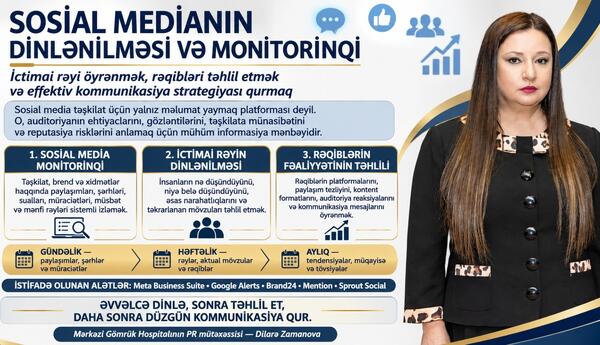
7. Social Listening and Social Media Monitoring
In PR activities, social media should be viewed not only as a tool for distributing information but also as an important source for understanding public opinion.
Social Listening and Social Media Monitoring are closely related but distinct concepts.
- Social Media Monitoring involves tracking publications, comments, mentions and user reactions related to an organization, brand or specific topic.
- Social Listening involves a deeper analysis of the collected information to identify audience attitudes, needs and broader trends.
For example, a large number of positive and negative reviews about an organization on social media should not be viewed merely as statistical data.
It is necessary to investigate the reasons behind these reviews, identify public concerns and, where necessary, make adjustments to the communication strategy.
The following tools can be used in this process:
- Meta Business Suite.
- Google Alerts.
- Brand24.
- Mention.
- Sprout Social.
Social Listening helps PR specialists better understand public opinion and identify potential communication risks in a timely manner.
8. Personalized Audience Communication and Building Trust
One of the greatest advantages of social media is the opportunity for direct interaction between an organization and its audience.
Previously, organizations primarily communicated through one-way information delivery. In today's digital environment, audiences ask questions, express opinions, leave comments and expect timely responses.
Therefore, the following principles should be observed when managing social media accounts:
Followers' questions should not remain unanswered. Enquiries should be addressed promptly and politely. Responses should be clear, accurate and written in accessible language. Negative feedback should be handled professionally and without emotional reactions. Particular attention should be paid to protecting confidential information.
These principles are especially important in the healthcare sector. Organizations must protect patients' personal data, provide medical information responsibly and prevent the spread of inaccurate information when communicating through social media.
9. Social Media Risk Management and Crisis Communication
Social media offers significant opportunities for organizations, but it can also create reputational risks.
Misinformation, user complaints, negative public sentiment, information security issues and unexpected events can attract widespread attention within a short period of time.
Therefore, every organization should have a social media crisis communication plan.
Such a plan should cover the following areas:
- Early identification of potential risks.
- Clear allocation of responsibility for official communication.
- Preparation of verified and approved information.
- Establishment of a rapid response mechanism.
- Coordination of communication with the media and the public.
- Assessment of reputation and public trust following a crisis.
The main principle of crisis communication is to act without rushing, but also without unnecessary delay, relying exclusively on verified information.
The HubSpot educational programme also addresses social media risk management, crisis planning and the development of internal social media guidelines as separate topics.
10. Practical Application of a Social Media Strategy
To apply theoretical knowledge in real working environments, it is necessary to develop a specific action plan.
Below is an example of a three-month social media strategy model for an organization.
|
Area of Activity |
Tasks to Be Performed |
|
Analysis |
Reviewing current social media performance indicators. |
|
Strategy |
Defining objectives and identifying the target audience. |
|
Content |
Developing a monthly content calendar. |
|
Video |
Producing expert interviews and short video materials. |
|
Advertising |
Running advertising campaigns based on the target audience. |
|
Monitoring |
Tracking feedback and public reactions. |
|
Analytics |
Analysing Reach, Engagement, CTR and ROI indicators. |
|
Reporting |
Preparing monthly and quarterly reports. |
Example of a Monthly Report for a PR Specialist
A monthly report should not simply reflect the number of publications. It should also evaluate the effectiveness of the work performed.
The report should include the following information:
- Total number of publications.
- Audience reach.
- Growth in the number of followers.
- Publications with the highest performance indicators.
- Video views.
- User feedback and enquiries.
- Advertising campaign results.
- Suggestions and recommendations for the following month.
This approach makes it possible to demonstrate the actual results of social media activities and develop a more effective strategy for the future.
11. The Role of Artificial Intelligence in Social Media Strategy
The development of artificial intelligence technologies is creating new opportunities in social media management.
AI tools can help PR specialists to:
- Generate content ideas.
- Edit publication texts.
- Prepare communication messages for different audiences.
- Produce video materials and visual content.
- Analyse social media performance.
- Structure and prepare reports.
Useful Tools
ChatGPT
For preparing texts, generating content ideas, developing communication strategies and creating reports.
Canva
For designing posters, presentations, infographics and social media visuals.
Google Analytics
For analysing website traffic and user behaviour.
Meta Business Suite
For managing Facebook and Instagram pages and monitoring performance statistics.
At the same time, information generated with the assistance of artificial intelligence must always be verified. This is particularly important in healthcare and other sensitive sectors, where content must undergo expert review.
Artificial intelligence does not replace the professional judgement of a specialist. Instead, it helps make their work more efficient and organized.
An effective social media strategy is an integral part of the communication activities and reputation management of modern organizations.
To achieve successful results, organizations must define their objectives accurately, understand their target audiences, create high-quality content, manage digital advertising effectively and measure performance regularly.
Professional social media management is not limited to increasing the number of followers and likes. True success lies in building trusting relationships with audiences, strengthening organizational reputation and demonstrating the real impact of communication activities.
It is important to remember that the foundation of a successful strategy in the digital world consists of reliable information, creative content, effective communication and measurable results.
Dilara Zamanova
PR specialist

Bütün xəbərlər Facebook səhifəmizdə

















 USD

 EUR

 GBP
 RUB