


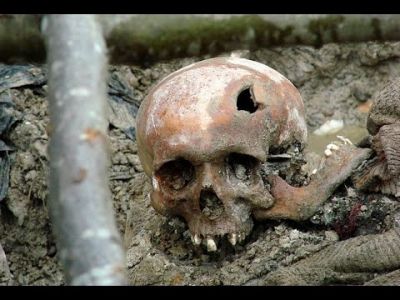
On Saturday, Bosnia marks the 20th anniversary of Europe’s worst mass killing since World War Two - the slaughter of some 8,000 Muslim men and boys by Bosnian Serb forces during five July days in 1995.
Some bodies lay in plain sight on the floor of the forest when Dr Vedo Tuco, a forensic pathologist, entered Srebrenica at the end of the Bosnian war. Others he's still digging for - 20 years later.
"It was so quiet, there wasn't even the sound of the birds," Tuco, 48, said last month as a digger probed for bones in the yard of an empty house. "Once I started, I never stopped."
Tens of thousands of people are expected to attend the commemoration, when the remains of 136 victims recently identified will be interred beneath white marble headstones.
Even now, the forests and farmland around Srebrenica are yielding bones; over 1,000 victims are missing, tossed into pits then dug up months later and scattered in smaller graves by Bosnian Serb forces trying to conceal the crime.
Investigators believe at least one more big grave eludes them, while the accused architects – Bosnian Serb wartime leader Radovan Karadzic and military commander Ratko Mladic – are still standing trial at the United Nations war crimes tribunal in The Hague, fiercely unrepentant.
As such, Srebrenica remains an open wound, the lack of closure a dark shadow over Bosnia, where many Serbs still dispute what went on.
"I found and buried my husband, but have yet to reach my son," said Hajra Catic, whose son Nino was 26 years old when Dutch U.N. peacekeepers abandoned the 'safe haven' of Srebrenica to Mladic on July 11, 1995.
For Muslim Bosniaks, Srebrenica has become a symbol of collective suffering. Serbs see it as a stick for the world to beat them with; many dispute the death toll and deny it was genocide, as the U.N. tribunal has ruled.
Milorad Dodik, president of Bosnia's autonomous Serb Republic, last month called the massacre "the greatest deception of the 20th century".
He and Serbia have enlisted big-power ally Russia to block a British-drafted U.N. Security Council resolution condemning any denial of Srebrenica as genocide. The Council vote was due on Tuesday, but postponed to Wednesday under threat of a Russian veto.
Insisting the resolution would not pass, Serbian Prime Minister Aleksandar Vucic announced on Tuesday that he would attend the anniversary commemoration.

Bütün xəbərlər Facebook səhifəmizdə























 USD
USD
 EUR
EUR
 GBP
GBP
 RUB
RUB