


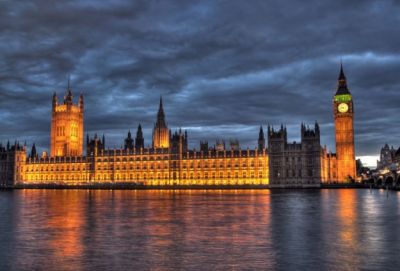
Almost two weeks since Sweden pledged that it would recognize the state of Palestine British lawmakers are to vote on a similar motion - "That this House calls on the government to recognize the state of Palestine alongside the state of Israel."
The non-binding vote was put forward by backbench members of the parliament in April this year, but had been put off until after the summer recess.
Hours after taking office October 3, Sweden's Prime Minister Stefan Lofven announced that his country would recognize the state of Palestine, which was received in Israel with uproar. Foreign Minister Avigdor Liberman criticized the announcement - which was made on the Jewish religious holiday of Yom Kippur - saying it came to compensate for Western failures.
The opposition Labour Party has backed the proposal and instructed its MPs to vote for the motion. This has upset pro-Israel members amongst its ranks, some threatening to defy party orders and not turn up to the vote.
The party has underlined that to pass the motion is in line with party policy, and its position following the United Nations 2012 vote that gave Palestine non-Member Observer State status.
Of the 193-member assembly, 138 members voted in favor, with only nine - Canada, the Czech Republic, Israel, the Marshall Islands, Micronesia, Nauru, Panama, Palau, and the United States - against and 41 abstentions.
Britain and Germany were among those abstained.
Among those who expressed support for the resolution was Turkey's Prime Minister Ahmet Davutoglu - then the Minister for Foreign Affairs - who said for 65 years the whole world, had shut its eyes to the plight of the Palestinian people. During that time, no resolution towards a Palestinian State had been honored.
"The reality of Palestine", he said, "is a bleeding wound in the conscience of all humanity."
Conservative MPs are free to vote on Monday's motion, while the Liberal democrats are mostly in support.
Writing for the blog "Labourlist," shadow Foreign Secretary Douglas Alexander wrote, "Labour believes statehood for the Palestinians is not a gift to be given but a right to be recognized."
He added, "As Labour has argued over recent years, recognition of Palestinian statehood by the international community can be an important contribution to securing a negotiated two state solution."
The move has angered Israeli politicians, especially those in the Israeli Labour party.
The secretary general of Israel's Labor Party Hilik Bar has written to Labour lawmakers asking them to defy the party line.
"I understand why many of you will want to vote for anything which claims to be a contribution to peace… But our view in the Israeli Labour Party is that unilateral recognition of Palestinian statehood does nothing to advance this vital cause," wrote Bar, who is also the deputy speaker of the Knesset (Israel's parliament).
Grahame Morris, a Labour party backbencher, will present the motion to parliament Monday. He told the independent newspaper: "Not only is statehood the inalienable right of the Palestinian people, but recognizing Palestine will breathe new life into a peace process that is at an impasse."
However, it is thought that some Labour party members will introduce an amendment that will add, "contributing towards a negotiated settlement,"
Two of the Labour shadow cabinet members expected to vote against the motion are in the friends of Israel group - Rachel Reeves, shadow secretary of state for work and pensions, and Michael Dugher, shadow minister for the cabinet.
In an unusual move, Labour Leader Ed Miliband will not have to turn up to the vote - but lawmakers that do turn up to vote will be expected to vote for the motion. The move has been interpreted as to avoid Miliband any embarrassment due to senior Labour pro-Israeli MPs voting against the motion.

Bütün xəbərlər Facebook səhifəmizdə





























 USD
USD
 EUR
EUR
 GBP
GBP
 RUB
RUB