


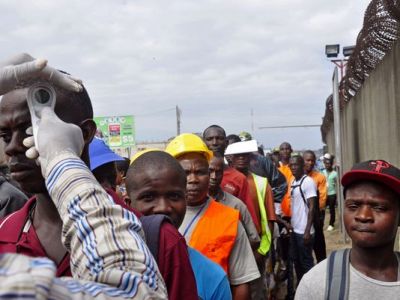
A Spanish priest has received one of the world's few doses of an experimental Ebola drug, raising ethical questions about how to allocate scarce medicines for a fatal disease at at time when the virus has infected at least 1,848 people in West Africa.
The drug, ZMapp, is a mixture of three antibodies engineered to recognize Ebola and bind to infected cells so the immune system can kill them. It hasn't yet been tested in humans.
ZMapp's maker, Mapp Biopharmaceutical of San Diego, has said "very little of the drug is currently available" and that it is cooperating with government agencies to increase production as quickly as possible. The drug — made available on a compassionate use basis — also takes several months to produce, meaning that it will be months before any would be available in large amounts. Anthony Fauci, director of the National Institute of Allergy and Infectious Diseases, has publicly said that he knows of only three or four doses.
Two American aid workers, who were infected with Ebola and flown from Africa to a special unit at Emory University Hospital in Atlanta, also have received doses.
Contrary to what many people believe, the "ultimate decision" for who gets an experimental drug is made by the manufacturer, not the government, says Arthur Caplan, head of the division of medical ethics at New York University's Langone Medical Center. Companies have drastically different policies for making unapproved drugs available, he says.
The World Health Organization scheduled a special meeting Monday to discuss how to ration scarce doses of the drug, and is expected to release a statement Tuesday. There are currently no proven medications or vaccines to treat Ebola, which has killed at least 1,013 people in West Africa, according to WHO officials, although several therapies are in development.
Bütün xəbərlər Facebook səhifəmizdə



























 USD
USD
 EUR
EUR
 GBP
GBP
 RUB
RUB