


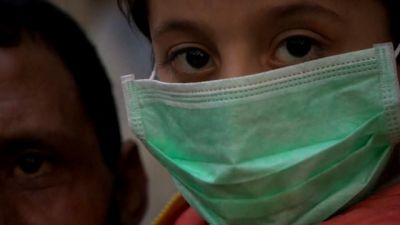
"Please, please take us out, we are dying here," 60-year-old Wafiqa pleads, sobbing uncontrollably as she cradles her lined face in rough gnarled hands.
She stumbles toward us in her grief, toward anyone she thinks can rescue her from the punishing eight-month siege of Yarmouk, a devastated Palestinian refugee camp south of Damascus.
Just behind her, a tide of hundreds of people presses against a security barrier. Armed men struggle to contain a crowd desperate to reach a UN food distribution point at the end of a narrow rutted road that cuts through a desolate wasteland of utter ruin.
"I'm so tired, so tired," one woman cries out.
 Wafiqa: "Please take us out, we are dying here"
It was as if she was a self-appointed spokesperson for the suffering.
So many were in tears - old men bent over in wheelchairs, exhausted women with vacant stares, distraught children of every age. Many show signs of malnutrition.
"We had to eat local herbs boiled with spices," one mother told me. One of her daughters in a pink pushchair was inconsolable. Her little scuffed black patent shoes and a fraying tweed coat may have been the last remnants of a better life lived long ago.
Emotion was so raw it was as if disaster had just struck.
Fragile food deal
And Yarmouk looks like a earthquake zone. Buildings are now shells of gaping holes with jagged slabs of concrete and plaster hanging from the floors. Some are just mounds of rubble.
 Refugees queue for food, but the UN has to struggle to make every delivery
But this is a human catastrophe born of a conflict where food is a weapon of war.
The UN's Relief and Works Agency, Unrwa, which takes care of Palestinian refugees, first secured access to a camp which is now one part of a sprawling suburb, on 18 January. A fragile agreement between Syrian rebel groups and government forces working with Palestinian factions has allowed limited amounts of food and medicine to be distributed, on and off, since then.
The deal means Syrian rebel groups will leave this camp, to be replaced by Palestinian factions allied to the Syrian government.
But with details of sensitive new security arrangements still being negotiated, the UN has had to do battle every day to arrange the delivery of aid. On many days, no food at all has been given out.
The day we enter Yarmouk with the UN after securing permission from the Syrian government, only about 60 food parcels are handed out to men and women who line up, in neat and orderly separate queues.
Behind them, inside blackened buildings, we could make out more queues forming with people shouting and pushing forward. Thousands more people further inside were not even able to reach this narrow opening.
On some days there've been angry protests over the the indignity of being forced to gather in such a cramped area instead of being allowed to go to one of the Unrwa buildings, which are relatively intact, further inside.
'Much more to be done'
 Filippo Grandi: "We hope to reach everyone"
But Unrwa's commissioner-general also came to Yarmouk to deliver a message of hope.
"We will not forget you, the world will not forget you" Filippo Grandi promises the crowd which gathers around him, telling stories of a life which wasn't a life at all.
"We hope to reach everyone if the people who are fighting will allow us," Mr Grandi assures them.
His visit comes just days after the UN Security Council agreed a landmark humanitarian resolution which calls on all sides to lift sieges across the country now entrapping more than a quarter of a million Syrians.
Mr Grandi was carrying a copy of the resolution with him.
"What I have seen and heard today underlines the timeliness of the UN Security Council resolution 2139 on humanitarian access and the need for all sides to implement this resolution. "
He thanks the Syrian government for providing assurances that the access will be maintained and expanded.
"Much more needs to be done, he emphasises, "but this shows good will on behalf of all parties."
 Kiffah: "There is no bread"
UN officials mingle with workers from the Syrian Arab Red Crescent Society which is involved in most aid operations across Syria.
We overhear one visibly moved UN official deep in conversation over a situation "that is against everything of humanity".
Tears of hunger
But if Yarmouk provides a small glimmer of light, it is also a reminder of the dark stubborn realities of war.
The camp, first built as a refuge for Palestinians fleeing the 1948 Arab-Israeli war, became the focus of heavy fighting in late 2012 when armed opposition groups moved in.
 Much of the camp is destroyed
At the start, tens of thousands of Palestinians fled what had been their thriving community, the biggest in Syria, of about 180,000.
But since government forces cut off the rebel held camp in July last year, some 20,000 refugees have been trapped inside, with Syrians among them.
Only a few are managing to escape now.
As we are about to leave, we meet 13-year-old Kiffah waiting with his two little sisters to leave.
He dutifully puts on a brave face, telling me "life is fine, normal".
But then, he mentions "a little hunger," and suddenly bursts into tears. "There was no bread," he cries and then can speak no more.
As we walk out, we see 60-year-old Wafiqa not far behind us. She managed to get out, presumably through a relative with the right contacts.
"I have been taken out of hell," she exclaims as she clutches a piece of bread. "We have been saved from eating grass."
But the mother of five sons, four daughters, and seven grandchildren is still not at peace.
"Three sons are still inside," she laments.
Yarmouk is a small snapshot of a wider war. But it presents the clearest of pictures of overwhelming distress and destruction, and the loudest of messages of the need to find a way out.
(BBC News)
Bütün xəbərlər Facebook səhifəmizdə



















 USD
USD
 EUR
EUR
 GBP
GBP
 RUB
RUB
