


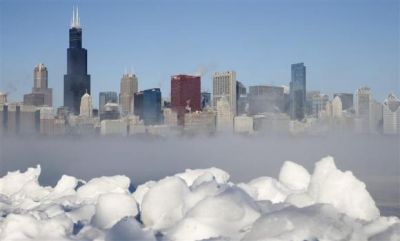
A blast of Arctic air gripped the vast middle of the United States on Monday with the coldest temperatures in two decades causing at least four deaths, forcing businesses and schools to close and canceling thousands of flights.
Shelters for the homeless were overflowing due to the severe cold described by some meteorologists as the "polar vortex" and dubbed by media as the "polar pig."
Temperatures were 20 to 40 degrees Fahrenheit (11 to 22 degrees Celsius) below average in parts of Montana, North and South Dakota, Minnesota, Iowa, Wisconsin, Michigan and Nebraska, according to the National Weather Service.
It was colder in Brimson, Minnesota, where the mercury plunged to minus 40 Fahrenheit (minus 40 Celsius) than in Arctic Bay, Canada, where it was minus 31F (minus 35C).
The U.S. cold snap outdid freezing weather in Almaty, Kazakhstan, where it was minus 8F (minus 22C), Mongolia at minus 10F (minus 23C) and Irkutsk, in Siberia, at minus 27F (minus 33C).
More than half the flights at Chicago's O'Hare International Airport were canceled as fuel supplies froze, leaving crews unable to fill aircraft tanks. The afternoon temperature in Chicago was minus 12F (minus 24C).
The polar vortex, the coldest air in the Northern hemisphere that hovers over the polar region in winter but can be pushed south, was moving toward the East Coast where temperatures were expected to fall into Tuesday.
The coldest temperatures in years and gusty winds were expected as far south as Brownsville, Texas, and central Florida, the National Weather Service said.
The Northeast saw unseasonably mild weather and rain, but authorities warned travelers to expect icy roads and sidewalks on Tuesday.
New York Governor Andrew Cuomo declared a state of emergency, announcing that parts of the New York State Thruway in Western New York would be closed due to extreme winter weather conditions.
At least four weather-related deaths were reported, including a 48-year-old Chicago man who had a heart attack while shoveling snow on Sunday and an elderly woman who was found outside her Indianapolis home early Monday.
In oil fields from Texas to North Dakota and Canada, the severe cold threatened to disrupt traffic, strand wells and interrupt drilling and fracking operations.
It also disrupted grain and livestock shipments throughout the farm belt, curbed meat production at several packing plants and threatened to damage the dormant wheat crop.
In Cleveland, Ohio, where the temperature was minus 3F (minus 19C) and was forecast to drop to minus 6F (minus 21C) overnight, homeless shelters were operating at full capacity. Shelter operators had begun to open overflow facilities to accommodate more than 2,000 people who had come seeking warmth.
"There are also going to be people that won't go into the shelters," said Brian Davis, an organizer with Northeast Ohio Coalition for the Homeless. Frostbite can set in within minutes in such low temperatures, according to experts.
The National Weather Service issued warnings for life-threatening wind chills in western and central North Dakota, with temperatures as low as minus 60F (minus 51C).
(Reuters)

Bütün xəbərlər Facebook səhifəmizdə






























 USD
USD
 EUR
EUR
 GBP
GBP
 RUB
RUB