


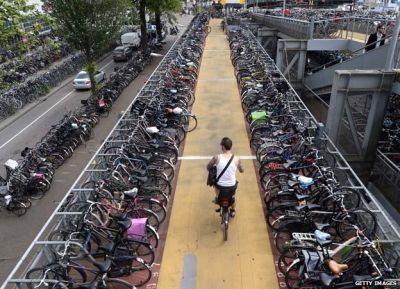
There are more bicycles than residents in The Netherlands and in cities like Amsterdam and The Hague up to 70% of all journeys are made by bike. The BBC's Hague correspondent, Anna Holligan, who rides an omafiets - or "granny style" - bike complete with wicker basket and pedal-back brakes, examines what made everyone get back in the saddle.
Before World War II, journeys in the Netherlands were predominantly made by bike, but in the 1950s and 1960s, as car ownership rocketed, this changed. As in many countries in Europe, roads became increasingly congested and cyclists were squeezed to the kerb.
The jump in car numbers caused a huge rise in the number of deaths on the roads. In 1971 more than 3,000 people were killed by motor vehicles, 450 of them children.
In response a social movement demanding safer cycling conditions for children was formed. Called Stop de Kindermoord (Stop the Child Murder), it took its name from the headline of an article written by journalist Vic Langenhoff whose own child had been killed in a road accident.
he Dutch faith in the reliability and sustainability of the motor vehicle was also shaken by the Middle East oil crisis of 1973, when oil producing countries stopped exports to the US and Western Europe.
These twin pressures helped to persuade the Dutch government to invest in improved cycling infrastructure and Dutch urban planners started to diverge from the car-centric road-building policies being pursued throughout the urbanising West.

Bütün xəbərlər Facebook səhifəmizdə
































 USD
USD
 EUR
EUR
 GBP
GBP
 RUB
RUB