


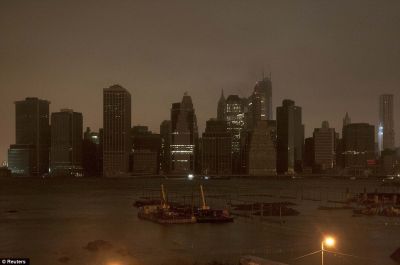
More than 7 million people are without power throughout the eastern U.S. as post-tropical storm Sandy leaves a path of destruction, at least 17 dead, and a record-breaking storm surge that has flooded parts of the Eastern Seaboard, including New York City.
Exact details of the damage caused by Sandy have yet to be determined, but the impact is huge: Seventeen people are dead including one in Canada, millions of people have no electrical power, and a record-breaking four-metre storm surge hit New Jersey and New York City, flooding streets and subway tunnels.
U.S. President Barack Obama has declared a major disaster in New York City and Long Island.
The declaration makes federal funding available to people in the area, which bore the brunt of the sea surge from the superstorm.
Standing along the banks of the Hudson River near Battery Park in Lower Manhattan, CBC's David Common said seven subway tunnels are full of water but the pumping process cannot begin due to power outages. A tunnel from Lower Manhattan to Brooklyn has also filled with water.
"This is really an island cut off right now," Common said.
The Associated Press reported the U.S. deaths happened in New York, New Jersey, Pennsylvania, Connecticut, Maryland, North Carolina and West Virginia. Three of the dead were children, including an eight-year-old.
The cause of death was not immediately clear in most cases, but Reuters reported that at least two of the deaths were in Queens, New York. One man died when a tree hit a house, and a woman died in the same borough after stepping in an electrified puddle.
Meanwhile, a woman in Toronto was killed by a falling sign that came apart in high winds.
After days of dire forecasts, warnings and mass evacuations in coastal areas, Sandy came ashore near Atlantic City, N.J., around 8 p.m. ET. Environment Canada said the storm's effects were felt as far as 1,000 kilometres away.
As of 5 a.m. ET Tuesday, the storm was approximately 145 kilometres west of Philadelphia, the U.S. National Weather Service said.

"Standing water combined with downed power lines will pose a threat for the coast, heavy rain across the northeast will bring the risk of flooding and west of the Appalachians heavy snow will continue to fall in places like West Virginia," CBC meteorologist Jay Scotland said.

The remnants of Sandy are expected to move to the west-northwest and then turn north into New York state Tuesday night. The storm's centre is expected to move into Canada on Wednesday.
Environment Canada said Sandy was expected to weaken "very rapidly" as it moves toward the eastern Great Lakes.

U.S. forecasters warned there was still potential for six-metre waves bashing into the Chicago lakefront and up to 90 centimetres of snow in West Virginia.
Bütün xəbərlər Facebook səhifəmizdə





























 USD
USD
 EUR
EUR
 GBP
GBP
 RUB
RUB