


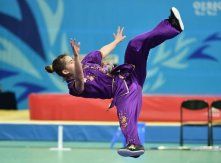
Asian Games organisers on Tuesday expelled Malaysia's wushu gold medal-winner Tai Cheau Xuen after she failed a drug test, becoming the tournament's third doping case.
Tai, 24, was tested after winning the Chinese martial art's women's nanquan and nandao all-round event on September 20, Malaysia's first gold medal of the Games.
She was found to have taken the stimulant sibutramine, the Olympic Council of Asia (OCA) said in a statement. The Asian Games involves 9,500 athletes from across the region.
"The competitor has been disqualified from the competition as well as these Games, and as such her accreditation cancelled and her medal withdrawn," said the statement.
The official announcement of the failed test was delayed because Tai and the Malaysian Olympic Committee had asked for the B-sample to be examined, officials said.
A Tajik footballer, Khurshed Beknazarov, and a Cambodian soft tennis player have already been expelled for failing tests.
Nineteen-year-old Cambodia Yi Sophany was also found to have taken sibutramine, which is widely used as a dietary supplement to control weight.
About 1,900 doping tests will be carried out on the Asian Games athletes, according to the OCA medical committee chairman M. Jegathesan. According to Jegathesan, there are three kinds of doping failures.
There are the "hard-core" cheats who deliberately take the "magic pill" because they think it will help them to win. There are competitors who are pushed into doping by their coaches. And there are athletes who get caught through "ignorance" just by taking medicines and diet treatments.

Bütün xəbərlər Facebook səhifəmizdə

































 USD
USD
 EUR
EUR
 GBP
GBP
 RUB
RUB