


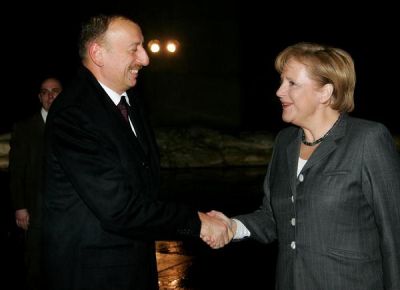
The New Europe newspaper publishes an article about a visit of President of Azerbaijan Ilham Aliyev to Germany and attendance at the Davos Forum.
According to the article, President Ilham Aliyev discussed with German Chancellor Angela Merkel and members of the country’s Bundestag Azerbaijan’s leading role in the South Caucasus. Merkel told Aliyev that Azerbaijan deserves the dialogue as the equals and strategic partners, probably in the format of legally binding strategic agreement or something of that nature.
In her turn German Cancellor Angela Merkel shared Azerbaijan’s concerns about regional security, reiterating her support to Azerbaijan’s territorial integrity and commended the country’s ability to withstand pressures, ensure sovereignty, and forge closer ties with Europe. On that note, Merkel voiced Germany’s perception that Armenia and Russia have sort of the same and common position on regional security and other matters.
On the backdrop of the Ukrainian crisis, Merkel and Aliyev discussed Azerbaijan’s role in the fight against terrorism and creating an equal partnership with Baku. Traditionally Muslim, Azerbaijan has been a predictable, multi-cultural and stable partner for the EU in the region.
Azerbaijan’s very friendly and honest foreign policy towards the EU is manifested in high-level visits and deep straightforward discussions held in the European capitals and conferences.
Merkel also hailed the role of Azerbaijan in European energy security and expressed support for the Southern Gas Corridor project.
SIA presents the article :
Azerbaijan’s President Ilham Aliyev propelled EU-Azerbaijan dialogue during his trips to Berlin and Davos this week.
Aliyev discussed with German Chancellor Angela Merkel and members of the country’s Bundestag Azerbaijan’s leading role in the South Caucasus. Merkel told Aliyev that Azerbaijan deserves the dialogue as the equals and strategic partners, probably in the format of legally binding strategic agreement or something of that nature.
Merkel shared Azerbaijan’s concerns about regional security, reiterating her support to Azerbaijan’s territorial integrity and commended the country’s ability to withstand pressures, ensure sovereignty, and forge closer ties with Europe. On that note, Merkel voiced Germany’s perception that Armenia and Russia have sort of the same and common position on regional security and other matters.
On the backdrop of the Ukrainian crisis, Merkel and Aliyev discussed Azerbaijan’s role in the fight against terrorism and creating an equal partnership with Baku. Traditionally Muslim, Azerbaijan has been a predictable, multi-cultural and stable partner for the EU in the region.
Azerbaijan’s very friendly and honest foreign policy towards the EU is manifested in high-level visits and deep straightforward discussions held in the European capitals and conferences.
Merkel also hailed the role of Azerbaijan in European energy security and expressed support for the Southern Gas Corridor project.
Aliyev said that the projects initiated by the Azerbaijani side change the energy map of Europe, boosting energy security.
"The TANAP project started in 2012 and the TAP project was selected in 2013 as a main export route, and late last year the foundation for the Southern Gas Corridor was laid. Azerbaijan is the initiator of all these projects. At the same time, Azerbaijan undertakes large financial commitments for the implementation of these projects," Aliyev said.
The president expressed confidence that all the work will be done in a timely manner.
"The TANAP project will be realised in 2018, and TAP a year after it. In order to achieve this, of course, it is needed to have closer cooperation in this area between Azerbaijan and the EU," he said.
Merkel voiced Germany’s unequivocal support to the project and Azerbaijan’s instrumental role in enabling Azerbaijani and even larger, other Caspian gas supplies to Europe.
Aliyev’s trip to Europe continued in Davos, where he talked about contribution to Europe’s security of energy supplies, about challenges of transition period and efforts to build a modern secular society in Azerbaijan, and even frankly admitting that if oil prices continue to fall or last like this for some years, there would be an advantage to seek rather than get upset about low income – that is, Azerbaijan should learn to live with low oil prices and needs to diversify its economy. The good news is, Aliyev said, that Azerbaijan had already started to do so. This country has started investing in IT, agro-business, tourism, and even abroad, in Europe.
Azerbaijan also transformed its image as a beneficiary of foreign assistance and turned into an emerging donour country with activities in Africa and Asia for the least developed countries.
The conflict between Russia and Ukraine has implications for Eurasia, especially, for countries that rely on remittances from their citizens working in those countries. Russia and Ukraine’s shrinking economies will result in economic slowdown for other Eurasian countries as well.
"Russia is a good friend and reliable trading partner of Azerbaijan. Our cooperation is an indicator of how relations between a big and a small partner can be managed," Aliyev said. Azerbaijan and Kazakhstan also value their partnership with the EU from an economic and political perspective. In this sense, Eurasia can function as a bridge that is more than just geographic between its Russian and European neighbours.
"A good balance between investment in infrastructure and maintaining foreign reserves must be found," Aliyev said.

Bütün xəbərlər Facebook səhifəmizdə





















 USD
USD
 EUR
EUR
 GBP
GBP
 RUB
RUB