


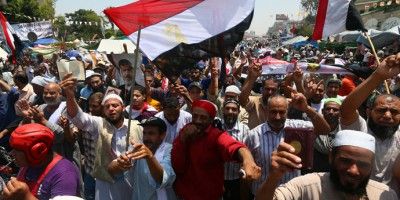
Egypt, one of the largest countries of the Middle East, is going through turmoil, and with no signs of subsiding the situation is beyond prediction. It is safe to say that preconditions are not there yet while indifference of the West can be related to various realities within Egypt’s domestic and regional position.
Democracy or security interests?
There is no doubt that ousting of Egypt’s democratically elected President Mohammed Mursi’s was literally a military coup. Responding to public rallies demanding Mursi’s resignation the military deposed the president and appointed an interim one instead. This was a consequence of certain steps taken by Mursi during his tenure as a President and structural problems that persisted in Egypt.
Notable aspect is the international reaction to the developments in the country, let alone their consistency with Mursi’s interests. With the exception of the African Union that suspended Egypt’s membership and Turkey that referred to the developments as a military coup, the U.S., EU and even UN had failed to express adequate position. Taken into account West’s self-proclaimed notion of democracy and respective norms, its unwillingness to recognize the events as a military coup evokes astonishment and interest, to say the least.
Reaction of the U.S. is particularly noteworthy. While being indifferent to the ousting of Mursi, the U.S. has merely displayed optimism with regard to the "Constitutional declaration envisaging return to the democratically elected governance and holding of new Presidential and Parliamentary elections". In the meantime, State Department spokesman had already said that Mursi was not the President: "Egyptian people have spoken… there is an interim government in place". Some observers believe that reluctance to identify the events in Egypt as a coup has to do with 1.3 billion USD military aid pledged to the Egyptian army, whereas U.S. law prohibits assistance to countries where coup takes place. Considering the current situation in the Middle East, military of Egypt, one of the U.S. allies in the region, heavily relies on such an aid for fulfillment of its duties.
Reaction of the White House spokesman Jay Carney to the military coup helps explain U.S.’s true intentions: "It’s a complex and difficult situation and what we do not believe is necessary is to hastily reach a determination…Our objective is to aid the Egyptian people in democratic transition and to uphold our commitment to national security interests". This statement clearly articulates U.S.’s position.
What are the U.S. national security interests in the ongoing processes? Its commonly known that the U.S. did not support the popular protest against Mubarak in 2011 and only called for him to step down once the opposition’s victory was deemed imminent. U.S. did not oppose the election of the "Muslim Brotherhood" candidate Mohammed Mursi as a President. Because the army, power that the U.S. relied upon, retained its dominance and leverage capability over the processes, and eventually stepped in when needed. It is an indication that as long as army maintains its position within the country U.S. will refrain from interfering into Egypt’s domestic affairs.
According to renowned U.S. analyst George Friedman, Peace Treaty of 1979, signed between Egypt and Israel, remains as a cornerstone of the balance of power in the region. As a result, Sinai Peninsula became a demilitarized buffer zone between the two countries. Elimination of the possibility of Egypt attacking Israel has nullified chances of relatively weaker Arab states to launch an offensive against Israel. Egypt’s military essentially safeguards the very balance. It is not surprising that once the U.S. announced its intention to revisit the issue of providing assistance to Egyptian military, Israel’s "Haaretz" newspaper published an article. According to it, Israeli government informed the U.S. Administration that halting of assistance would exacerbate the situation in Egypt, ultimately jeopardizing Israel’s security.
There is some suspicion that the U.S. may have played a role in the military coup. "Al-Jazeera" channel claims that the U.S. financially supported opposition forces that sought to overthrow the government through State Department’s "Democracy support initiative". This assistance was allegedly channeled to Egyptian NGO’s through the National Republican Institute, the National Democratic Institute, the Freedom House and others. This had to be the reason why in June the Cairo court banned 5 foreign NGO’s in the country, including the ones mentioned above (See:"Exclusive: US bankrolled anti-Morsi activists",http://www.aljazeera.com/indepth/features/2013/07).
Inconsistency of the "Muslim Brotherhood" government that chose political Islam as its ideology with the U.S. interests was inevitable. Aspirations of the organization to turn Egypt into a Muslim state, its position on the Palestinian issue and statements calling to revisit existing peace treaty with Israel ran counter to the U.S. interests.
What is next for Egypt?
Experts suggest two reasons for Mursi’s ouster. First, efforts of Mursi, in his one year in office, to consolidate his power and to replace the fundamental principles of secularism of the Egyptian state with the Islamic ones. Second and the biggest reason is the failure of Mursi to address Egypt’s dire social-economic situation. For fairness sake, it has to be emphasized that it was not feasible for Mursi to address grievances that accumulated for years and it would have taken much longer for him to succeed.
Interim government currently being formed is charged with facilitation of the next presidential and parliamentary elections and stabilization of the internal situation in the country. All the political parties were invited to form a new government. "Muslim Brotherhood" rejected the offer and remains defiant to reinstate their legitimate authority. Although their peaceful demonstrations are accompanied with clashes, without external intervention this standoff is less likely to turn into a civil war. The army controls the situation while the "Muslim Brotherhood" lacks substantial resources for critical confrontation.
The fate of the new forces to come to power in Egypt will largely depend on their ability to deliver on the social-economic front and to meet the demands of the masses. 12 billion USD aid pledged by Saudi Arabia, UAE and Kuwait who shared concerns with the "Brotherhood" led government’s agenda, will certainly alleviate the situation. However, Egypt’s problems are of a structural nature that requires longer time to solve. Therefore, it is difficult to predict that upcoming elections will bring stability to Egypt.
Albeit President Obama said that the U.S. is willing to reconsider the issue of assistance to Egypt’s military it is nothing more than an appearance. The continuation of assistance is more than likely because by far the Egyptian army is the only player capable of controlling internal situation and leveraging the impact the potential domestic changes may have upon the international policy of the country.
Developments in Egypt lead us to key conclusion. In the world, there is no unequivocal approach to such notions as democracy and human rights and freedoms. In most cases, global powers handle the events and processes in line with their interests and aim to impose their will upon the rest of the world. However, when faced with certain facts such as the military coup in Egypt, no other way is left than to admit it.
Elmar Huseynov

Bütün xəbərlər Facebook səhifəmizdə























 USD
USD
 EUR
EUR
 GBP
GBP
 RUB
RUB