


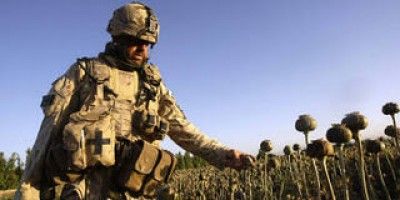
The focus of imperial ambitions for nearly 2,500 years, Afghanistan is one of the poorest countries in the world, SIA reports citing New Times. The country`s main export products include poppy (opium), wool, carpets, cotton, and precious and semi-precious stones. Afghanistan also accounts for 90 per cent of global opium poppy supply (main raw material for making heroin).
Located at the crossroads of civilizations in the Old World for centuries, Afghanistan then became the focus of attention of emerging powers of the New World. In the 4th century B.C. Alexander the Great with his 200,000-strong army carried out a brief expedition to what is now Afghanistan. Henceforth the country achieved fame as home to poppy and hashish.
Modern-day Afghanistan has retained this feature. Before the Soviet invasion in 1979 Afghanistan was a backward agrarian country that was supplying opium to the global marketplace. The war with the USSR saw opium production in Afghanistan rise as Mujahideen were using revenues from its sale to buy weapons. Between 1982-1989 opium production grew from 225 tons to 1,200 tons in the country, which was a major battlefield in the Cold War.
Taliban`s coming to power in 1996 marked a boom in opium production. Soon after, the Taliban leadership declared that growing opium was un-Islamic, resulting in one of the world's most successful anti-drug campaigns. However, international pressure also played an important role in forcing Talibs to eliminate poppy cultivation.
According to Fariba Nawa, an afghan journalist and the author of "Opium Nation: Child Brides, Drug Lords, and One Woman's Journey Through Afghanistan" book, this was done as Taliban needed to artificially boost the value of opium.
After the invasion of NATO forces of the region in 2001 Afghanistan became the largest illicit poppy producer on a global scale. Analysts says the international troops were soft on the country`s poppy growing industry in order to avoid conflict with local farmers. Farmers prefer cultivating poppy blaming a lack of government support, poverty and "desire to earn much from a small land" for this.
Opium is 10 times profitable to cultivate than other plants. Afghan farmers tend to produce opium in order to solve their financial problems. According to Opium Survey 2012 of the United Nations Office on Drugs and Crime, potential net export value of opiates made $2.4 billion dollars in Afghanistan, which accounts for 15 per cent of the country`s Gross Domestic Product.
In 2009, the USA in partnership with the British and Danish governments launched Hilmand Food Zone Project (HFZP) to encourage cultivation of saffron in Afghanistan. Haji Akbar, formerly engaged in poppy cultivation, was a pioneer in planting saffron in Afghanistan. Famously known as ‘The Father of Saffron’, he mastered saffron growing in Iran. This resulted in the expansion of saffron cultivation in Afghanistan. Local farmers started to earn nearly $6,000 from 2,000 square meters of a saffron farm, while the profit from a poppy farm of the same size was $2,500-4,000.
However, this was not that effective against poppy cultivation. Not all regions of Afghanistan have favorable conditions for growing saffron. Local farmers say the government has not remained committed to its promise to allocate funding for saffron-growing industry. For farmers, poppy buyers are much more reliable because they collect the harvest themselves and even pay in advance.
The major part of NATO`s 110,000-strong military personnel in Afghanistan is expected to be pulled out by 2014. According to Jean-Luc Lemahieu, country representative of the UN Office on Drugs and Crime in Afghanistan, the fight against poppy cultivation in Afghanistan can take long because of political problems and massive corruption in the country.
David Mansfield, a researcher and consultant for the European Commission and the World Bank, says the U.S.`s strategy in Afghanistan is to break up the opium problem to withdraw from the country on a positive tone. Therefore, the U.S. is using military to force provincial leaders to eradicate poppy cultivation. Although drug police is making some successes, they are facing a growing number of attacks. Official figures show that 102 Afghan soldiers, police officers and civilians died from attacks by farmers, drug traffickers and Taliban insurgents during the 2012 poppy eradication campaign. Carried out regardless of a UN program, this eradication campaign continues to cause people`s discontent. And this will definitely have its impact on the presidential elections in 2014.
Despite the war launched in 2001, Afghanistan`s GDP stood at 9 per cent. According to the World Bank, the country will see a slowdown of its GDP growth to a range of 4–6 percent annually in 2011-2018. This will be caused primarily by cuts in international assistance because the closure of military bases eliminates any need for big security spending. Foreign countries came up with pledges of $16 billion in development aid to Afghanistan. From 2002-2011, the country received $85 billion in foreign assistance, with 90 per cent of this sum provided by the United States.
Viktor Ivanov, head of Russia's Federal Drug Control Service, said Afghanistan was the greatest threat to Russia in terms of drug trafficking. According to him, drugs production in Afghanistan has increased 40 times since NATO began its ‘War on Terror’ in 2001. The volume of drugs produced in Afghanistan is so great that the country can supply only 30 per cent of its drugs to world markets. Russian analysts say that Russia`s Iranian and Turkmen border with Afghanistan are well protected. They believe the most part of opium entering Russia is smuggled over Tajikistan. So, according to analytics, the only way to solve the problem is that Russia should deploy military to its Afghan-Tajik border after the NATO forces pull out from Afghanistan.
One of the drug trafficking routes from Afghanistan lies through the occupied Nagorno-Karabakh region. Azerbaijan has repeatedly applied to international organizations to include the drug trafficking route through the Nagorno-Karabakh in their reports, but they have been useless. Such indifference on an international scale and the delay in the conflict`s resolution pave the way for the Nagorno-Karabakh to become Afghanistan of the region.
Historic experience shows that drug trafficking and opium production boom during military conflicts. Some analytics say foreign military forces do not pay proper attention to borders, which paves the way for drug trafficking. It seems that Afghanistan`s being home to drugs is in the interests of all powers. But it is humanity that suffers the most.
Ramil Taghıyev

Bütün xəbərlər Facebook səhifəmizdə





















 USD
USD
 EUR
EUR
 GBP
GBP
 RUB
RUB