


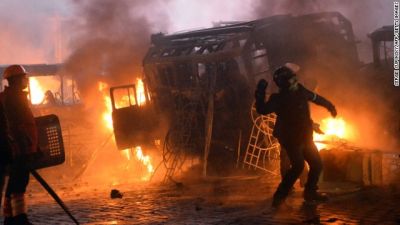
A protester demonstrating against new laws limiting the right to protest was reportedly shot and killed in Ukraine's capital, Kiev, on Wednesday morning.
The medical service of the Ukraine protest movement told CNN about the death. And Ukraine's Interior Ministry said it has been notified of one fatality. It said an investigation will be launched into the case.
Demonstrators have been rallying in the snowy streets since the weekend in protest against the laws that came into effect Wednesday.
Televised images Wednesday showed ongoing clashes between police and protesters who've massed around barricades on Hrushevskoho Street, near the burned-out shells of police buses.
The clashes are an escalation of weeks of largely peaceful public protests prompted by President Viktor Yanukovych's decision in November to spurn a planned trade deal with the European Union and turn toward Russia instead.
The U.S. ambassador to Ukraine, Michael McFaul, tweeted Wednesday that he was "watching with sadness" the events in Kiev.
The U.S. Embassy in Kiev said in a statement that it has "revoked the visas of several Ukrainians who were linked to the violence" in response to actions taken against protesters in November and December.
"Because visa records are confidential under U.S. law the Embassy will not comment on individual cases," it said. "We are considering further action against those responsible for the current violence."
Masks, helmets banned
On Tuesday, the Interior Ministry said more than 30 protesters had been detained and 119 police officers injured since Sunday afternoon, when the violence began.
The controversial new protest laws have sparked concerns they could be used to put down demonstrations and deny people the right to free speech.
They include provisions barring people from wearing helmets and masks to rallies, from setting up tents or sound equipment without prior police permission, and from traveling in convoys of more than five vehicles without authorization.
Opposition politicians have objected to the way that lawmakers loyal to the pro-Russian Yanukovych pushed the legislation through parliament last week by a show of hands.
A separate Interior Ministry order allowing riot police to use firearms came into force Tuesday, according to the official Ukrainian legislation website.
'Out of control'
U.N. High Commissioner for Human Rights Navi Pillay on Tuesday described the violent clashes in Kiev as "very worrying" and said there was an urgent need for dialogue to avoid an escalation of violence.
Pillay also called on the government to suspend implementation of the new protest laws so they can be reviewed. "I am particularly concerned by the potential that these laws have to curtail the right to freedom of expression and freedom of assembly, the right to information, the right of civil society to work freely," she said.
Russian Foreign Minister Sergey Lavrov warned that the situation in Ukraine was "getting out of control" and urged dialogue between all the parties.
Yanukovych's official website said Tuesday that a newly formed government working group had met to discuss the political crisis.
Opposition leader Vitali Klitschko, on his UDAR party's website, called on Yanukovych personally to take part in talks and said the opposition would hold a "founding meeting of the People's Council" on Wednesday.
Ukraine's future ties
In December, despite weeks of protest by anti-government demonstrators, Yanukovych agreed to a deal with Russian President Vladimir Putin for Moscow to buy Ukrainian debt and slash the price Kiev pays for its gas.
The tumult in Ukraine goes to the heart of its future ties with Russia and the rest of Europe. Ukraine is split between pro-European regions in the west and a more Russia-oriented east.
The protests have unfolded since November 21, when Yanukovych changed his stance on the EU trade pact, which had been years in the making.
The demonstrators say an EU agreement would open borders to trade and set the stage for modernization and inclusion. Ukraine's government says the terms needed to be renegotiated to protect Ukrainians better.
(CNN News)

Bütün xəbərlər Facebook səhifəmizdə



























 USD
USD
 EUR
EUR
 GBP
GBP
 RUB
RUB