


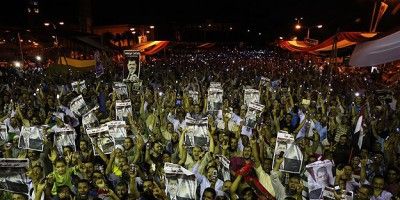
Cairo remains the epicenter of bloody clashes. Speculations circulate on the involvement of foreign countries in the events while religious fractions based in the country are also fueling the tensions. However, one fact is clear - Egypt impacts the situation in all the regional countries. Projections regarding its geopolitical outcome are made but more dangerously, it is the society that becomes ever closer to a political division.
Dangerous games: tensions run high
Clashes continue in Egypt and so does the rise of a death toll among civilians. By various estimates some 3500 Egyptians have lost their lives. Notwithstanding, politicians remain defiant. Those behind the ouster of Mohamed Morsi are resorting to harsh and violent means while "Muslim Brotherhood'' supporters remain defiant. In the meantime, the big geopolitical powers are attempting to pursue plans of their own. Therefore, the situation in the country is extremely sensitive and complexity is only growing.
Official Cairo continues to exclude Morsi’s supporters. Arrests are conducted in every corner of the country and various means of pressure are employed. M.Morsi himself faces new charges. He is indicted of organizing unrest and actions that lead to human casualties, whereas H. Mubarak is said to be released soon.
Interestingly, regional countries are demonstrating various reactions to developments in Egypt. Saudi Arabia’s Foreign Minister announced that wealthy Arab and Muslim states strand ready to aid Egypt in case the West decides to halt assistance to Cairo (See: Suudi Arabistan: Arap ulkeleri Misir’a yardima hazir // www.dunya.bugun.com.tr, 19 August 2013). Positions of Qatar and Turkey are somewhat different. They consider Morsi a legitimate President and accuse the new Egyptian authorities of forcible takeover.
It must be said that official Cairo responded to Turkey’s position. Egypt’s new Foreign Minister accused Ankara of animosity. Some media outlets even claim that Egypt’s Interim President Adly Mansour had twitted about possible recognition of "Armenian genocide'' by his country. Although claims were not officially verified, it nevertheless signifies tensions in Turkey-Egypt relations.
Citing "New York Times'' Turkey’s "Milliyet'' newspaper reported about significant influence of Israel on the situation in Egypt (See: Misirda butun ipler o ulkenin elinde // www.dunya.milliyet.com.tr, 19 August, 2013). Allegedly, Tel-Aviv assured General Sisi that Israel would prevent America from imposing sanctions on Egypt. According to experts, owing to those assurances, incumbent Egyptian authorities feel emboldened to kill innocent civilians.
European Union has its own position on the events in Egypt. This organization is gearing up to impose some sanctions against official Cairo. UK’s Foreign Secretary William Hague already announced a halt to several military contracts with Egypt. He denounced forcible takeover of power but stopped short of rejecting Egypt’s new authorities.
Experts highlight the fact that recent processes around Egypt impact the geopolitical landscape of the region, referring to it as "crisis policy'' (See: Египет: геополитика кризиса // "Publico.es'' (Spain), 19 August, 2013). Such an approach recognizes correlation of developments in Egypt and global geopolitics. According to N. Armaniyan, someone of Armenian descent, Iran gained from the events in Egypt while Turkey had lost (See: previous source). Surely, we are aware of Armenians’ enmity to Turkey, however, an article published by European media outlet attests to concrete interests of the West. What are those interests?
Target of geopolitics: is Islamic world being split?
Apparently, some quarters are attempting to bring havoc, war, chaos and strife to the Muslim world in general. They remained idle when legitimate President of Egypt was overthrown. The West was silent. Now they deliberate on some sanctions against the perpetrators of the coup. In both cases, they are acting against Egypt’s statehood. According to experts’ estimates, Egypt’s economy, once worth 260 billion USD is now crumbling.
Another aspect concerns the efforts to unseat the governments in the Muslim countries not by means of elections but through confrontation, intrigue and discord. Thus, social-economic growth is obstructed in a vast geopolitical space while Muslims are portrayed as antidemocratic. Naturally, big geopolitical powers will aim to benefit from the situation.
The aforementioned appears perilous in light of denominations clash in Egypt. Some countries, especially those of the North Africa, have already shared their concern with possible strengthening of Al-Qaeda in Egypt. The point is that Al-Qaeda is trying to seize the moment for gaining power. And terror is its main tool of choice. Therefore, terrorism is feared to become more rampant.
In this context, Western media report on attacks on Shia Muslims and Christians, specifically against the churches in the country. Thus, events in Egypt are portrayed from such an angle to make an impression of being dangerous for the Christians. At present, "Muslim Brotherhood'' continues the resistance. General Sisi in turn, is targeting its entire organizational structure. Experts believe that largely, the motives are to diminish to a minimum the position of political Islam in the Muslim countries (See: Gokturk Tuysuzoglu. Misir’daki darbe neden mesurlastirilmaya calisiliyor? // www.blog.milliyet.com.tr, 18 August, 2013).
This method is chosen to ebb the political-ideological revival in the Islamic world happening in recent years. The objective is to show that democratic state is only viable if conceived based on a Western-Christian model. Consequently, Muslim states are dragged into chaos one after another. Their growth potential is undermined and they succumb to recession. Projections are made that chaos in the Middle East is there to stay which makes sustainable development inconceivable.
Along with other factors, developments in Egypt are also a test of democracy. Admittedly, they are many flaws there. But ultimately, Western countries failed to preserve democracy in Egypt; ideological factor hampered their act. Bearing that in mind, no other country in the world is insured from a similar attitude.
The course of the processes demonstrates that Egypt is sliding towards a civil war. Political groups are far from talking peace and reconciliation, while confrontation may potentially engulf entire country. It is thought-provoking that no substantial actions are taken to prevent the development of events in that direction.
Possible sanctions to be imposed by the West are not hampering the process as they are mere declarations of commitment to democracy. Besides, regional countries lack unanimous position on Egypt. Moreover, actions of the official Cairo reveal possibility of deepening rift among the Muslim countries. Once aspiring to unite, the Muslim world today faces the danger of fragmentation.
Events in Egypt also prove that societies with presence of radical religious groups are fertile grounds for external powers to sow intrigue – a testament to the need to exercise caution when dealing with religious issues. Introduction of "Al-Qaida'', "Al-Nusra'', "Hezbollah'', "Muslim Brotherhood'' and other organizations of religious substance into politics is associated with contradictions. The conclusion one may come to when assessing the events on the streets of Cairo is that they are connected with some deeply-entrenched factors.
Newtimes.az
Bütün xəbərlər Facebook səhifəmizdə




















 USD
USD
 EUR
EUR
 GBP
GBP
 RUB
RUB