


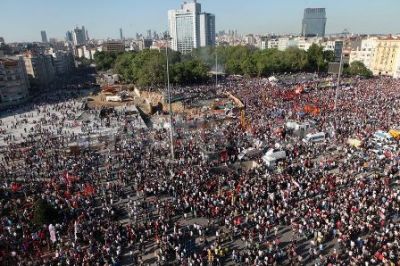
It has already been two weeks that one of Istanbul’s oldest squares makes the international media headlines. Started as a protest against the cutting of some trees the process is now acquiring complex nature. True motives and the stakeholders are becoming difficult to determine. What is actually happening in Turkey?
Spark causes the fire
Interest of the global media towards the developments in Turkey is not accidental. Initially described as resentment against the plans to cut limited number of trees in the Taksim Square, the essence of the protests has changed. There are differing opinions regarding the true motives behind the protest movement that has engulfed several large cities of the country. Therefore, views of the media are quite noteworthy.
"Gezi park protest" - the very title of the events is thought-provoking. Protesters claim to care about the environment. Instead, portraits of the Leftist individuals, terrorist symbols and extreme rhetoric prevails in the "Taksim Square" events. Apparently is has nothing to do with plans to cut some trees. "Environmentalists" destroy private property, offices and government buildings. They have totally dismantled the sidewalk around the Prime Minister’s office in Ankara. Protesters consider entering the mosques with shoes, drinking alcohol and insulting the staff as a manifestation of freedom. Although trumpeting about democracy, they deny the rights of those with opposite views.
Moreover, there are controversial aspects that cannot be dismissed. Those aspects imply irrelevance of the protests. Authorities allowed mistakes of their own, with incidents incompatible with democratic governance. There are thousands of Turkish citizens that joined the protests with honest intentions. In other words, Taksim did not "explode" by chance. However, it is extremely crucial for every Turk to realize that there are forces ready to capitalize of this movement and direct it against the statehood and development. This is the real threat.
Approaching the issue from the aspect of geopolitical processes may prove to be useful. Very serious political developments are taking place in the Middle East as distinct perturbations lead to armed clashes in the later stages. Use of "Molotov cocktails" against the police in the Taksim Square was registered. Investigations revealed that the members of the Social-Democratic Party (SDP) were to blame. However, social media claimed that it was the police responsible for the use of the "cocktails" - a hint that certain quarters are interested in fomenting armed conflict in Turkey.
Another intriguing development is the negotiations held between the government and the protesters. Official Ankara is aware of the risk of losing control over the situation and Erdogan spoke on this issue on several occasions. According to him, the main objective in the processes is the undermining of Turkey’s dynamically growing economy. The protests are said to have cost the Turkey’s economy some 40 billion USD. Tourism sector is already slowing down.
There is logic to underpin the government’s claims about the obstruction of the economic growth. Turkey has repaid its entire foreign debt and emerged as a country capable of providing assistance to international organizations. Moreover, Turkey’s growing international and regional prominence is beyond doubt. Therefore, Taksim events may possibly target Turkey’s economy.
Impact of global geopolitical interests
Another aspect that deserves consideration is the timing of the events in Turkey – run up to the Geneva Convention on Syria. Turkey is heavily involved with preparations without concealing its ability to make its voice heard and leverage the final decision. The matter is discussed among the most powerful countries. Are there some, interested in weakening Turkey’s position in Geneva? Yes. Taksim events appear as a message to Turkey that reads "we can disturb your domestic situation". Sharp ideological confrontation in Turkey is also something that must be taken into account. Proponents of "secularism" reject the government’s policies. There are different views with respect to such processes as the "Ergenekon trials" and the "Kurdish opening". This has led to escalation of resentment. Now, the displeased have the opportunity to manifest their protest, and it is particularly evident in the behavior of certain political parties.
Republican People’s Party (CHP) is rumored to have started the processes. Allegedly, Peace and Democracy Party (BDP) with explicit sympathy towards the PKK (Kurdistan Workers’ Party) was also involved. The leftists are noticeably enthusiastic. With looming elections, such course of developments indicates the possibility of appearance of certain sensitive aspects. It is beyond doubt that some political groups will seek to capitalize on the situation for political gains.
Interestingly, Western media believes that Erdogan is already using the protests as the election campaign. Western experts believe that Erdogan is playing with fire accusing the foreign banks in stirring up things in Turkey by saying the country faces the "interest rate lobby". U.S. based "Wall Street Journal" published an article called "Turkish Premier Takes His Fight to The Capital Markets". It claims that the government puts investors against each other while analyst Christian Keller believes Erdogan was able to suppress the protesters at risk of undermining the confidence towards Turkey (see "Uzmanlar uyardi: "Gosteriler devam ederse…" // "Milliyet" newspaper, 11 June, 2013).
The aforementioned only attests to the ambiguous nature of the events. Grievances of the society accumulated for years, supplemented with intentions of foreign quarters to make the best of the situation, aggravate the matters further. Even Armenians started raving talks about some sort of "memorial tombs" in Taksim while the Armenian experts rejoiced, claiming "developments in the region were favorable for Armenia".
European Union is also seeking to reap economic dividends. Apparently, certain Western quarters are troubled with Turkey’s perseverance against the backdrop of world financial-economic crisis. They are unable to grasp a dynamically growing Muslim country at Europe’s doorstep. Russia and Iran also would not mind a weakened position of a contender for global leadership. As far as Iran is concerned, there is no doubt that uncertainty in Turkey would help contain the situation in Iran.
The reality is that social-economic and political sensitivity of the situation in Turkey is only growing. The exacerbation of the situation affected by the intertwinement of social-economic factors and global geopolitical aspects is evident. Therefore, true essence of Taksim events are yet to be known as the "Gezi park" developments are difficult to explain just in the context of domestic Turkish politics. The time puts things in proper perspective.
Newtimes.az

Bütün xəbərlər Facebook səhifəmizdə
















 USD
USD
 EUR
EUR
 GBP
GBP
 RUB
RUB