


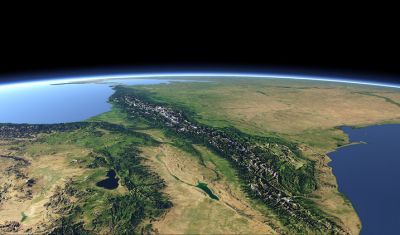
The Caucasian region holds a prominent place in the global politics. There is a curious ratio between the interests of the great geopolitical powers and the foreign policy conducted by the regional states. In the dimension of new geopolitical realities attention is now riveted to the forecasts regarding the geopolitical future of the region.
The role of the Caucasus in the new geopolitical reality
Turkey’s International Politics Academy had published an interesting analytical article by Dr. Gokturk Tuysuzoglu named "The breaking point of the system – the Caucasus". The author had reviewed the ongoing geopolitical processes from the perspective of the struggle between the global powers. There are several notable conclusions in the article.
According to the article the events unfolding in the Caucasus are related to the interests of large geopolitical powers. So there are not some short term events. This location will witness active geopolitical movement long time to come. There are two options: the first, geopolitical order remains unaltered, the second, fundamental geopolitical changes happen. The likelihood of the second option materializing is quite high.
With this on the backdrop geopolitical games played by the U.S., Russia, Turkey and Iran appear quite dramatic. Presently the Caucasus is divided into two in terms of its geopolitical features – the North and the South. The situation in the Northern Caucasus is worth of scrutiny, since the nature of the ongoing processes is quite vague. Struggle of the people for independence and externally imposed radical religious movements are two conflicting trends. As an example author mentions Doku Umarov’s political activity. Struggle for independence, along with salafism and wahhabi ideology had developed into a highly controversial standpoint.
Anatomy of the separatism in the Northern Caucasus
Similar aspects create favourable conditions for terrorism in the Northern Caucasus. Presently armed confrontations are widespread in the very location. The influence of the Saudi Arabia and the Gulf states had forced the ethnic identity factor to recede. Instead, being detrimental to Islam, ideological factor of radical salafism and wahhabism had moved into forefront.
Such impact is dragging the Northern Caucasus into an ideological swamp. Another factor that condones separatism is stemming from the position of the leading geopolitical powers. Russia is undertaking activity aimed at the establishment of the multipolar world. This had caused irritation on the part of the U.S. and regional geopolitical players and entailed a creation of a common front against Moscow. Those powers are attempting to obstruct Moscow’s plans by inflaming the separatism in the Northern Caucasus.
However, strategy of the political encirclement of Russia has so far been slow moving. Author believes China and India’s reluctance to support the West to be the key reason.
Two factors impacting the politics in the Southern Caucasus
As to the Southern Caucasus, there ethic-cultural and territorial conflicts are the key factors aggravating the geopolitical situation. The region’s energy factor is a serious leverage point. Immense projects are in place delivering energy resources to Europe bypassing Russia. Several projects have seen their commencement, increasing the prominence of the Euro Atlantic union and that of Turkey in the region. However Moscow persistently pressures EU and Turkey over the matter.
Russia displays force in Eurasia, using Nagorno Karabakh, Abkhaziya and South Osetia factors to that end. The states of the Southern Caucasus have polarized positions which, is mainly explained by the different geopolitical courses of their choice.

Georgia has so far conducted an unequivocally U.S. oriented foreign policy. Armenia has aligned itself with Russia due to political, ideological, geopolitical, economic and security concerns. The author reiterates that Azerbaijan happens to be the only country to conduct an independent foreign policy. Azerbaijan is not dependent on Russia in terms of energy projects. In this regard the country can even compete with the latter. However, official Baku has a flexible position and is able to accommodate the interests of leading powers. Bearing in mind the Turkey factor Azerbaijan appears closer to Euro Atlantic union.

Deriving from Spikeman’s "land along the rim" and Huntington’s "clash of the civilizations" terms the author draws interesting general conclusions regarding the geopolitical dynamics of the Caucasus, defining the latter as a significant "geopolitical breaking point". It is closer to Europe in this quality. This feature enables coexistence of the relations of forces and application of brutal force. Turkey, under the circumstances, stands a chance to emerge as a prominent force in the region.
In this connection Ankara should engage in closer cooperation with Russia, and consider Iran in the context of Azerbaijan. Turkey should act based on mutual dependence policy. While relying on its "soft power" potential Ankara should objectively assess the capacities of the regional states.























 USD
USD
 EUR
EUR
 GBP
GBP
 RUB
RUB