


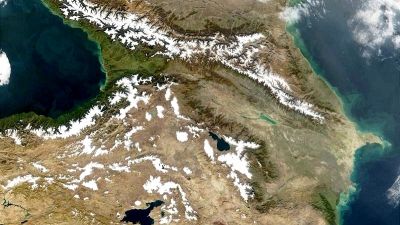
Beginning from the late 20th century the South Caucasus, defined by Zbigniew Brzezinski as Eurasian Balkans, has been an arena for confrontation among the states claiming to be regional and world powers. Situated between the Black and Caspian seas, the South Caucasus is of great importance because it is an area where Southern-Northern and Western-Eastern energy and transport lines intersect, a place rich with energy resources of the Caspian basin.
The South Caucasus played a pivotal geopolitical role in the Asian continent, and this role was enriched with new political, security and economic motives after the fall of the Soviet Union. For its nature and geographical location, the region has historically been a route for nomadic tribes and nomadic cultures between the South and the North, between the East and the West. Nomadic life had great impact on the formation of Southern Caucasian nations` political history.
According to Dmitry Trenin, director of the Moscow Center of the Carnegie Endowment for International Peace, the South Caucasus is a tampon zone and a rivalry area between the Northern empire (Russia) and Muslim states in the Middle East (Ottoman Empire, Iran). From this point of view, in addition to regional countries, powers beyond the South Caucasus also became actors in the geopolitical struggle in the region.
Today, all researches on the South Caucasus consider the region as a whole only from geographical point of view. In terms of all other parameters (social, political, economic, military, cultural and security ones), the region is characterized by different values and political and philosophical ideals. Various projects have been carried out since 1990 to bring different values and philosophies in the region to common denominator, develop regional cooperation and ensure security.
Located on the peripheries of Turkey, Iran and Russia, the region has been an arena for political, military, religious, and cultural rivalries and expansionism for centuries. If we look at the past 30 years there have not been any security problems in the South Caucasus given that the region is in the hands of one state and that Azerbaijan, Armenia and Georgia are part of a common security mechanism. However, serious problems emerged when the region divided from military and security points of view.
In the early 19th century the South Caucasus was conquered by the Russian Empire, and the Russian governance continued here until the late 20th century (December 1991) except for the period from 1918-1920.
Under the Treaty of Brest-Litovsk of 1917, after Russia`s withdrawal from the South Caucasus and the dissolution of the Russian State Duma by the Bolsheviks Caucasian representatives of the State Duma created the Special Transcaucasian Committee on February 23, 1918. However, confrontations among members of the Committee, in particular with respect to foreign policy, led to the establishment of the Transcaucasian Independent Federative Republic on April, 1928. This was followed by Georgia`s declaring its independence on May 27, with Azerbaijan and Armenia proclaiming their independence on May 28.
Regional states were occupied by Russia in 1920-1921, and were part of the Soviet Union`s security mechanism until 1991.
The fall of the Soviet Union and the creation of three independent states in the region led to emergence of new economic, military and political balance in the South Caucasus. Regional countries faced different security problems, which they were trying to solve by joining regional and internationals security organizations and expanding cooperation. At this stage, Armenia focused on economic and security cooperation with Russia.
Beginning from the late 1980s political, military and ethnic local armed conflicts have been posing a serious threat to regional security. Projects aimed at solving these problems and super powers` economic, political and military policies in the region have increased the importance of regional and international security in the South Caucasus. Although there has been a lot of different projects, none of the problems, which emerged in the past 20 years, have yet been solved.
Two large security organizations have been struggling to establish their hegemony in the region since 1991. The first is Russia-led Collective Security Treaty Organization within the Commonwealth of Independent States. Another is the U.S.-led NATO. Security mechanisms aimed at ensuring regional security cover Azerbaijan, Armenia and Georgia one way or another.
One of the main reasons behind the failure to ensure security and stability in the South Caucasus is that in addition to regional countries super powers also attempt to build security mechanisms with the aim of safeguarding their own economic, military and political interests in the region. Russia, the United States and the European Union aspire to create a security system that will fully ensure the protection of their interests.
Although Georgia seeks integration into NATO security system and Azerbaijan tries to strengthen and enhance relations with the Alliance, both countries are pursuing a balanced policy with respect to Russia. As far as Armenia is concerned, it definitely entered Russia-led Collective Security Treaty Organization. However, the country still wants to develop its relationship with NATO.
As the search continues for ways of ensuring regional security, Azerbaijan and Georgia focus on expanding political and economic relations with the regional and international system, while Armenia remains isolated from this process because of its Russia-oriented policy both from political and economic points of view.
When assessing regional ethnic conflicts, security problems and cooperation opportunities, the issue of ensuring peace and cooperation in the region can be looked at from three perspectives:
-solving regional problems, building a security system, fostering cooperation and completion process;
-trying to inculcate cooperative values in society, building, preserving and developing mutual confidence and trust;
-matching regional interests of regional and international powers, and specifying the place and role of the South Caucasus in a globalizing world.
However, such an approach to regional problems cannot be a way-out. This approach can hardly justify itself if it`s not accepted by regional states and peoples, and if it`s not financially and politically supported by Russia, the United States and Europe. The main problem here is that regional states assess their problems cold-bloodedly, and do not consider the South Caucasus as something whole. Another reason is that super powers pursue different economic, political, military and cultural interests in their policy towards the region.
The aforementioned problems have existed in the region in the past 20 years; none of peace projects carried out by international and regional organizations, regional countries and states outside the region has yet proved successful, instead causing more serious problems. The nature of problems, different attitudes and different models proposed by regional and other countries, a lack of mutual confidence, trust and concessions between regional states demonstrate that problems in the South Caucasus will exist for a long period of time.
Dr. Hatam Jabbarly,
chairman of Eurasian Security and Strategic Studies Center

Bütün xəbərlər Facebook səhifəmizdə




























 USD
USD
 EUR
EUR
 GBP
GBP
 RUB
RUB