


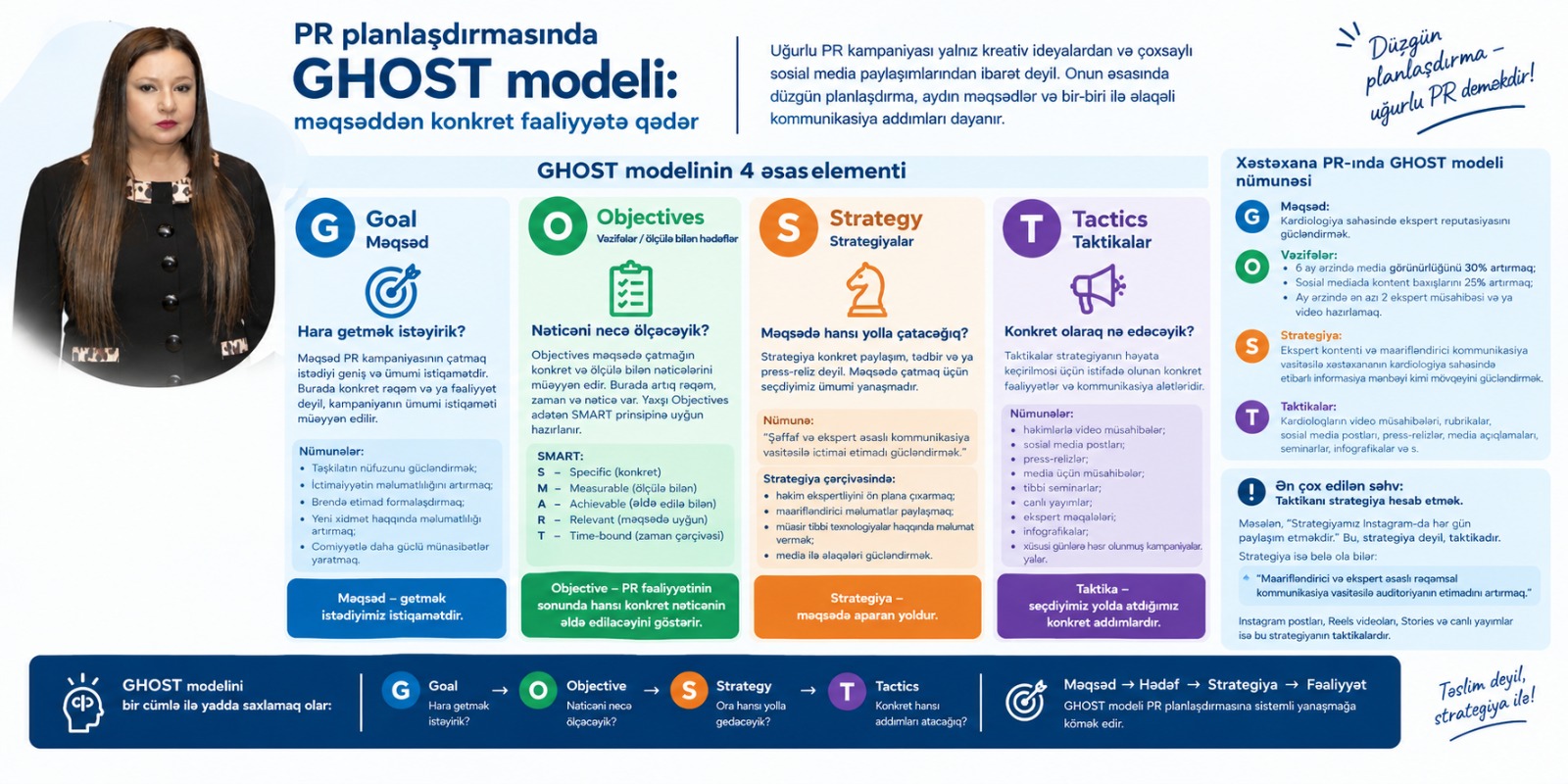
In the field of public relations (PR), a successful communication campaign is not based solely on creative ideas and a large number of social media posts. At the heart of a successful PR campaign are proper planning, clear goals, and interconnected communication activities.
One of the approaches used to structure PR planning is the GHOST model. It consists of four main elements:
G – Goals
O – Objectives
S – Strategies
T – Tactics
The main advantage of the GHOST model is that it enables a PR professional to systematically move from the question “What do we want to achieve?” to “How exactly will we implement it?”
1. Goal: Where Do We Want to Go?
A Goal is a broad and general direction that a PR campaign aims to achieve. A goal is not a specific number or an individual action. It defines the overall direction of the campaign.
For example:
“Increase public trust in the hospital.”
This is a Goal. It does not yet specify by how much public trust should increase, within what period the result should be achieved, or which tools will be used to achieve it.
Other examples include:
strengthen the organization’s reputation;
increase public awareness;
build trust in the brand;
increase awareness of a new service;
build stronger relationships between the organization and the public.
Simply put: A Goal is the direction in which we want to move.
2. Objectives: How Will We Measure the Result?
If a Goal shows the overall direction, Objectives define the specific and measurable results that need to be achieved in order to accomplish that goal.
For example, our goal is:
“Increase public trust in the hospital.”
The corresponding objectives could be:
increase positive audience engagement with the hospital’s social media content by 20% within 6 months;
increase public awareness of the hospital’s medical services by 25% within 3 months;
increase the average number of views of educational videos by 30%;
increase the participation of hospital experts in media content.
At this stage, we already have numbers, timeframes, and specific outcomes.
Good Objectives are usually formulated according to the SMART principles:
S – Specific
M – Measurable
A – Achievable
R – Relevant
T – Time-bound
Simply put: An Objective defines the specific result that should be achieved through PR activities.
3. Strategy: How Will We Achieve the Goal?
A strategy is not a specific social media post, event, or press release.
A Strategy is the overall approach we choose to achieve our objectives.
For example, if we want to increase public trust in a hospital, our strategy could be:
“Strengthen public trust through transparent and expert-led communication.”
Within this strategy, the hospital may:
emphasize the professional expertise of its doctors;
distribute educational information on medical topics;
highlight modern medical technologies;
prepare useful materials for patients;
strengthen communication relationships with the media and experts.
A strategy sets the direction, but it is not yet a list of specific actions.
Simply put: A Strategy is the path that leads us toward our goal.
4. Tactics: What Exactly Will We Do?
Tactics are the specific actions and communication tools used to implement the strategy.
For example, our strategy is:
“Increase public trust through expert-led and educational communication.”
The tactics supporting this strategy could include:
producing educational video interviews with doctors;
publishing posts on social media;
preparing press releases;
arranging media interviews;
organizing medical seminars;
conducting live broadcasts;
preparing expert articles;
creating infographics;
communicating the hospital’s successful medical outcomes;
conducting educational campaigns linked to relevant awareness days.
At this stage, we can answer the specific question:
“What exactly are we going to do?”
Simply put: Tactics are the concrete steps we take along the chosen path.
How Can the GHOST Model Be Applied to Hospital PR?
Suppose our goal is to strengthen the hospital’s expert reputation in the field of cardiovascular medicine.
G – Goal
Strengthen the hospital’s expert reputation in cardiology.
O – Objectives
increase the hospital’s media presence in cardiology-related topics by 30% within 6 months;
increase views of cardiology-related educational content on social media by 25%;
produce at least 2 expert interviews or video materials per month.
S – Strategy
Strengthen the hospital’s positioning as a reliable source of medical information in cardiology through expert-led and educational content.
T – Tactics
video interviews with cardiologists;
a “Doctor’s Advice” content series;
publications on heart health;
expert comments for the media;
educational articles;
medical seminars;
infographics;
campaigns linked to relevant awareness days.
Thus, each tactic supports the strategy, the strategy supports the objectives, and the objectives contribute to achieving the overall goal.
The Most Common Mistake: Confusing a Tactic with a Strategy
In PR, we often encounter an approach such as:
“Our strategy is to publish posts on Instagram every day.”
In fact, this is not a strategy but a tactic.
Why? Because publishing posts on Instagram is a specific action.
A strategy could instead be formulated as:
“Build audience trust through educational and expert-led digital communication.”
In this case, Instagram posts, Reels, Stories, and live broadcasts are tactics supporting that strategy.
Understanding this distinction is essential for professional PR planning.
How Can You Remember the GHOST Model in One Sentence?
The GHOST model can be remembered as follows:
Goal → Where do we want to go?
Objective → How will we measure the result?
Strategy → What path will we take to get there?
Tactics → What specific steps will we take?
In other words:
Goal → Objective → Strategy → Action
The GHOST model helps PR professionals approach planning systematically. It encourages PR specialists not simply to think about “creating lots of content,” but to understand:
why the content is being created,
what result is expected,
and how that result will be measured.
In professional PR campaigns, the key is not the number of tactics. The key is having a logical connection between the goal, measurable objectives, strategy, and tactics.
In a good PR plan, every action should have a clear rationale:
“Why are we doing this?” → Goal
“What result do we expect?” → Objective
“How will we achieve the result?” → Strategy
“What exactly will we do?” → Tactics
This approach transforms PR activities from a collection of random communication initiatives into a strategically managed communication process.
PR Specialist at Central Customs Hospital
Dilarə Zamanova
Bütün xəbərlər Facebook səhifəmizdə



.jpg)
.jpg)









.jpg)

 USD
USD
 EUR
EUR
 GBP
GBP
 RUB
RUB