


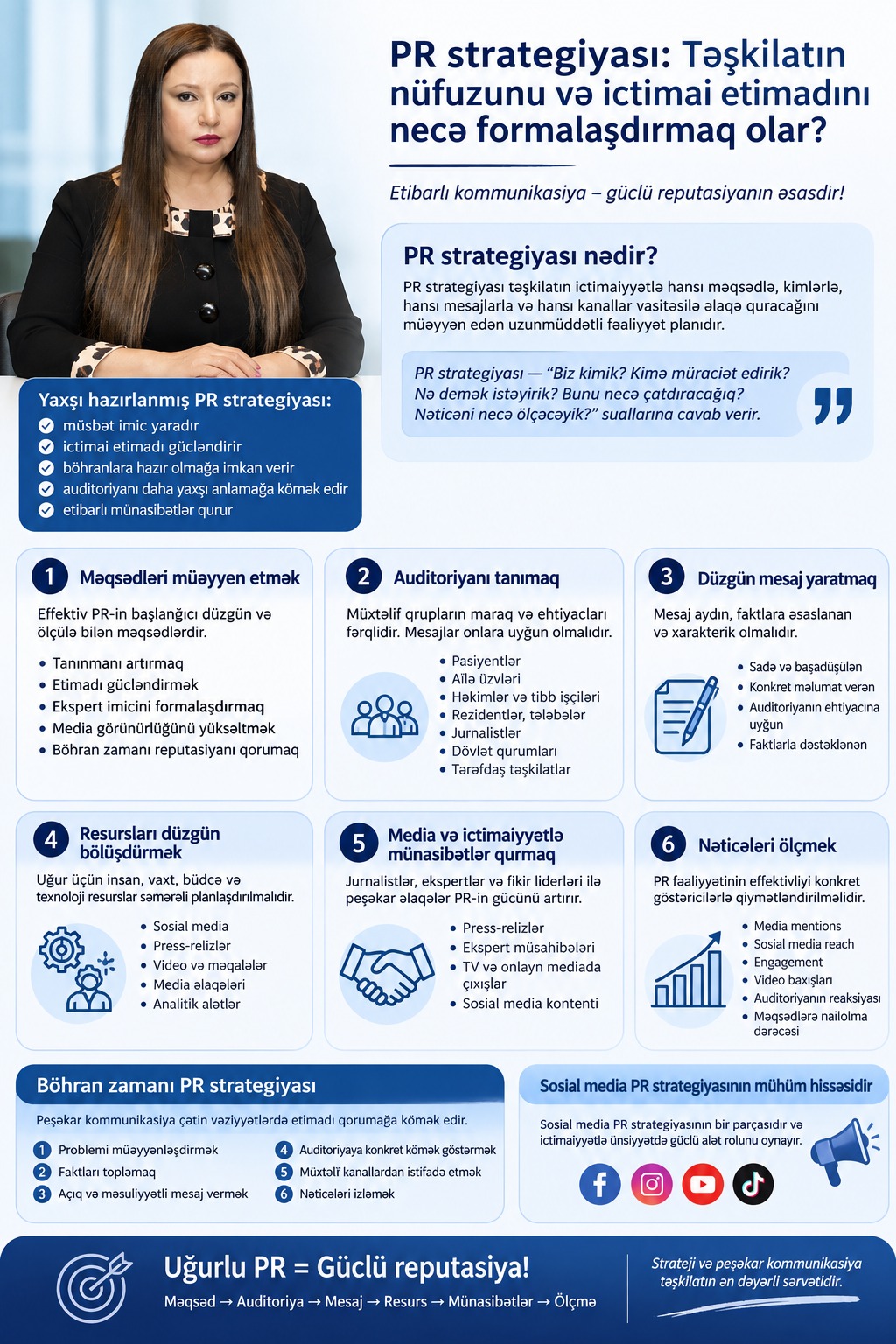
What Is a PR Strategy?
A PR strategy is a long-term action plan that determines why, with whom, through what messages, and via which communication channels an organization will communicate with the public.
Simply put: A PR strategy answers the questions: “Who are we?”, “Who are we talking to?”, “What do we want to say?”, “How will we communicate it?”, and “How will we measure the results?”
A well-developed PR strategy helps an organization not only build a positive image but also prepare for crisis situations, understand public opinion, and establish trusted relationships with different audiences.
1. First Step: Define PR Objectives
The starting point of effective PR activity is setting the right objectives. An objective should be specific and measurable.
For example:
• increase the organization’s awareness;
• strengthen public trust;
• increase awareness of a new service;
• build the organization’s expert image;
• protect the organization’s reputation during a crisis;
• increase media visibility;
• strengthen engagement with audiences on social media.
For example, the goal of a hospital should not simply be “to become more well-known.” Instead, it could be:
“To increase the reach of medical educational content and strengthen the hospital’s expert image in specific medical areas within six months.”
Such an objective gives the PR team a clearer understanding of the direction in which it should work.
2. Understand Your Audience
The second important element of a PR strategy is identifying the target audience.
Communicating with everyone using the same message may not always be effective because different groups have different interests and information needs.
For example, a hospital’s audiences may include:
• patients;
• patients’ family members;
• doctors and healthcare professionals;
• medical residents and students;
• journalists;
• government institutions;
• partner organizations;
• social media users.
A patient’s main question may be “How can this service help me?”, while a journalist may be more interested in “Why is this topic important to society?”
Therefore, a PR professional should first understand the audience and then build communication accordingly.
3. Create the Right Message
One of the key elements of a PR strategy is the message.
It should be clear, consistent, fact-based, and aligned with the organization’s values.
A PR message should:
• be simple and easy to understand;
• provide specific information;
• consider the needs of the audience;
• clearly communicate the organization’s position;
• be supported by facts whenever possible.
For example, instead of saying “We are the best hospital,” it is more convincing to provide specific facts:
“The hospital uses modern medical technologies and provides multidisciplinary healthcare services across various medical specialties.”
Fact-based communication helps create a higher level of trust among audiences.
4. Allocate Resources Effectively
The success of a PR strategy does not depend only on having a good idea. To implement that idea, it is necessary to plan human resources, time, budget, technology, and content resources effectively.
For example, a PR team can use:
• social media platforms;
• photo and video production;
• press releases;
• media relations;
• expert interviews;
• video content;
• educational articles;
• advertising budgets;
• analytics and monitoring tools.
The key principle is not “spend more resources,” but rather “use available resources more effectively.”
5. Build Relationships with the Media and the Public
One of the important responsibilities of a PR professional is to build professional relationships with journalists, media representatives, experts, and other opinion leaders.
For example, when preparing information about a new organizational project, simply publishing a post on social media may not be enough.
If the topic is of public interest, the organization can:
• prepare a press release;
• inform journalists;
• arrange an expert interview;
• provide comments to television and online media;
• create separate content for social media.
In this way, the organization’s core message can be adapted and communicated to different audiences through different communication channels.
How Does a PR Strategy Work During a Crisis?
The importance of a PR strategy becomes especially clear during crisis situations.
For example, a large company faces a problem related to the security of customer data. In such a situation, remaining silent or providing inaccurate information can make the situation even more difficult.
A professional crisis communication strategy may include the following steps:
1. Identify the Problem
Determine what happened and who has been affected.
2. Gather the Facts
Communication should be based only on verified information.
3. Deliver an Open and Responsible Message
The organization should not hide the existence of the problem and should explain what measures are being taken to address it.
4. Provide Practical Support to the Audience
For example, customers can be provided with additional support and a dedicated channel for receiving information.
5. Use Different Communication Channels
The organization can use its website, social media, email, media statements, and video messages.
6. Monitor the Results
Public reactions, media coverage, and social media metrics should be monitored.
The main goal here is not simply to “reduce the number of negative publications.”
The primary objective is to manage the problem effectively, communicate responsibly, and rebuild trust.
What Role Does Social Media Play in a PR Strategy?
Today, social media is one of the most important channels for PR activities.
However, a social media strategy and a PR strategy are not the same thing.
A PR strategy is a broader concept. In addition to social media, it may include media relations, internal communications, public events, expert communications, crisis communications, and other areas.
For example, an educational video featuring a doctor at a hospital could be structured as follows:
PR objective → increase public awareness and strengthen the expert image
Audience → patients and their families
Message → reliable and useful health information
Channels → Instagram, Facebook, TikTok, YouTube
Media support → television and news websites
Measurement → views, shares, comments, reach, and other metrics.
Thus, social media becomes an important part of the overall PR strategy.
How Can the Effectiveness of a PR Strategy Be Measured?
Measuring the results of PR activities is extremely important.
Simply saying “we made a lot of posts” does not necessarily mean that the PR strategy was successful.
The following metrics can be used:
• media mentions — the number of mentions in the media;
• media reach — potential media reach;
• social media reach and impressions;
• video views;
• engagement — likes, comments, and shares;
• website traffic;
• audience response;
• changes in brand perception;
• the extent to which PR objectives have been achieved.
The most important point is to compare the results with the objectives that were defined in advance.
An effective PR strategy is not simply a collection of random posts.
It is a systematic process that combines research, planning, communication, relationship-building, and measurement of results.
A successful PR professional does not ask only:
“What should we post?”
They think more broadly:
What is our purpose in communicating?
Who are we talking to?
What should we say?
Which communication channel should we use?
How does this message contribute to the organization’s goals?
And most importantly — how will we measure the results?
This approach transforms PR from simple information distribution into a strategic communication tool.
To make the concept easier to remember, a PR strategy can be expressed through these key elements:
Objective → Audience → Message → Resources → Relationships → Measurement
When these elements work together, an organization can communicate more consistently, strengthen public trust, and manage its reputation more effectively over the long term.
Dilara Zamanova,
Public Relations Specialist of
Central Customs Hospital.
Bütün xəbərlər Facebook səhifəmizdə










.jpg)
.jpg)











.jpg)

 USD
USD
 EUR
EUR
 GBP
GBP
 RUB
RUB