


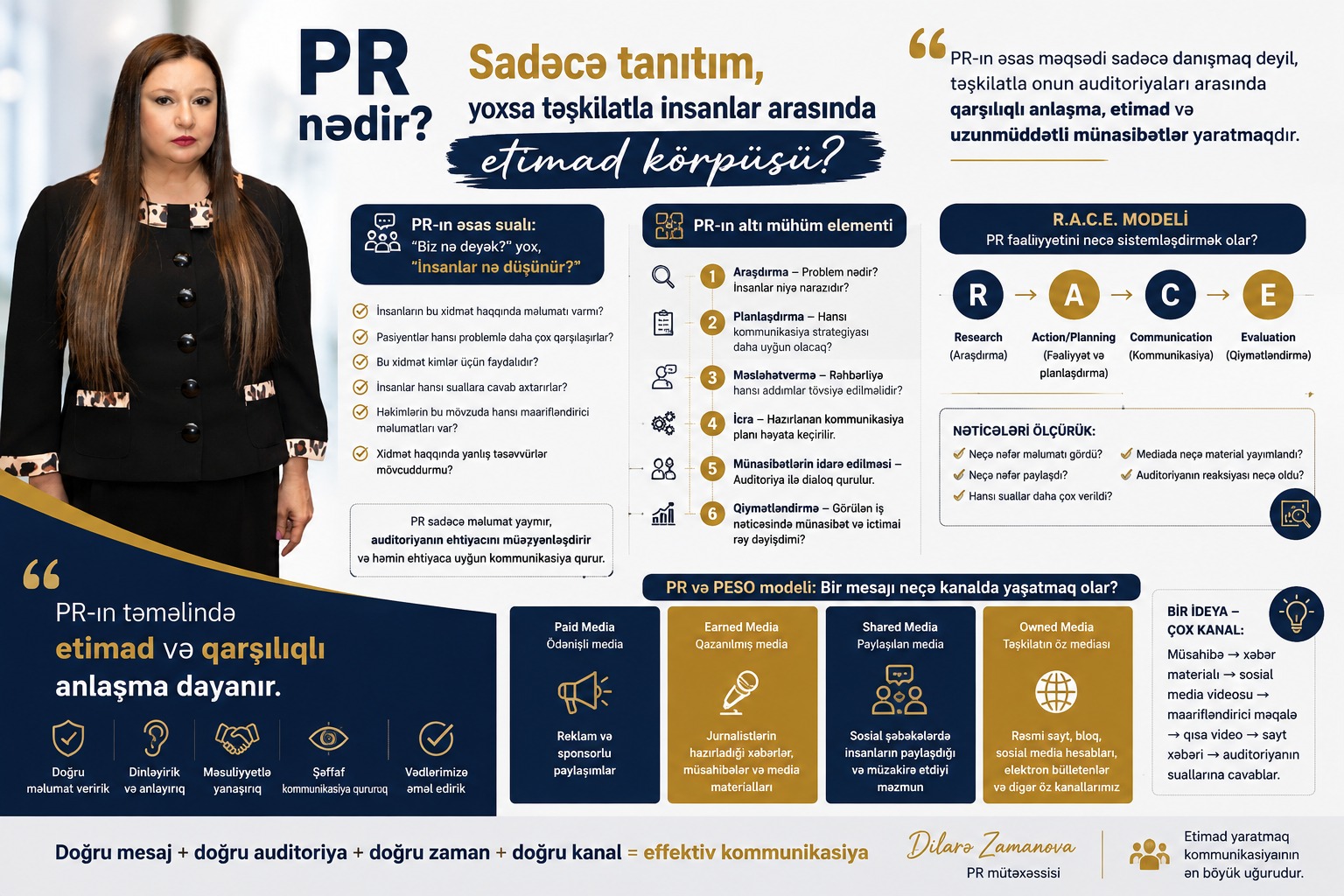
Public Relations (PR) is often equated with advertising and social media activities. However, PR is a much broader concept. The main purpose of PR is not simply to talk about an organization, company, or brand, but to create mutual understanding, trust, and long-term relationships between an organization and its audiences.
In today’s world, people encounter hundreds of information messages every day. Advertising can capture attention, but it is much more difficult to make people trust an organization. This is where the importance of PR becomes evident.
The Key Question in PR: Not “What Should We Say?” but “What Do People Think?”
A professional PR specialist does not think only about what the organization wants to say. They also study what the audience thinks, what it needs, and which issues are most important to it.
For example, a hospital introduces a new medical service. A simple approach might be:
“A new medical service is now available at our hospital.”
The PR approach, however, begins with different questions:
• Do people know about this service?
• What problems do patients face most often?
• Who can benefit most from this service?
• What questions are people looking for answers to?
• What educational information can doctors provide on this topic?
• Are there any misconceptions about the service?
Thus, PR does not simply distribute information; it identifies the needs of the audience and builds communication based on those needs.
Six Important Elements of PR
There are many definitions of Public Relations in PR theory. One common feature of these definitions is that PR is a strategic and management function.
In Howard Simon’s approach, key elements of PR activity include management, relationships, research, counseling, program implementation, and the development of favorable relationships.
These elements can be more easily understood through an example from everyday practice.
Imagine that negative comments about an organization are spreading on social media. A PR specialist should not immediately start responding to them. The first step should be to investigate the situation:
1. Research — What is the problem? Why are people dissatisfied?
2. Planning — What communication strategy would be most appropriate?
3. Counseling — What steps should be recommended to management?
4. Implementation — The communication plan that has been developed is put into action.
5. Relationship Management — A dialogue is established with the audience.
6. Evaluation — Have public opinion and the audience’s attitude changed as a result of the work carried out?
This approach shows that a PR specialist is not simply someone who writes texts and prepares social media posts. They are also a strategist who researches, analyzes, advises, and measures results.
R.A.C.E.: How Can PR Activity Be Systematized?
One of the best-known approaches in PR is the four-stage process:
R – Research
A – Action/Planning
C – Communication
E – Evaluation
For example, a hospital wants to conduct an awareness campaign about children’s vision problems.
First, research is conducted: What questions are parents most concerned about?
Next, a plan is developed: a doctor interview, an educational article, video content, social media posts, and media appearances.
The next stage is communication, when the planned activities are implemented.
Finally, the results are measured:
• How many people saw the information?
• How many people shared the content?
• Which questions were asked most frequently?
• How many media materials were published?
• How did the audience respond?
Therefore, the success of PR activity is not measured only by saying “we published a post,” but by asking the more important question: “What changed?”
PR and the PESO Model: How Can One Message Work Across Multiple Channels?
Modern digital communication is not limited to using a single media channel. The PESO model explains communication channels through four categories:
Paid Media
Advertising and sponsored posts.
Earned Media
News stories, interviews, and other media coverage produced by journalists.
Shared Media
Content that people share and discuss on social media.
Owned Media
An organization’s own communication channels, such as its official website, blog, social media accounts, email newsletters, and other owned platforms.
For example, a hospital doctor gives an interview on an important medical topic. One activity can be repurposed into different formats:
Interview → news story → social media video → educational article → short video → website news story → answers to audience questions.
In this way, one idea can be presented across different communication channels in different formats.
Trust and Mutual Understanding Are at the Heart of PR
Advertising can inform people about a product or service. However, trust is essential for building long-term relationships.
And trust does not develop overnight.
An organization must consistently:
• provide accurate information;
• listen to the audience’s questions;
• take responsibility for its mistakes;
• maintain transparent communication;
• keep the promises it makes.
For example, if a company talks only about its successes on social media but ignores questions and criticism from its audience, this can weaken trust in the long term.
Professional PR is not only about “sharing good news.” When necessary, it also means providing accurate, fact-based, and responsible answers to difficult questions.
How Should a PR Specialist Think About the Future?
In the digital age, the boundaries between PR and advertising have become increasingly interconnected. Social media, video content, influencer communication, media relations, and digital advertising are used together as part of an integrated communication strategy.
However, one principle remains at the center of all these tools:
Right message + right audience + right time + right channel = effective communication
Therefore, it is no longer sufficient to view PR simply as “promoting an organization.”
Modern PR means researching, listening, thinking strategically, building relationships, creating trust, and, most importantly, measuring communication results.
That is why a good PR specialist does not ask only:
“What should we post today?”
They ask a much more important question:
“How will this communication change the way people perceive the organization and influence their behavior?”
It is precisely this question that transforms PR from simple information dissemination into strategic communication.
Bütün xəbərlər Facebook səhifəmizdə
.jpg)
.jpg)




.jpg)
 USD
USD
 EUR
EUR
 GBP
GBP
 RUB
RUB