


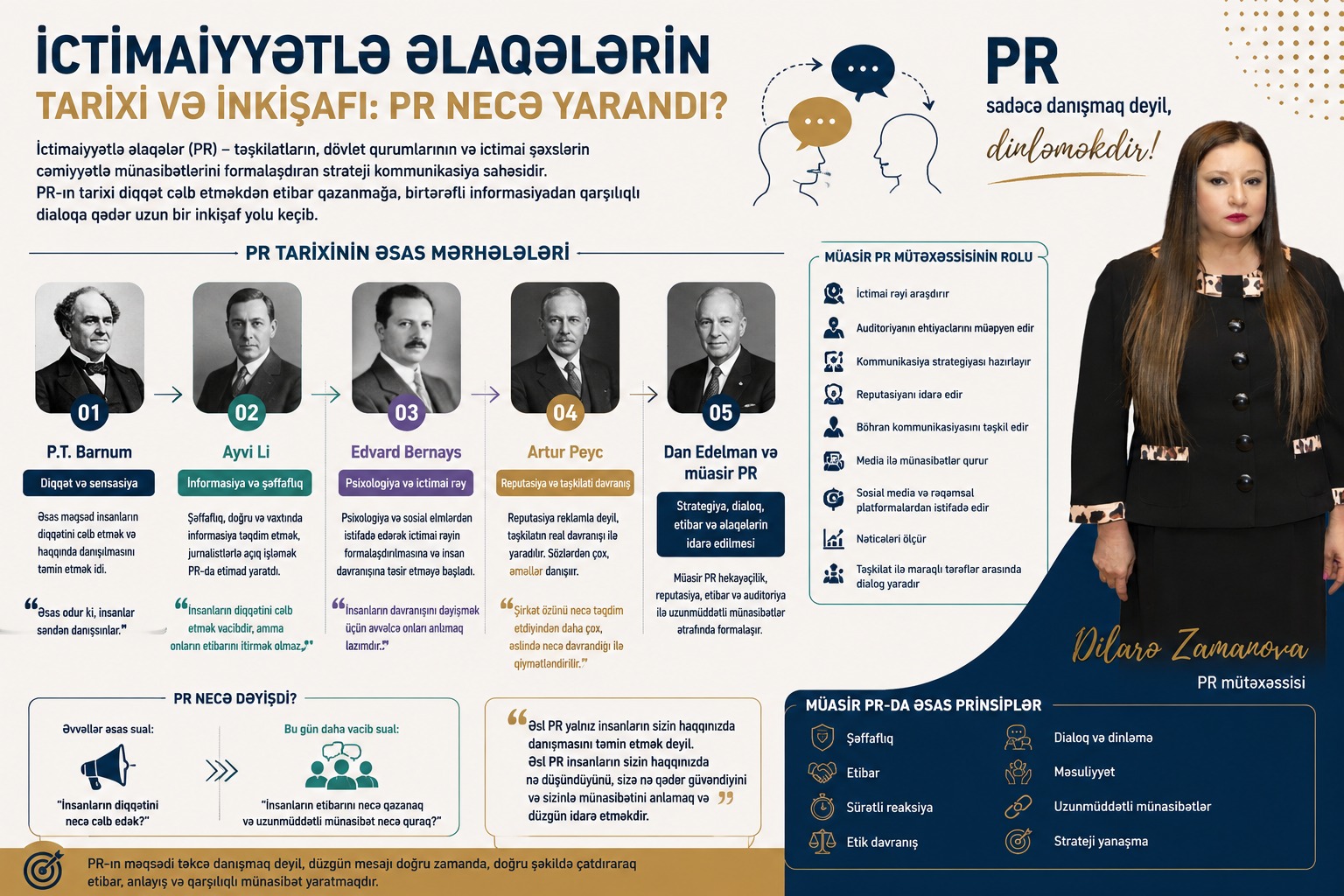
Public Relations — PR (Public Relations) is today an important field of strategic communication that plays a significant role in shaping the relationships of companies, government institutions, organizations, and public figures with society. However, modern PR has gone through a long and fascinating process of historical development.
Studying the history of PR helps us understand how the profession has evolved — from simply attracting attention to building trust, and from one-way information dissemination to mutual dialogue.
The Early Stage of PR: The Main Goal Was to Attract Attention
In the early stages of PR development, the primary objective was to attract people's attention and generate public discussion around a particular person, organization, or event. One of the most well-known figures of this period was the American showman and entrepreneur P. T. Barnum.
Barnum used sensational news, unusual stories, and large-scale publicity campaigns to promote his shows and circus performances. In his approach, the primary goal was not always to communicate the truth, but rather to generate public interest.
Later, this approach became known in the history of PR as the press agentry model. Communication was largely one-way: an organization or individual disseminated information, while the audience's response remained secondary.
Put simply, the principle of that period could be expressed as:
“The important thing is to make people talk about you.”
However, over time, the limitations of this approach became increasingly clear. It was not enough simply to attract people's attention — it was also necessary to earn their trust.
Ivy Lee: The Beginning of Transparency in PR
At the beginning of the 20th century, one of the key figures who had a significant influence on the development of PR was Ivy Lee.
Lee believed that organizations should not hide problems but should provide the public with accurate and timely information. He placed great importance on open communication with journalists and on providing the public with fact-based information.
This approach represented an important turning point in the development of PR. The goal was no longer simply to “create media noise,” but to provide reliable information and build trust.
His approach can be summarized as follows:
“It is important to attract people's attention, but you must not lose their trust.”
Ivy Lee's work also had a significant influence on the development of the press release and systematic relations with the mass media.
Edward Bernays: Bringing PR and Psychology Together
One of the most widely discussed figures in the history of PR is Edward Bernays.
He sought to use psychology and the social sciences to influence public behavior and decision-making. Bernays viewed PR not simply as the transmission of information, but as a process of shaping public opinion.
Bernays' work offered PR professionals an important insight: in order to influence people's behavior, it is first necessary to understand their motivations, emotions, and ways of thinking.
As a result, PR became increasingly connected with psychology, sociology, and behavioral sciences.
Arthur Page: “Actions Speak Louder Than Words”
Another important figure in the history of PR is Arthur W. Page.
In developing important principles of corporate communications, Page emphasized that reputation is not created solely through advertising or carefully chosen words.
The central idea of his approach is very simple:
An organization is judged not so much by how it presents itself as by how it actually behaves.
If an organization provides poor-quality services to its customers, treats its employees unfairly, or behaves irresponsibly toward society, even the most effective PR campaign cannot build a strong and sustainable long-term reputation.
Thus, PR gradually became part of an organization's overall management philosophy.
Dan Edelman and Modern PR
At a later stage in the history of PR, the work of communication leaders such as Dan Edelman became particularly significant.
In 1952, he founded Edelman, making an important contribution to the development of independent PR agencies.
In modern PR, storytelling, reputation, trust, and the development of long-term relationships with audiences have become increasingly important.
Today, the role of a PR professional is not limited to sending a press release to a journalist or publishing a post on social media.
A modern PR professional:
• researches public opinion;
• identifies audience needs;
• develops communication strategies;
• manages reputation;
• organizes crisis communications;
• builds relationships with the media;
• uses social media and digital platforms;
• measures communication results;
• creates dialogue between the organization and its stakeholders.
How Has PR Changed?
The development of PR can be understood through several major stages:
P. T. Barnum → attention and sensation
↓
Ivy Lee → information and transparency
↓
Edward Bernays → psychology and public opinion
↓
Arthur Page → reputation and organizational behavior
↓
Modern PR → strategy, dialogue, trust, and relationship management
This development brought significant changes to the very nature of PR.
If the main question in the past was:
“How can we attract people's attention?”
today, a much more important question is:
“How can we earn people's trust and build long-term relationships with them?”
Modern PR: Not Just Speaking, but Listening
Today's PR is not limited to transmitting information from one side to another. Modern communication is a two-way process.
An organization should not only communicate its messages to its audience but also listen carefully to their opinions, expectations, and concerns.
The development of social media has accelerated this process even further. People are no longer simply an audience that reads the news. They can leave comments, share posts, ask questions, express criticism, and directly influence an organization's reputation.
Therefore, transparency, trust, responsiveness, ethical behavior, and dialogue have become some of the key principles of modern PR.
The history of PR demonstrates that public relations is not simply the art of advertising or disseminating information. Over the years, the field has evolved from attracting attention to building trust, from one-way communication to dialogue, and from individual campaigns to strategic reputation management.
If P. T. Barnum demonstrated the power of public attention, Ivy Lee brought the importance of transparency to the forefront. Edward Bernays demonstrated the role of psychology and public opinion. Arthur Page emphasized that an organization's reputation depends primarily on its actual behavior.
Today, all of these approaches form the foundation of modern PR.
True PR is not simply about making people talk about you. It is about understanding what people think about you, how much they trust you, and how to build and manage meaningful relationships with them.
Dilara Zamanova
PR Specialist
Central Customs Hospital
Bütün xəbərlər Facebook səhifəmizdə







.jpg)
.jpg)












.jpg)

 USD
USD
 EUR
EUR
 GBP
GBP
 RUB
RUB