


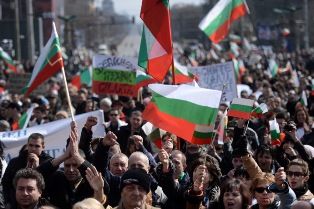
Waves of protests swept Bulgarian cities again on Sunday, as tens of thousands took to the streets despite the government’s resignation. Bulgarians demanded the ‘mafia’ to leave, but it wasn’t clear who could unite them as the country’s new leader.
Anti-government slogans and demands to end monopoly powers were again in evidence on the streets of Bulgaria following the government’s failed attempts to negotiate with the public and its eventual resignation last Wednesday.
Bulgarian cities of Sofia, Plovdiv, Burgas, Blagoevgrad, Ruse, Sliven and Varna saw crowds of people protesting against the corruption, poverty and high energy prices that consume their wages. The largest demonstration took place in the Black Sea city of Varna, with about 50,000 people taking part, according to the local media.
Outgoing prime minister Boiko Borisov was reportedly hospitalized with "high blood pressure and general weakness" amid the mass protests. Borisov pledged to cut electricity prices by 8 percent and even promised to revoke the license of the Czech power supplier CEZ just before his resignation.
Although Borisov and his rightist GERB party have lost a lot of support over the last year, the opposition Socialist Party is not trusted either, according to polls.
"It is obvious that the protesters are not united and this could very quickly destroy the enthusiasm of the people," Georgi Trendafilov, a demonstrator in Sofia told Reuters.
President Rosen Plevneliev meanwhile stated that the interim government would implement the previous commitments and stick to the 2013 budget.
However, the president’s latest initiative to ease public anger failed on Saturday. Representatives of the protesters refused to participate in the establishment of a public council intended to represent people's interests, saying that they could not "sit at the same table with those they were fighting."

Bütün xəbərlər Facebook səhifəmizdə



















 USD
USD
 EUR
EUR
 GBP
GBP
 RUB
RUB