


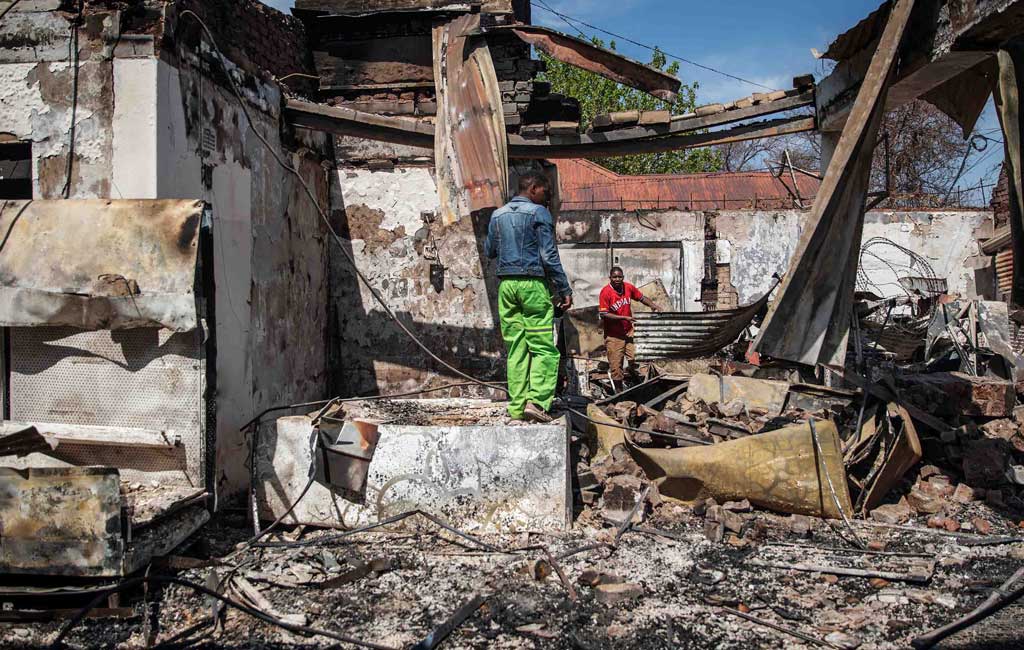
South Africa and Nigeria stepped up security on Wednesday after deadly attacks on foreign-owned stores in Johannesburg triggered reprisals against South African businesses in Nigerian cities told AFP.
Despite a downturn in violence, tensions rose on the diplomatic front, as Nigeria declared it would boycott a top business forum and South Africa's neighbours urged Pretoria to clamp down on xenophobia.
The death toll rose to seven after two charred bodies were found in a store in Johannesburg's Alexandra township, police said. Nearly 300 people have been arrested.
The centre of Johannesburg and Alexandra remained calm, however, as police boosted patrols following two days of looting, AFP reporters saw.
"It's the first time this happened," said Ashi Ashfaq, a Pakistani, who lost three of his six shops to arson.
"Before it happened, they weren't burning the shop, just stealing. When they burn the shop you lose everything."
He added: "[Before] they were maybe stealing little things, and that was better."
Also on Wednesday, Nigeria said Vice President Yemi Osinbajo will boycott the World Economic Forum's Africa summit in South Africa over riots in the host country, Nigeria's foreign minister said on Wednesday.
"Clearly with this climate, he and Mr President have agreed that he should not go," Foreign Minister Onyeama told a news briefing.
'We face a huge challenge'
Shops cautiously reopened again as some residents sifted around in wrecked stores, rummaging for food and anything usable.
President Cyril Ramaphosa reiterated his condemnation of the violence, but acknowledged: "We face a huge challenge."
"A number of people [are] taking the law into their own hands," he said in Cape Town, ahead of a three-day meeting of the World Economic Forum (WEF) due to be attended by more than a dozen African leaders.
"Taking action against people of other countries is not right," he said. "South Africa is home for all. We are not the only country that has become home for people fleeing."
Nigeria reprisal attacks
In Nigeria, police said security had been strengthened around South African businesses after apparent reprisal attacks in several cities against stores operated by the supermarket chain Shoprite, the telecoms giant MTN and other firms.
But in the capital Abuja, a crowd of more than 100 demonstrators clashed with police outside a shopping mall which has a Shoprite store.
They burned tyres and hurled rocks before being repelled by a dozen police, an AFP journalist saw.
On Tuesday, Nigeria summoned the South African ambassador for talks and said President Muhammadu Buhari was sending an envoy to convey his displeasure to Ramaphosa.
Nigerian celebrities also took to social media in outrage, with music star Burna Boy leading calls for a boycott of South Africa while fellow stars Teni the Entertainer, Tiwa Savage and Davido condemned the violence.
Amnesty International said the attacks on foreigners targeted a "vulnerable group" in South Africa.
This, it said, was "a direct consequence of years of impunity and failures in the criminal justice system."
Worried neighbours
Similar messages of concern were voiced by South Africa's neighbours.
In Zambia, about a thousand students demonstrated outside the South African embassy in Lusaka, as President Edgar Lungu urged measures to prevent xenophobia from escalating into "genocide."
Zambia on Tuesday also cancelled a friendly football match against South Africa, scheduled to take place in Lusaka at the weekend.
In Botswana, the Ministry of International Affairs and Cooperation urged all citizens living in or travelling to South Africa "to exercise extreme caution ... [and] avoid areas where unrests are currently occurring."
In Johannesburg's Alexandra township, foreign business owners were disconsolate as they surveyed their ruined possessions.

Bütün xəbərlər Facebook səhifəmizdə
.jpg)








 USD
USD
 EUR
EUR
 GBP
GBP RUB
RUB