


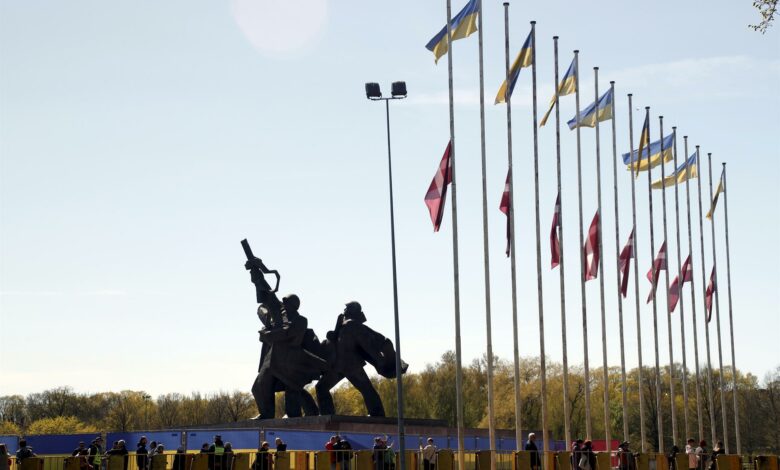
Latvia is to demolish nearly 300 Soviet monuments, including the giant victory memorial looming over the capital, in an emotionally charged gesture that is likely to anger the Kremlin and many members of the Baltic nation’s large Russian-speaking minority.
Near the old town area of Riga, a 79-metre (259 feet) column commemorates the Red Army’s victory over Nazi Germany in Latvia.
On one side, there is a trio of statues – chiselled, solid-limbed soldiers. On the other, a woman, the “Motherland” embodied, her arms held high.
Over the years, the site has often been covered with flowers as tributes were paid. In 1997, Latvian nationalists tried to blow it up.
The Riga Victory Monument, built in 1985, is currently sealed off to the public by police. By November 15, it will be gone.
It is one of at least 70 Soviet-era monuments, memorials or plaques set to disappear from public space in the coming months in Latvia.
A new law, triggered by Russia’s invasion of Ukraine, empowers local authorities to remove about 300 sites. The exact total is yet to be determined.
Dismantled objects are to be entrusted to museums or potentially destroyed.
It is a sudden break with the past but it has been a long time coming. Since the dissolution of the Soviet Union in 1990-1991 ushered in independence in Eastern European states, the debate about these monuments has flared up cyclically.
In the 90s, Latvia rid itself of dozens of Leninist memorials.
Riots rocked the Estonian capital in 2007, when the “Bronze Soldier” statue was moved to a war cemetery.

Bütün xəbərlər Facebook səhifəmizdə




.jpg)











 USD
USD
 EUR
EUR GBP
GBP RUB
RUB