


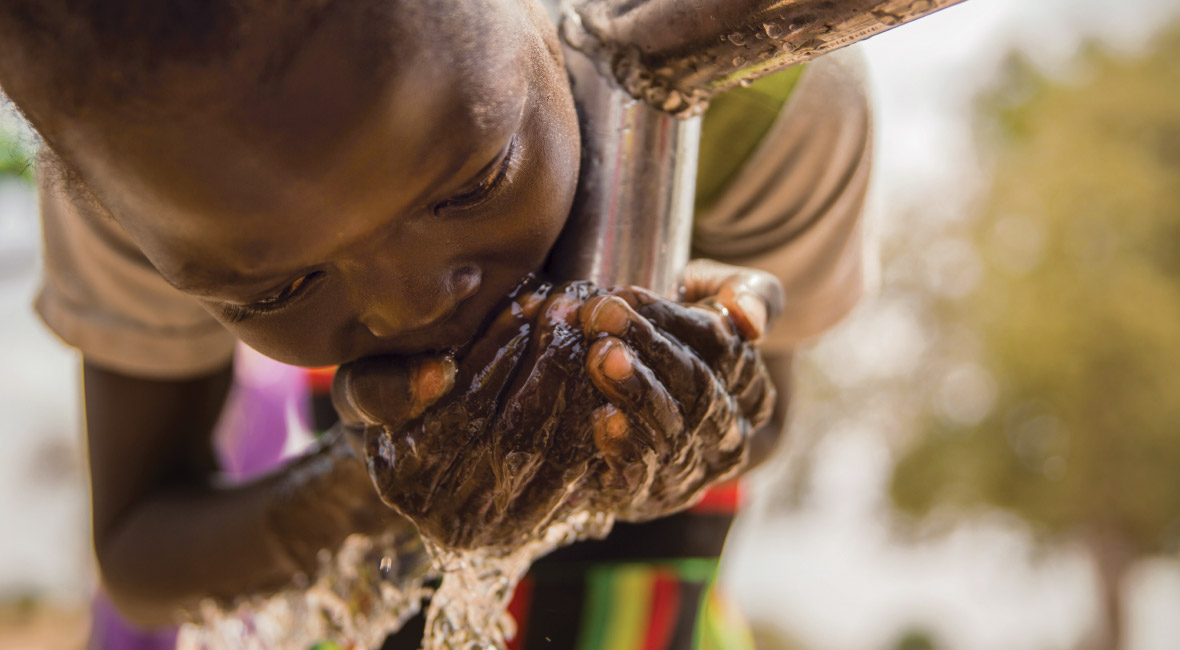
Mozambique is one of 16 sub-Saharan countries belonging to the Southern Africa Development Community.Around 40% of the community's population has no access to safe water - that's around 130 million people.The small town of Ressano Garcia, near the border with South Africa, illustrates the gravity and urgency of the situation Euronews reports.
"Right now, 14,000 people live in this town, Ressano Garcia," explains Silvestre Mario Trigo, technical manager at the Ressano Garcia water treatment plant. "Not all of them have access to drinking water. So they turn to the river. But the water in this river is not treated. So when it reaches the households, it causes diarrhoea and other water-borne diseases".
Contaminated water can also spread diseases like cholera, dysentery, typhoid or polio, even though in Ressano Garcia diarrhoea is the most common.
The local health centre takes care of some 500 patients every day. Around 10 per cent of them suffers from diarrhoea.
Abdul Rafael Sega is the director of the town's medical centre:
"One of the reasons for most cases of diarrhoea and diarrhoea-related diseases is the quality of water. It is very, very clear that the better water people have access to, the greater the improvement in the health of the entire population would be".
Water cleaning technology
Providing safer water is the aim of this pilot unit being installed on the premises of the town's decaying water treatment plant.
The prototype was designed to degrade harmful pollutants such as pesticides and inactivate microbes and pathogens.
It uses a technology called "electro-chemical oxidation" that produces ozone in the polluted water. The ozone acts as a cleaning agent.
Amiro Abdula Martins is a civil engineer with Salomon LDA. He explains how the pilot system works:
"The station is able to treat the water over very different processes; coagulation, decantation [the splitting of liquids] and different phases of filtration. The system creates ozone in the water. This ozone is a characteristic of the high quality of the water; it effectively cleans the water. Our studies have shown that this system is able to clean between 80 and 90 per cent of all dirt present in the water".
In South Africa, researchers had previously installed a bigger pilot plant 40 km south of Johannesburg using similar technology. The plant filters and cleans water from a nearby polluted river and an adjacent treatment plant.
Horizon 2020
This research effort is developed as part of the Horizon 2020 Programme.
The programme's international cooperation strategy aims to tackle global environmental and societal challenges using a partnership approach between European and local researchers.
European researchers have been working on how to prepare the water for treatment in a way that will maximise the effectiveness of the disinfection process.
The quality of the water in both South Africa and Mozambique turned out to be much worse that scientists had expected, especially due the massive presence of faecal compounds. So researchers had to develop a system designed to guarantee an efficient pre-treatment of that water to facilitate its later disinfection. That technology was developed in central Spain.
Bütün xəbərlər Facebook səhifəmizdə

















 USD
USD
 EUR
EUR
 GBP
GBP RUB
RUB