


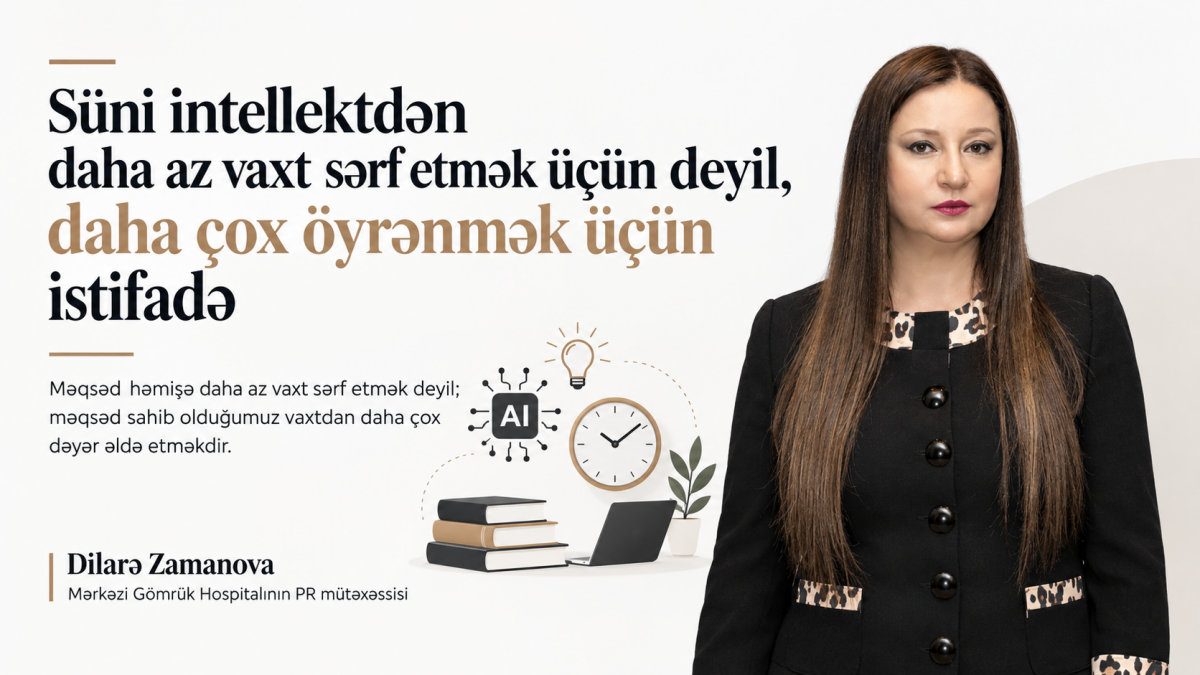
When we talk about artificial intelligence and time management, the main focus is often on the question: “How much time can AI save me?” Indeed, ChatGPT, Gemini, Claude, and other artificial intelligence tools offer significant opportunities to prepare texts, summarize information, generate ideas, and speed up everyday tasks. However, effective time management is not only about completing work in less time.
Sometimes, the better strategy is not to spend less time, but to direct our time toward more important and valuable activities. For example, a student is preparing for an exam and encounters a difficult topic. They can ask AI, “Write the answer to this question.” AI will provide an answer within seconds. The student will complete the task quickly. However, this does not necessarily mean that they have truly understood the topic.
Instead, the student can use AI in the following ways: “Explain this topic to me in simple language,” “Give me three examples from everyday life,” “Prepare five practical questions about this topic,” or “Check my answers and explain my mistakes.” In this case, artificial intelligence does not think instead of the student. Rather, it creates additional opportunities for independent thinking.
For Example, When Learning a Language
Imagine that someone is learning English and is struggling to understand the Present Perfect tense. Instead of simply asking AI to explain the rule, they can use it step by step.
First, they can ask AI to explain the rule in simple language. Then, they can ask for examples from everyday conversations. After that, they can write their own sentences and ask AI only to identify their mistakes. Finally, AI can prepare new exercises for further practice.
In this way, instead of spending 10 minutes receiving a ready-made answer, a person may spend 30–40 minutes studying the topic more deeply. At first glance, this may seem like a waste of time. In reality, the additional effort may reduce the need to relearn the same topic in the future.
How Can AI Be Used in Professional Life?
The same principle applies to professional activities. For example, a PR professional is developing a new communication campaign. They can simply ask AI, “Prepare a campaign plan for me.” As a result, they will quickly receive a ready-made text and plan.
However, a more effective approach could be:
-
first, define the objective of the campaign;
-
analyze the target audience;
-
formulate the key messages;
-
identify potential risks;
-
compare different communication channels;
-
ask AI to suggest alternative ideas;
-
finally, select the most appropriate option independently.
For example, if a public awareness campaign is being developed for a healthcare institution, it is possible to ask AI, “Write 10 social media posts.” However, it may be much more useful to consider questions such as: “What should the objective of this campaign be?”, “What questions might patients have?”, “Which message could be misunderstood?”, and “Which communication channel is most appropriate for each target audience?”
In this case, AI becomes not simply a text generator, but a tool that supports the thinking process.
For Example, When Writing an Article
A person using AI can generate a complete article within seconds. However, instead of accepting the text without changes, it is much more useful to first develop their own ideas about the topic.
For example, someone writing an article about “Artificial Intelligence and Time Management” can first identify three examples from their own experience:
speeding up information research with AI;
reducing the time spent editing texts;
explaining complex topics in different ways.
After that, AI can be used to structure these ideas, identify missing points, and suggest alternative approaches. In this way, the main ideas of the article are developed by the person, while AI helps to expand and improve them.
Using AI as a “Teacher”
One of the most useful ways to use artificial intelligence is to turn it into a personal learning assistant.
For example, a person is learning a new topic in PR. They can ask AI, “What is the PESO model?” However, there is no need to stop there.
For more effective learning, the following sequence can be used:
1. Explanation: “Explain the PESO model in simple terms.”
2. Example: “Give me an example of applying the PESO model to a healthcare institution.”
3. Practice: “Give me a hypothetical campaign and let me apply the PESO model myself.”
4. Feedback: “Check my answer and explain my mistakes.”
5. Deeper Learning: “Prepare a more challenging task on this topic.”
In this way, AI becomes not simply a system that provides information, but an interactive tool that participates in the learning process.
The Difference Between a “Ready-Made Answer” and Learning
There is an important distinction here: completing a task and learning something are not the same thing.
For example, a student has to write an essay. If they ask AI to prepare the entire essay, the task can be completed in a short time. However, the student will spend less time thinking about the topic, developing arguments, and improving their writing skills.
If, instead, the student first develops their own outline and then asks AI to review their arguments, provide opposing viewpoints, and give recommendations on the structure, they may spend more time. However, this process contributes to the development of their writing and analytical thinking skills.
How Can AI Help Us Gain “More Time”?
Here we encounter a certain paradox. On the one hand, AI helps us save time; on the other hand, it gives us the opportunity to use that time for more valuable activities.
For example, a PR professional may reduce the time spent on the initial processing of information from two hours to 30 minutes. They can use the remaining 90 minutes to think about the campaign strategy, understand the target audience more deeply, develop creative ideas, and discuss them with the team.
In this case, the main benefit is not simply “90 minutes of free time.” The real benefit is that a person can devote more time to activities that require professional thinking and the development of their own skills.
What Questions Should We Ask Ourselves When Using AI?
Before and after using artificial intelligence, it is useful to ask ourselves several questions:
-
Am I using this tool to do the work for me?
-
Or am I using it to understand the topic better?
-
Am I accepting the ready-made answer without analysis, or am I evaluating it myself?
-
Am I verifying the information provided by AI?
-
What skill am I developing through this process?
-
When AI saves me time, what am I using that time for?
These questions can help us use artificial intelligence more consciously and effectively.
A New Approach to Time Management
In traditional time management, one of the main goals is to complete tasks as efficiently and quickly as possible. In the age of artificial intelligence, another principle can be added:
“Manage your time not only to save it, but also to direct it toward more valuable activities.”
If AI helps us prepare the initial version of a report more quickly, we can use the time saved to analyze the report more deeply. If AI summarizes the main points of a topic, we can use the additional time to compare the information and draw our own conclusions. If AI creates practical exercises for us, we can complete those exercises ourselves to reinforce our knowledge.
Effective use of artificial intelligence is not only about being able to “get things done faster.” Sometimes it is much more useful to use the time gained through AI to think more, practice more, ask more questions, and explore a topic more deeply.
The main goal is not for AI to think instead of us. On the contrary, artificial intelligence should be used to strengthen our own thinking, learning, creativity, and decision-making skills.
Therefore, we can approach AI and time management in the following way: the goal is not always to spend less time; the goal is to get more value from the time we have.
Dilara Zamanova
PR Specialist, Central Customs Hospital
Bütün xəbərlər Facebook səhifəmizdə






















 USD
USD
 EUR
EUR
 GBP
GBP RUB
RUB