


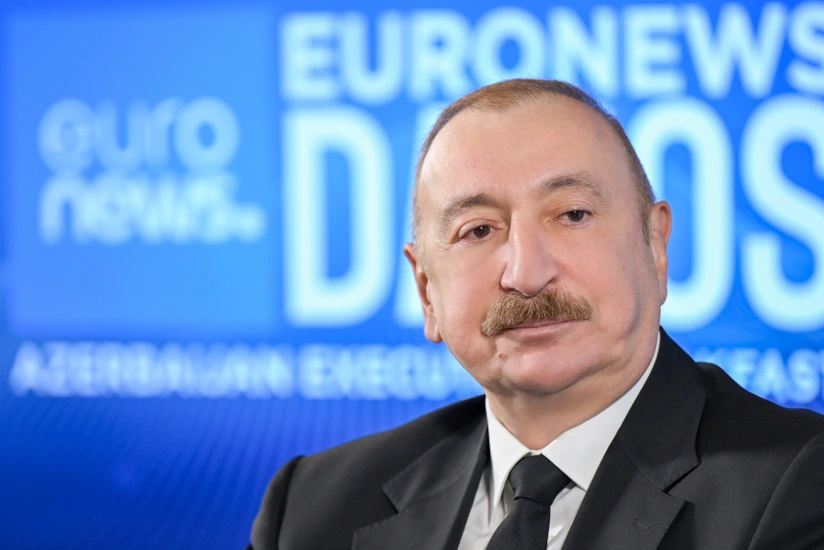
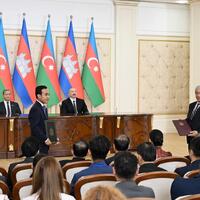
On January 20, following his interview with Euronews TV in Davos, President Ilham Aliyev attended the "Azerbaijan Executive Breakfast" event organized by the television channel.
During the event, the head of state answered questions from business representatives from various countries.
Moderator: Good morning, Your Excellencies, ladies and gentlemen.
Welcome to a very special event this morning: the inaugural Azerbaijan Executive Breakfast here in Davos, unlocking regional prosperity and economic opportunities for Azerbaijan and the wider region. And today we welcome you, government officials, business leaders, and investors, to explore Azerbaijan's growing role as a regional hub for connectivity, energy, and, of course, economic development. Now, in this session, we"ll look to explore regional connectivity, strategic investment priorities, and Azerbaijan's vision for sustainable growth. It's my great pleasure, first off, to welcome to the stage our Chairman of Euronews, Mr. Pedro Vargas David, with his opening address. Welcome, Pedro.
Pedro Vargas: Good morning. Well, first, let me tell you that Euronews is very proud to host the first Azerbaijani Executive Breakfast here in Davos. Azerbaijan is changing at a very rapid pace, and I think the association between Euronews and Azerbaijan to host and have such a distinguished number of guests around the room shows the interest and the willingness to discuss, to engage with Azerbaijan, and really to look at this country as one of the great stars for the future. But first, I need to start with a historical note. And having many Azerbaijani friends and Your Excellency, Mr. President, here, we do mark today the 36th anniversary of Black January, where more than 131 Azerbaijanis lost their lives at the hands of a Soviet invasion and occupation of Baku. And so it is in the world that we live in today - something that we need to go back to history and remember - and please accept our respect for this tragic event.
Now, in 2026, Azerbaijan is at peace, a sovereign country with territorial integrity across all of its territory, looking toward development and the next steps. Your leadership, Mr. President, is a testament to how a leader can impact the future of a nation, how you can deliver peace. And I could even suggest that you and your colleague from Armenia should get a peace prize. I'm not going to go into that discussion, but for sure I can tell you that I think you are getting the most important peace prize, which is the peace prize of your people - the recognition that justice and prosperity come from peace, and that recognition comes from the actions that you have taken. And that is probably worth more than any gold medal or any other prize from any prestigious organization. I was, of course, talking about FIFA.
You preside, Mr. President, over a proud country, a country that is confident in its future, and you can feel that Azerbaijan is confident in its place in the world. And as a foreign investor - because beyond Euronews, we are happy to invest in Azerbaijan through our private equity - let me point to three areas which I believe are key to the success of Azerbaijan's current positioning. The first is your diplomacy and international relations. You are a bridge - a bridge in a very difficult geography. I come from Portugal. For us, it's very easy. We have our brothers from Spain, although let me tell you, they were not always our brothers. We fought them for five centuries. And I always tell my friends in the South Caucasus: look, it's possible that there are no borders. There is almost no difference - we have a hard time identifying the differences between the countries. They continue to be too loud and sleep in the afternoon. And of course, we fight over football. And I hope that very soon in Baku we can see a fight between Azerbaijan and Armenia on a football pitch, 11 against 11, and then let the best win. Although I hope the Portuguese contribution in the last few years was not brilliant, we will work on improving it very soon.
Mr. President, in today's world - and of course, I was imagining that we were going to spend this Davos year talking about Iran. Apparently, we're going to spend it talking about Greenland. But for sure, when your neighbors are Russia, when your neighbors are Iran, when your neighbors are countries that have historically had territorial ambitions, it's not easy to survive. And you need a combination of strength and diplomacy. And that is what I think you have achieved. On the other hand, I think you have made a very important and pivotal change with your connection to Central Asia. Of course, historically and from an origin perspective, you are a Turkic country. But the association with C5, now C6, is a landmark moment, and it is also something that the rest of the world needs to take advantage of. This is, for me, at this moment, one of the best regions in terms of investment. This is one of the best risk-reward opportunities one can present. And for many investors here who tend to look more to the Western side, definitely look at this region, look at the opportunities these markets offer. And Baku, with all of its wins, has never been so calm. You have built not just a bridge, but also a harbor - a harbor where Muslims, Christians, and Jews can find a place of harmony. And that, which should be the norm everywhere, is unfortunately, in today"s world, something unique. A secular country that also brings together the Caspian and the Black Sea. And when you talk about the strategic dimension, especially here for Europe, these two seas are going to be very relevant for our future.
Second, you are a reliable economic partner. Through your reforms, and through the reforms that continue to be implemented in the country, Azerbaijan is now a country that is ready to receive foreign investment and is open to that foreign investment. And I would just like to point to three very important areas where I believe that opportunity lies. Looking at the middle class and local markets, there is really an opportunity in many sectors to bring innovation and investment into that middle class and its growth. We see margins going down, but volumes definitely compensate for the decrease in margins. And so, there is a great opportunity in the growth of the middle sector and the middle class in Azerbaijan. There is a young, educated population, speaking English and becoming much more educated in terms of IT. That is something that will definitely be an opportunity, whether in tech or other IT sectors.
And finally, infrastructure. Of course, with the TRIPP and the reforms that you are putting in place, Azerbaijan will be the natural host for a lot of infrastructure investments, whether in airports, ports, fiber optics, or big data and data centers. By the way, I don't want to let some of my other investors go faster than us, but definitely on data centers. With the cost of energy that Azerbaijan has and its strategic position, there is a significant opportunity there. And finally, some numbers, because I'm an economist by training and we are in Davos, so we have to put out some numbers.
You had 2.7% growth in the non-oil sector of your GDP last year. Of course, we all know how the energy sector performed last year, but Azerbaijan continues to present significant growth in its other sectors, with GDP per capita reaching $7,400 according to the latest numbers. Probably these numbers are from last week.
I have no doubt in affirming that Azerbaijan is open for business. And we say that you have to put your money where your mouth is, right? And so it is with great pleasure that we announce today that Alpac is launching and has reached the first closing of our new private equity fund for Azerbaijan, Uzbekistan, and the wider region.
This is a fund that is going to invest in many of the things that we've been talking about. And we have agreed on a target of 250 million euros for the fund, and we see that this could result, over the next four or five years, in up to half a billion euros of investment in the country. And so, as we say, you have to put your money where your mouth is.
I think what we would invite all the people who are watching us and all the people who are here in the room to do is visit Baku, visit Azerbaijan, spend time, send your teams, learn the market - the opportunities are there, the government is ready to partner, and the region is certainly strategic for the future.
We are very proud to be your partners. We are inspired by your leadership. We look forward to this land of peace - secular, safe, and with strong economic development. So thank you very much for being with us today. And now I"ll let the most interesting part of the conversation begin. Thank you very much.
Moderator: Ladies and gentlemen, Mr. Pedro. Thank you so much, Pedro.
As you know, we're joined by a very special guest today. And it is my delight, once again, to welcome to the stage the President of Azerbaijan, His Excellency Mr. Ilham Aliyev.
President Ilham Aliyev: Thank you.
Moderator: Mr. President, I think the way this is going to play out is that I will ask you a quick question, and then we're going to open it to the audience. So please get your thinking caps on and be ready to volunteer your own questions. I wanted to start by talking about the fact that investors at Davos are increasingly focused on resilience, sustainability, and long-term returns. What are Azerbaijan's top strategic investment priorities today?
President Ilham Aliyev: Gratitude for all the kind words that have been said about our country. And definitely, we will continue our path of reforms. And our strong partnership with Euronews is an opportunity for us to present Azerbaijan as it is, to demonstrate our achievements, and also to attract potential investors.
With respect to investment priorities, for many years, for us, the number one priority was the energy sector, because the resources we had allowed us to increase our economic performance and improve the living standards of the people. Today, most of the energy portfolio is done. Yes, we continue, and definitely we will have more to offer to international markets. But of course, the priority is the non-energy sector, the non-oil and gas sector.
Diversification of the economy for our country is the number one priority. And from a practical point of view, today we see a growing interest in renewable sources. We already inaugurated two big renewable power stations. And in the coming six years, we will dramatically increase our capacity to generate energy from solar and wind.
In other words, by 2032, we expect to have eight gigawatts of solar and wind energy, because there is a lot of sun and a lot of wind. And we see a big potential. We have already contracted several projects, and now we are thinking about storage capacity. The first storage capacity is already being installed.
We are expecting investments in transmission lines, because our target is to export green energy. And also, as it was already said, with respect to data centers, we think Azerbaijan can be one of the main destinations for investors. First, energy is cheap. Second, we have extra capacity. Even today, we have two gigawatts of electric energy which we do not consume and which we do not export due to the limited, so far, transmission capability.
In six years, it will be eight gigawatts, and no country in our region has this extra capacity. Most of the countries depend on imports. Some countries are breaking even, but only Azerbaijan is the place where data centers can have maximum efficiency.
We are actively working on that, including my and the delegation's interactions here in Davos. So these are two main areas of investment where we are looking for international cooperation.
And the third one is mining. This is relatively recent, because most of our rare metals potential is in the territories which have been liberated from Armenian occupation during the last five and the last two years. And now we are in the active phase of surveys, using the most sophisticated technological capabilities in order to define all our potential. The fact that the potential is there is known from research made in Soviet times, but that was outdated technology.
So mining, renewable energy, AI, and data centers - I think these are the main targets for attracting investments from outside.
Moderator: How can connectivity initiatives remain resilient amid all the geopolitical fragmentation and sanctions-driven realignments that we're seeing? And can economic cooperation and connectivity serve on neutral ground, as a neutral ground, even when political relations are strained?
President Ilham Aliyev: We worked on connectivity basically with respect to the construction of oil and gas pipelines, because we are a landlocked country. In order to export our oil and gas, we need to go through the territory of other countries. We managed to build probably one of the most challenging projects - a gas pipeline stretching from Baku to the Italian coast, with a length of 3,500 kilometers, passing through several countries en route.
As you can imagine, it was not easy, because we had to agree with all the governments, host government agreements, on commercial terms, on tariffs, but that was done. This pipeline has already been operational for five years. The oil pipeline was built before; we inaugurated the major pipeline from the Caspian to the Mediterranean in 2006. So that was the first connectivity project. Then, building on those already established relationships with the neighbors, we started to invest in transportation connectivity and invested in the construction of the railroad going from Azerbaijan to Georgia and Türkiye, further down to Europe and to Mediterranean ports. So that partly covered the territory to the West of Azerbaijan. And now we think about projects to the East of Azerbaijan.
And as has already been mentioned here, we became a full member of the Central Asian Consultative Council last year. It was a unanimous decision by the presidents of five Central Asian countries to transform C5 into C6. We consider it a sign of respect to Azerbaijan, appreciation of our efforts, and also a sign of wisdom, because today, to avoid Azerbaijan means that you have to go through areas which are under sanctions. Two other options exist, but both go to the north and to the south of Azerbaijan, in sanctioned areas, which probably is not very comfortable for those who send cargoes and those who primarily receive cargoes. So Azerbaijan is, as it happens, the only reliable, safe, and friendly destination for the European community to have a connection with Central Asia.
We know about the European Union project, Global Gateway, which will connect Europe with Central Asia, and definitely Azerbaijan here plays an important role. We have so far managed to invest largely in our transportation infrastructure - seaports, airports, railroads, highways - so everything is almost ready. But the volume of cargo is growing so fast that we have now made a decision to increase the capacity of our Trade Sea Port. So connectivity, including the Trump Route for International Peace and Prosperity, which will also engage Armenia into the transportation network of the broader Central Asia region, will also serve the cause of peace, because Armenia will stop being a deadlock, will get benefits from tariffs, and will be part of broad international cooperation. And already they see the benefit, because Azerbaijan, after peace has been achieved with Armenia, lifted all the restrictions on the transportation of cargoes, and the first cargoes from Kazakhstan and from Russia through the territory of Azerbaijan to Armenia have already been sent. Moreover, we started to supply Armenia with critical oil products at a much cheaper price than they could ever get. So these are all interconnected: connectivity, good relationships with the neighbors, peace, predictability, and mutual interest.
Moderator: Thank you, Mr. President.
So it's over to you guys. Who would like to be the first to ask a question to Mr. President?
Pedro Vargas: Mr. President, one of the things that always impresses me when I visit Azerbaijan is how, for example, real estate and the middle class are really developing. When you see that people's lives are getting better, there is more purchasing power. How do you see this movement moving forward? And how open would you be to foreign investment also in sectors like retail and transportation in general? So this real opportunity of the middle class, which I really think is going to boom in the years to come-how do you see foreigners also being present in that sector?
President Ilham Aliyev: Yes. Along with our investment policy and policy of reforms, we seriously treated the issues related to unemployment and poverty levels and managed to reduce both of them to the level of 5 percent. So the middle class-those who are considered to be middle class-their number is growing. And therefore, we see growing purchasing power in Azerbaijan.
Today, in Baku, there are several large-scale city-building projects. One of them is White City, which is a city inside the city and will accommodate about 50,000 people in the coming couple of years. Another is also a touristic destination, which is called Sea Breeze, which is an integrated part of entertainment, hospitality, and residence, and which stretches now to a length of more than six kilometers and will go even longer. And the figures of the sales in only these two, not to mention other construction projects, demonstrate that there is a big demand. More than 70 percent of those who purchase apartments and houses are locals. This demonstrates that the purchasing power of people is growing due to economic reforms and economic development. And at the same time, this ratio also shows that Baku and Azerbaijan have become very attractive for foreigners, because today investors are looking for places where they can feel themselves comfortable and where they feel themselves safe. From this point of view, also what Pedro mentioned-multiculturalism, cultural and ethnic diversity, and a very positive spirit of interaction, coexistence, and mutual respect between all the ethnicities, all the representatives of traditional religions-really creates this spirit that people want to buy houses, buy apartments in Baku, to come to stay for summer, for vacation, to spend time on the seashore, and also to invest, because when you invest during the time of construction, then you can sell it when it is already built for twice as much.
So this is actually the best indicator of economic performance. Our economy, unfortunately, doesn't grow fast due to the natural decline of oil in Azerbaijan. But as you mentioned, the non-energy sector is growing more than 2 percent, and industry not related to oil and gas grew 5.5 percent last year. So for me as President, these are the main indicators.
With respect to the energy sector, we increase the production of gas and decrease the production of oil, but we have plans to stabilize oil production and even to increase it. Maybe it's premature now to talk about that, but we have very legitimate hopes that we may enjoy a second very important oil boom in Azerbaijan if exploration projects conducted by international energy companies bring good results. That's what we hope for.
Moderator: Thank you so much. I think we have a question from the floor.
Jenny Johnson: Mr. President, I'm going to ask you a question and have a little fun here. As I know, you're a skier. I've had the pleasure of skiing in Azerbaijan, and congratulations, because you have state-of-the-art equipment there. But I understand you have the World Cup coming in March. Can you tell us a little bit about that?
President Ilham Aliyev: Yes. To hear from you that I am a skier is like awarding me a gold medal, because Jenny is a real champion. I'm very glad that she enjoyed skiing in Azerbaijan. We were chatting just before the event started, and I said that this year we will have a World Cup event in Shahdag. Our relationship with the International Ski Federation has started, and it is already included in the calendar. So every year we will have at least either one World Cup event or a European Cup event, and that will balance, to a certain degree, our summer event, which is Formula One, which for more than 10 years has already attracted a lot of interest and played a very important role in the growing number of tourists. After the first Formula One, we had 20 percent growth, and this figure was growing steadily just before COVID. COVID just ruined everything. Now it's building up again. So this was a country presentation because it was a city circuit. It was, how to say, around the city-historical parts, modern parts.
Now the World Cup in Shahdag will be a winter Azerbaijan presentation, and I hope that a lot of people will choose this destination for skiing, taking into account that new hotels and new facilities are being built. Today, the length of the slopes is already 45 kilometers. It will be 55 in two or three years. So it will, of course, not be comparable with Switzerland, but in our part of the world it will be one of the biggest ski resorts and one of the most convenient. Because, as we skiers know, the most complicated part is getting on the bus, getting to the station, getting into the wagon, and waiting for 15 minutes to take you up the hill. In Shahdag, you can ski down from the hotel. So you save at least 30 minutes, and it makes you, how to say, happier.
So thank you very much for mentioning that. It gave me the opportunity to bring this to the audience, and once again, welcome to Shahdag.
Jenny Johnson: Thank you.
President Ilham Aliyev: We, by the way, agreed to ski together.
Moderator: Gentleman in the front, hello.
Damion Potter: I"m Damion Potter from H/Advisors. Thank you, Jenny, for your question. You beat me to it on the plans for the future, but perhaps, looking back, you were successfully able to host the Eurovision Song Contest, also successfully hosted COP29, and now you have these two flagship sport events with skiing and Formula One. What lessons have you learned from the events you've already hosted, and which other events do you aspire to host in the future?
President Ilham Aliyev: Well, the first lesson was that despite all the opposition to these events from different circles, you have to do what is right for the country. Whether it was Eurovision or COP, we were faced with unjustified criticism, especially for COP, where we were accused that we are an oil-producing country and how can an oil-producing country host a COP. Though there have been countries before and after Azerbaijan which produce much more oil than Azerbaijan. But the question was about us, and I said that it's not our fault to have oil. We should not be blamed for that. We must be judged by how we manage the oil wealth and how it is fairly distributed in society. So this was one of the lessons, because, frankly speaking, during this one year of preparation for COP, I regretted many times that we entered this adventure. Because really, the criticism, and actually the level of aggression in some media, was so high that it almost demoralized you. But nevertheless, we were committed to having a good event, and it really was a good event from the point of view of the organization, and, more importantly, from the point of view of the results. We achieved what was not possible to achieve for 10 years-agreeing on the functioning of the carbon market. Also, the Loss and Damage Fund was made functional, and the turnout was a good response to those who were advocating for a boycott. We had all the countries except Armenia participating. We had 70 heads of state and government. So the boycott tactics failed. So that was a lesson that if you think something is right and you are convinced of that, then you have to do it, despite all the resistance, all opposition, and sometimes all the hostilities. Plus, it gave us an opportunity also to present our case. Having oil and gas reserves, at the same time, as I already mentioned, we invest largely in renewables. And this is part of our responsibility. We invest in renewables not because we need energy; we invest because we are responsible people, and we want to make at least our country and our region more appropriate for living. Pollution and carbon emissions-all that which we cannot see with our eyes, but which we and our children feel, unfortunately. So I think countries rich in fossil fuels, when they invest in renewables, must be, how to say, treated with respect and appreciation.
Among the events of international scale which we already held, one also should be mentioned. Last year, for the first time in Baku, it was a UFC tournament with the participation of leading sportsmen. And that also was on all the main TV channels. So I hope UFC also will become a tradition. Not many countries host UFC, primarily the United States. So putting Azerbaijan on the map also demonstrates the capability of our country and us being more integrated into the international sports and entertainment agenda.
Moderator: Thank you. I think the gentleman next to you has a question.
Matthew Armstrong, Head of Government Affairs, Baker Hughes: I'm from the energy technology company Baker Hughes. And just to pick up on your insight regarding COP29, I was privileged to attend that event on behalf of my company. And I can assure you that, having gone to the ones before and after, all of which were hosted by oil-producing countries, as you observe, it was a fantastic event and an impactful event. And I do applaud you specifically for taking on some of that criticism, but responding to it directly and forthrightly and responsibly. We have gone through the same evolution as Azerbaijan, in fact, where molecules are important, electrons are increasingly important, but you produce both and you bring prosperity.
The interconnection with Europe has become increasingly important, and you are, despite criticisms from some regarding fossil fuels, doubling your supply of gas to Europe and also expanding those corridors-transmission, transportation, everything. Do you see an opening for direct European investment, particularly around Caspian Sea development around oil and gas? Do you see your pragmatism being reflected in public markets, the formation of capital to increase? Because we share your optimism that there is more oil and gas to be produced, of course, by SOCAR and others. Do you see that investment coming in from Europe, or is there more work to be done there?
President Ilham Aliyev: Yeah, unfortunately, from Europe, we do not see substantial investments, neither in fossil fuels nor in renewables. In renewables, I can tell you that our main partners are companies from the UAE, Saudi Arabia, China, the UK, and Azerbaijan. There's no European company which has expressed readiness to be an investor.
On fossil fuels, traditionally, it was American and British companies. After the merger between bp and Amoco, it's British. But again, we have very few European companies-one from France and one from some other country. So we, frankly speaking, do not see a big interest from European companies to invest, though Europe, as I already said, is the main destination for our natural gas.
Last year, we exported more than 25 billion cubic meters of natural gas. Almost 13 billion was exported to Europe, and this number will grow. And it was done based on the request from the European Commission. After the Russian-Ukrainian war started, the President of the European Commission came to Baku, and we signed a document on strategic partnership in the energy sector. And we agreed that we would double our gas supply to Europe from the existing, at that time, almost 8 to 16 BCM.
So in some three years plus, we already almost reached 13, and the number will grow. First, we will have natural gas from existing fields and new fields. It's already agreed. Second, renewables will save us a lot of gas. So 8 gigawatts of renewables will save us approximately 3 to 4 billion cubic meters of natural gas, which can also be exported to Europe.
So this is the situation. I think that investing in Azerbaijan now, with its renewables, fossil fuels, AI, and data centers, is in the interest of European companies. After a historical document was signed between President Trump and myself to establish a strategic working group on the elaboration of the Charter on Strategic Partnership, our cooperation with American companies became as intensive as never before. And we almost completed the document-I mean the strategic charter. Hopefully, it will be ready maybe next month.
And renewables, of course, are not part of that. We understand why. But data centers, AI, and many other connectivity and energy issues are part of that charter. So we already sent four delegations to Washington and other cities since August 8. All of them returned with good results. So we think that entering a new stage with the United States in political, economic, energy, and even defense cooperation will create great opportunities for Azerbaijan to attract direct investments from the United States. And hopefully, our European partners also will not be left behind.
Moderator: Mr. President, we've got about three minutes left on the clock, but I think this gentleman at the front has one last very quick question.
William Lin: Actually, thank you very much. It's a privilege to be here, Mr. President. I'm from bp, work in London-William Lin. I just wanted to make a comment really, not a question. Mr. President has already elaborated so much about the energy sector, so far be it from me to add anything to that, other than saying that, you know, us as bp, and Amoco previously, we are recipients of being involved in this fantastic partnership under your leadership, Mr. President. You've created a very investor-friendly, conducive environment for a true partnership. As you've mentioned, the many big projects we've done, both in oil and in gas, into Europe-big infrastructure projects. And we are also investing in renewables, as you know, and one of the first to have invested in solar projects in the new territories. And we think there are more opportunities in that field, not only to help Azerbaijan and the environment, but also to help bp itself decarbonize, because we have an obligation to do that as well.
Just to add a point that hasn't been mentioned, there are two things. One is our partnership with Azerbaijan and SOCAR extends beyond just cooperating in Azerbaijan. We're looking at opportunities actually to partner with SOCAR outside of Azerbaijan and go international. And I think we're talking to Mr. Rovshan and Minister Jabbarov about that, and I think that's quite successful. The other area is capability. I think Azerbaijan has huge talent. Inside bp, we've been able to enjoy and nurture that talent and actually export that talent as well. And many of our very, very senior leaders in bp are Azerbaijani-trained staff who have developed international careers inside bp and have been able to represent the country very, very strongly across bp in our global portfolio. So I just wanted to add a few points around that.
Moderator: Thank you. Very kind words. I'd like to invite you to put your hands together and thank him for joining us this morning.

Bütün xəbərlər Facebook səhifəmizdə
.jpg)

 USD
USD
 EUR
EUR
 GBP
GBP RUB
RUB